You are reading a working draft of The Palace of Thundering Gods, a living history project built through scholarly collaboration. Please click here to help improve this chapter.
I. Introduction
As the settler population in North America steadily rose throughout the seventeenth and early eighteenth centuries, so too did the numbers and variety of religious adherents. From 1650-1720, Catholics and Protestants alike took up the fervent work of fortifying existing settlements, gaining converts, and spreading their influence, often relying on individual families as partners in their quest to spread “true religion.” Religious bodies such as the Church of England ultimately succeeded in establishing Anglicanism as the official state religion of Britain’s North American colonies. But it was not easy. Church officials had to contend with the reality of increasing numbers of Protestant dissenters and colonists accustomed to living under relative religious liberty. European settler colonists sought to disrupt and, in many cases, eradicate Native American and indigenous African spiritual and kinship practices. But they failed, and a constellation of faith systems persisted, joined by a host of syncretic traditions. And the story of colonial American religion was not that of Christianity alone. The earliest recorded Jewish settlers in North America arrived in 1654, and Islam came to the Americas with enslaved African Muslims. Religion in colonial America reflected the diversity of those who inhabited it, and that diversity often spun into cycles of competition and coexistence.
II. Kinship and Family
Colonial American religion was rarely experienced or expressed in individualistic terms. Religious and spiritual life was largely communal for the many religious traditions in early America. “Family” was a porous term. But it was an essential idea in all religious groups. Individuals existed within communal life in the late seventeenth- and early eighteenth-century Atlantic world. Religious commitments to both hierarchy and mutuality held together white settler kinship networks. Christian settlers believed that families should be ordered as little churches, patriarchal structures that encouraged husbands and fathers to act as priests with wives and children serving as the congregation. A good wife and mother reinforced her family’s piety and Biblical education and ultimately submitted to her husband’s authority on religion and all other matters. Though women were expected to tend to their family’s religious education, they were often expressly barred from formal church leadership.
Such a familial arrangement was not just intended to shore up spiritual health but also to ensure the smooth operation of society. English settlers were especially vocal about the importance of religion in their culture. Puritan theologian Cotton Mather (1663-1728) stated: “Families are the Nurseries of all Societies; and the First combinations of mankind. Well-ordered Families naturally produce a Good Order in other Societies.”1 There were certainly Christian settlers whose religious lives embraced a more expansive understanding of a well-ordered family and household. For example, the intensely communal Moravians practiced communal child-rearing among other practices that upended the conventional model of a nuclear family in 1740s Pennsylvania. Catholics could always opt out of marriage by joining celibate religious orders, and some radical Protestant traditions like Quakerism allowed for women, married or single, to serve as traveling ministers. But for many white European Christians, Protestants in particular, the patriarchal household was foundational to proper religious and civic life.
This model of family sat directly at odds with Indigenous kinship systems. Kinship systems varied and continue to vary widely among and within Indigenous communities, but cosmologies frequently reflected the critical language of kinship shared by all. The Anishinaabe looked towards the Seven Grandfathers who offered the seven core teachings upon which to base the Anishinaabe way of life. Diné creation stories featured the White Shell Woman and Black Shell Woman, sisters who played crucial roles in the establishment of the world. The centrality of kinship to Indigenous beliefs undergirded both the disruptiveness of European colonization and the creativity of Indigenous responses. The imposition of European familial structures on Indigenous people was both a means of Christianization and of weakening Indigenous resistance. The emphasis on individual Christian salvation, strict monogamy, and women’s spiritual submission to men could and did disrupt familial and community bonds.
Yet it was those same familial and community bonds that Indigenous people called upon to retain native practices and ways of life. Native people routinely adapted and subverted settler religious practices to ensure their traditions’ longevity. For example, Spanish priests enforced nuclear family norms, but Native people creatively integrated Catholic practices, such as godparenthood, into their traditional rituals. These practices helped reinforce and repair social and spiritual networks suffering in the context of mass disease and exploitation. Often, Catholic missionaries were forced to adapt to Indigenous kinship and belief structures.2 The matrilineal Caddo of the Texas borderlands initially welcomed French and Spanish missionaries in the 1680s and 1690s, but restricted European access to full religious rituals such as seasonal planting rituals performed by women. Missionaries were only allowed in spaces where “male-defined rituals” took center stage.3
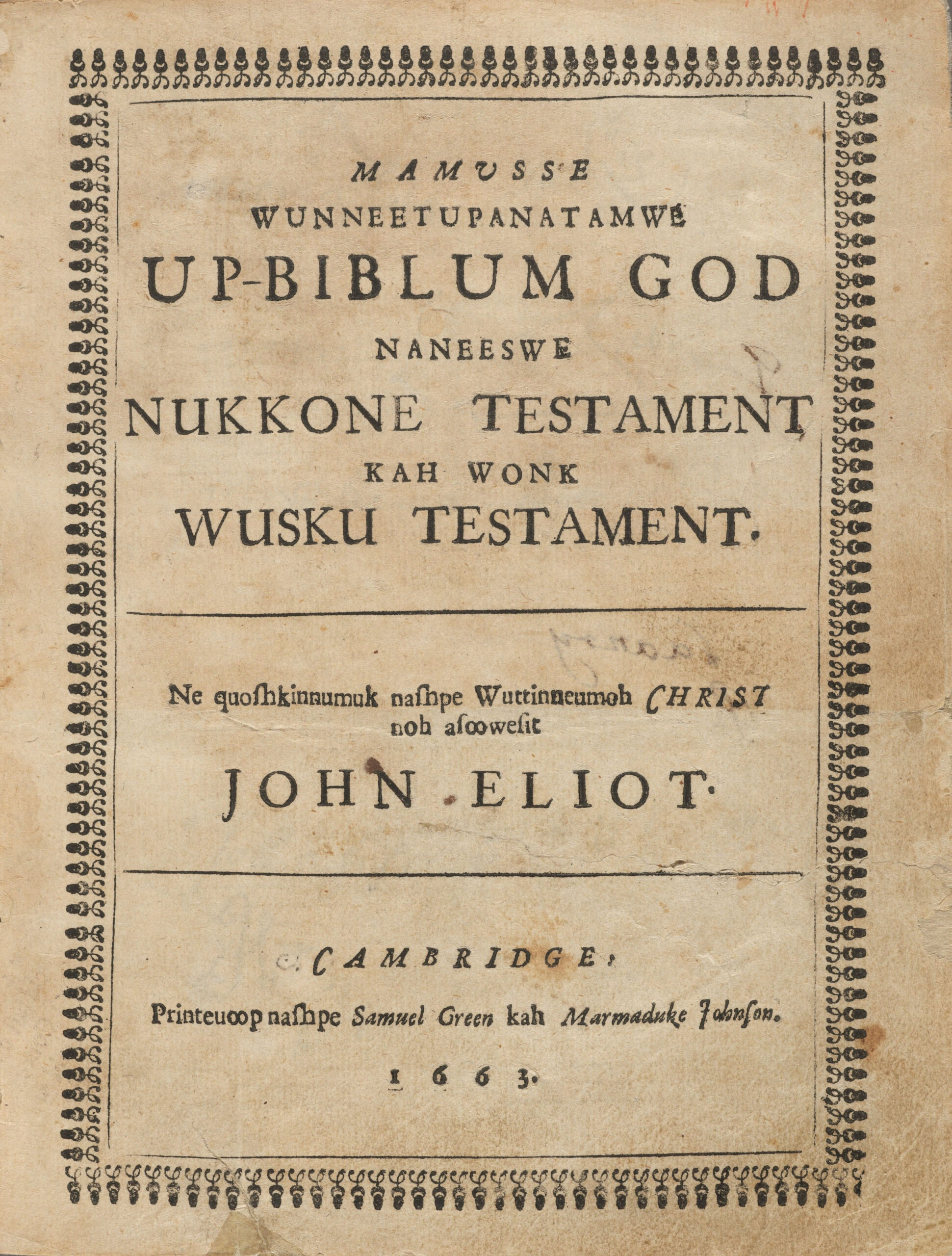
Native Protestants also found creative ways to maintain community ties amid attempts to separate them from one another and their culture. Throughout New England, Puritan missionaries such as John Eliot worked to establish “praying towns” or communities of Indigenous people who converted to Christianity. It was within one of these praying towns that Eliot worked with Indigenous Christians to produce an Algonquian-language edition of the Bible in 1663. For Eliot and other Puritans, the goal of a praying town was to convince Indigenous people to completely abandon their traditions and submit both to Puritan worldviews and governance.4 Yet across the late seventeenth and early eighteenth centuries, Indigenous Protestants connected Christian parables to Indigenous spiritual beliefs and created a distinct Native Christianity. Historian Douglas Winiarski describes this as Indigenous people creating “autonomous, though structurally parallel, indigenous churches.”5 As Catholic and Protestant missionaries competed with one another in claiming Indigenous territory and converts, Native Americans resisted and recast the rituals, symbols, and material culture of both to preserve kinship ties and spiritual longevity.
III. Catholic Foundations
Catholics had been in continental North America since at least 1513, when the Spanish established permanent footholds in present-day Florida. Across the sixteenth and seventeenth centuries, Catholics from Spain, France, the Netherlands, and Great Britain continued to arrive in North America even as they faced challenges from Protestant empires and their colonial envoys.
The most famous Catholic colony in British North America was the Province of Maryland. From 1634 until the establishment of the Anglican Church in 1692, Catholics in Maryland enjoyed a degree of religious liberty rarely found across Britain’s empire. Yet even in England’s supposed Catholic colony, Maryland’s Catholic settlers were frequently outside the primary halls of power, even if they were the demographic majority in certain towns.6 When granted the charter to settle Maryland in 1634, Cecelius Calvert, Lord Baltimore, hoped to establish a safe haven for Catholics living across England’s Anglican empire. The 1649 Maryland Toleration Act seemed to fulfill Calvert’s vision, granting freedom of worship to all Christians. The Act, though nullified just five years later in 1654, signaled the possibility–if an uneasy one–of Catholic and Protestant co-existence throughout North America.
More reliable Catholic strongholds could be found in the vast imperial holdings of New Spain and New France. These Catholic empires fought to save the souls of those they deemed to be damned, while also preventing the spread of Protestantism. Catholic and Protestant missionaries justified their capture of Indigenous lands through the doctrine of Christian Land Discovery, which directed all Christians to capture land in order to convert non-Christians living upon it, acting as if they were encountering empty land. Under this belief, acquiring land was not only a profitable means of supporting empire; it was also holy work.

Yet Native Americans both adapted and resisted Catholic encroachment at every turn, ensuring the survival of both their people and their beliefs. During “the Beaver Wars,” the French explorer Samuel de Champlain sought to take the Haudenosaunee capital in 1615 in current central New York. Champlain’s interest in Haudenosaunee territory only increased after 1654, when the Onondaga revealed a valuable salt spring to French Jesuit Father Simon LeMoyne. Onondaga Lake was both a valued nexus of Indigenous trade as well as a sacred space where 1,000 years prior the Peacemaker had carried the Creator’s message of peace to five warring nations: the Seneca, Cayuga, Onondaga, Oneida, and Mohawk. And though French Jesuits marched to the Haudenosaunee capital in 1656 with a deed for 600 acres of land, the Onondaga successfully coerced the Jesuits to leave eighteen months later.
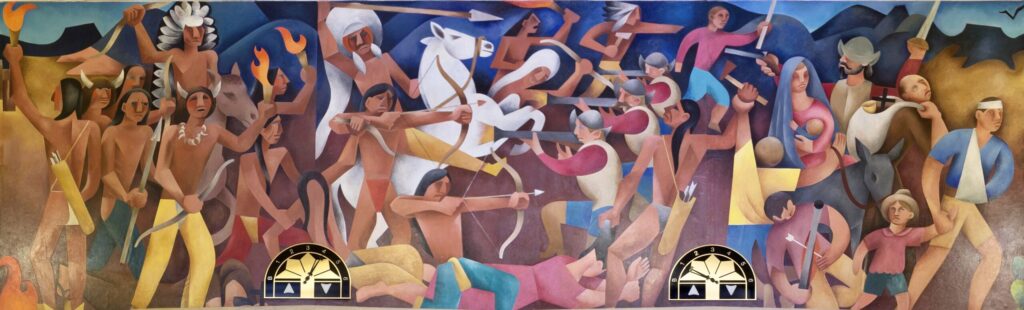
Elsewhere in Catholic North America, resistance turned to successful revolt. Fleeing from Spanish persecution, Po’pay, a medicine man from San DepJuan Pueblo, retreated to the secluded northernmost pueblo of Taos.7 From there, news spread through the Pueblo world of this medicine man’s visions of rebellion. The pan-Pueblo movement only excluded the Piro Pueblos to the far south, who perhaps were deemed too Christianized. Dispatching runners to both near and distant pueblos, Po’pay secretly recruited caciques from all of the pueblos. August 11, 1680, the first night of the new moon, was selected as the date for the revolt.
On August 9, 1680, Po’pay dispatched two runners to each of the pueblos with each runner carrying a knotted cord. By untying a single knot in the cord, pueblos would signal their willingness to participate in the action to come. The runners also delivered the corollary message that “all of them…should rebel, and that any pueblo that would not agree to it they would destroy, killing all the people.” Early on the morning of Sunday, August 10, Fray Juan Pío left Santa Fe on foot with an armed escort for Tesuque to give Mass. The pueblo was deserted on arrival. Searching for the Indians, the two eventually found them in an arroyo fully armed and wearing war paint. According to legend, he cried out to them: “what is this children, are you mad? Do not disturb yourselves; I will die a thousand deaths for you.”8 According to legend, his prophecy was fulfilled in one moment as “a shower of arrows pierced his breast.”9 The Pueblo Revolt of 1680 had begun.
When the stirs of rebellion had stilled with the last of the Spaniards retreating south to El Paso (Ciudad Juárez), the many Pueblos of present-day New Mexico and Arizona accomplished what no other Native American society had been able to achieve on such a broad scale before and what none have been able to achieve since – a massive reversal of European expansion in the New World. In the wake of the Pueblo Revolt of 1680, more than eighty years of Spanish colonial presence in New Mexico ended in ruins.
In the aftermath of the revolt, the Pueblos swiftly destroyed any remnants of Spanish presence and influence. In addition to killing twenty-one Franciscans (nineteen priests and two brothers), the rebels removed all the symbols and icons of Christianity. Images of the cross, Jesus, Mary, and all the saints were to be desecrated, smeared with feces, and finally destroyed. The Pueblo were to “wade into the rivers and wash themselves with yucca root” to wash away their Christian baptism. Christian names were to be forgotten and only their native ones were to be used. Spanish was never to be spoken and the names of the saints never again invoked. Men were to abandon their Christian wives. Even the plants and animals the Spaniards had brought to New Mexico were to be burned. Those who did not comply faced severe punishments. Though the Spanish would return twelve years later, the Pueblos sent a powerful message that their cultures and belief systems would not be easily suppressed.
IV. The Church of England in America
The Protestant presence in colonial North America grew alongside that of Catholics. Not only did Protestants hope to lead souls to salvation, but they also strove to combat the inroads made by Catholic empires and rival Protestant factions. Between 1650-1720, the Church of England intensified its efforts to establish permanent Anglican settlements and spread British imperial influence across the continent.
Anglicanism was successfully established as the state religion of Virginia in 1619, but church leaders dismayed at their struggle to establish Anglican dominance elsewhere in North America. The Society for the Propagation of the Gospel to Foreign Parts (SPG) tried to help assert Anglican authority. Founded in 1701, the SPG was tasked with sending Anglican clergy to the British colonies to establish churches and schools and convert all non-Anglicans. Because the Church of England was the official state religion of Great Britain, Anglican ministers were also implicitly tasked with establishing English cultural and political dominance in the colonies. In their view, to be Anglican was to be British, and vice versa. An early account of the SPG’s activities also explicitly identified the threat that Catholic missionaries posed to the practice of “true religion” as they tempted the King’s “loving subjects to Popish superstition and idolatry.”10
In the Anglican parish system, all those living within a designated area were expected both to regularly attend church services and to pay taxes to cover their priest’s wages. To Anglicans, everyone living within the boundaries of a parish were parishioners, even if only in name.11 Weekly church attendance, marriage, baptism, and daily family prayer were not only essential elements of a robust Anglican practice, but also crucial means of performing Englishness. Moreover, attendance at Anglican services every Sunday was both an important feature in parishioners’ social lives, as well as a valuable venue for demonstrating social hierarchies. Elite Virginians would arrive to worship prepared to demonstrate their piety while displaying their wealth in carriages and Sunday finery. As it was with Congregationalists (as former Puritans came to be called), Anglicans’ ability to rent or own box pews and sit together as a family close to the pulpit demonstrated their material and social capital.12
Yet as much as Anglican leaders stressed the importance of an active participation in church life, the reality on the ground was far more complicated: irreligion seemed endemic, especially in the Southern colonies. Anglican ministers routinely complained of recalcitrant parishioners who refused to regularly attend church services or pay priests’ wages. They railed against religious groups they viewed as threatening the spiritual health of British colonists (especially those traditions which eschewed baptism, like Quakers, and traditions critical of Anglican orthodoxy, such as Baptists and Presbyterians). Lacking significant clerical numbers even in supposed Anglican strongholds, magistrates were empowered and encouraged to conduct marriages, a rite typically deemed as being the church’s responsibility. Crucially, the Church of England failed to formally establish church courts as they existed in Britain. So judges, not priests disciplined moral offenses. Aggrieved by parishioners and colonial officials alike, Anglican ministers worried that the church’s influence was too weak. Yet while Anglican church leaders dismayed at the pace, the Church of England grew and became established as the official state religion for several colonies after Virginia, including Maryland, parts of New York, and the Carolinas.13
English Protestants in North America were never far removed from the influence of political and religious instability in Great Britain, and many of the grievances that Anglican leaders voiced in North America could be traced back to the bitter disputes raging over clerical and royal authority in Great Britain. Puritans, though most often associated with the Massachusetts Bay Colony, were similarly shaped by their counterparts back in the imperial metropole. Indeed, the vast majority of Puritans remained in England, where they became the most vocal critics of King Charles I (1625-49), who promoted consciously anti-Puritan attitudes and policies. Yet over the course of the mid and late seventeenth century, Protestants in North America witnessed the changes wrought by the English Civil Wars.
So vehement were the disputes between Charles I and Parliament that they erupted into civil war in 1642. Broadly speaking, Charles I’s Royalists were Anglican, and his Parliamentarian foes were Puritans and other dissenters, so the English Civil War (r. 1642-49) was both a contest over the exercise of political power and between competing forms of Protestant Christianity. Indeed, the small but steady flow of Puritans to New England dried up as the chances for “thorough reformation” at home grew. A few New Englanders even traveled back to Britain to fight against the Anglican crown.
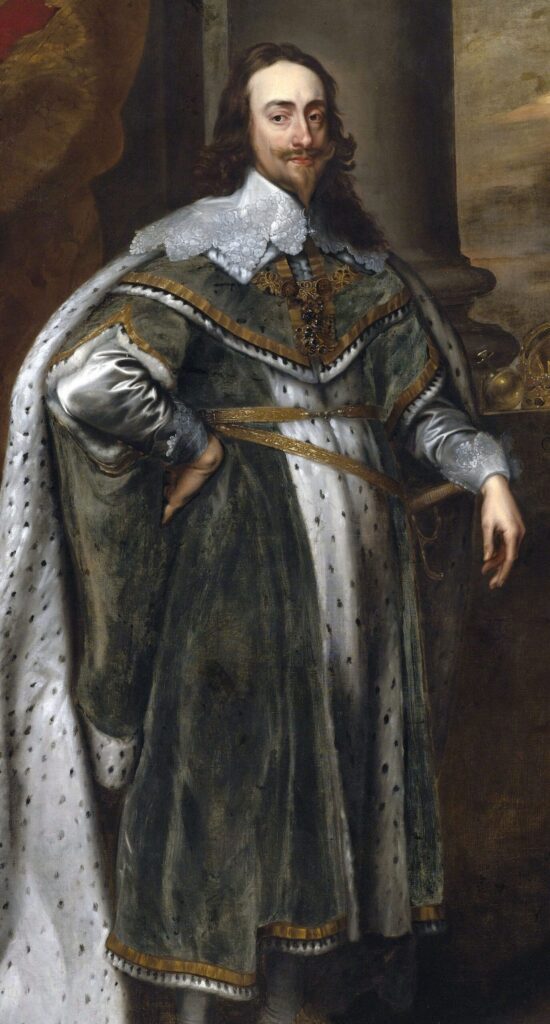

The North American colonies themselves were divided. Those with Anglican majorities or official sympathies, like Virginia, might prefer the Royalist cause, and those with Puritan or dissenter majorities, like New England, might pray for a Parliamentarian victory. But the colonies all opted to officially stay out of the conflict, and the violence remained confined to one side of the Atlantic.
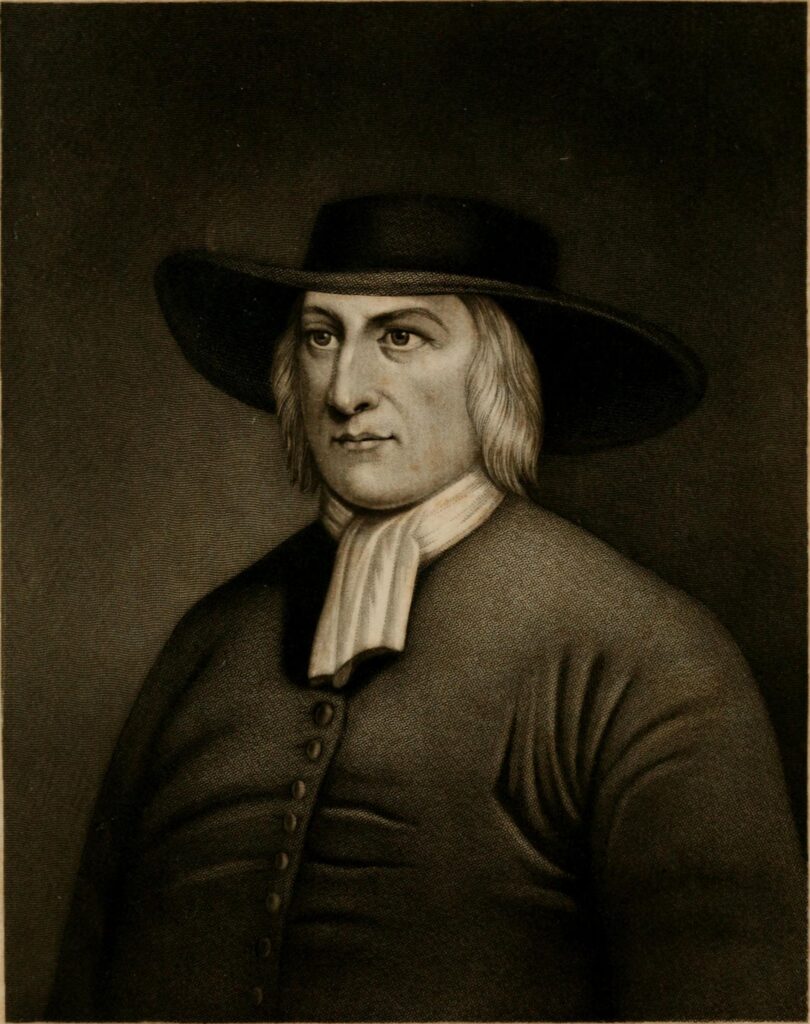
Far from forcing Puritan conformity, the Civil War and Commonwealth years saw the rise of several radical religious groups moving through every corner of English society. Groups such as the Society of Friends, or Quakers, were a direct product of the cultural and political upheavals of mid-seventeenth-century England. Dissenter George Fox yearned for a return to a “primitive Christianity” that rejected the material excess and clerical hierarchy of Anglicanism. Fox imagined a Christianity centered on an “Inward Light,” which he saw as the universal in-dwelling presence of God. He was spurred by a religious vision in 1652, and his ministry laid the foundations for the Quaker movement. As the number of Protestant sects in Britain exploded, Quakers embraced a radical set of beliefs, including that no priests or baptisms were necessary for salvation, women could serve as religious leaders, practitioners were forbidden from swearing oaths, and members were urged to live as simply and plainly as possible. Most controversially, Quakers also embraced a strict theological commitment to pacifism.
Quakers’ radical beliefs generated near instant animosity. Beginning in the early 1660s, several thousand Quakers were jailed for refusing to swear allegiance to the newly restored monarchy of King Charles II, galvanizing interest in taking Quakerism beyond England’s shores. William Penn’s “Holy Experiment” in the Pennsylvania Colony was the most famous of the Quakers’ destinations. A 1681 gift from King Charles II to satisfy a debt owed to William Penn, Sr., Pennsylvania touted itself as a Quaker stronghold and haven for religious liberty. But Pennsylvania was only one part of the Quakers’ story. Quakers also settled in the British Caribbean as early as the 1650s. They went to New England, securing a northern foothold in defiance of Puritan hostilities and the execution of the four Quaker martyrs in the late 1650s and early 1660s. They spread across the Carolinas and Virginia beginning in the 1650s, much to the chagrin of Anglican ministers like Charles Eden, who urged action in 1717 to “recover all those already seduced by Quakerism” in North Carolina.14
Radical groups like the Quakers were not the only source of ire for England’s beleaguered Anglicans. Protestants on both sides of the Atlantic continued in their shared fear of domestic and international Catholicism. England’s Catholics had become a tiny minority since Elizabeth’s reign, but their presence continued to agitate Protestants, who feared them both as enemies of God and of England. It did not help that Charles II himself exhibited Catholic sympathies. Worse, Charles had no sons; his brother James, Duke of York, was his legitimate heir, and James had converted to Catholicism. James became king in 1685 as James II, but Protestants hoped his Catholic regime would be short-lived. Already in his fifties, his heir was his eldest daughter, Mary, a Protestant married to the Dutch Protestant William, Duke of Orange. But Protestant elites watched with growing alarm as the Catholic king worked to undercut Protestant hegemony in the kingdom and elevated Catholics to high positions in government and the military. When Parliament objected, he dissolved it. His Protestant subjects increasingly saw his aggressive promotion of religious toleration as part of a conspiracy to return Catholicism to power.
While the North American colonies had largely steered clear of the English Civil War, they could not avoid being pulled into the controversies around James II. The king combined the Puritan colonies of New England with the more diverse Protestant colonies of New York and New Jersey to form the Dominion of New England in 1686. His lieutenant, Sir Edmund Andros, was sent to govern the Dominion with a mandate for religious toleration. When he arrived in Boston as governor, Andros appointed anti-Congregationalist judges, abolished mandatory religious taxation to support Congregationalist ministers, and requisitioned a Boston church for Anglican services.
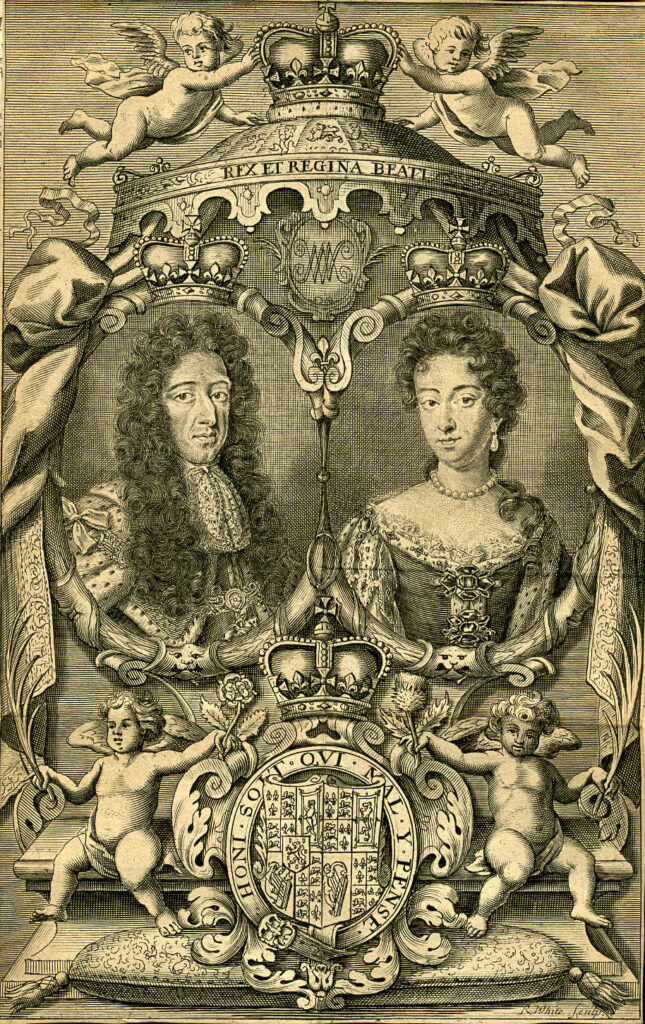

Back in England, the birth of a male heir to James II in 1688 was the last straw. Now facing not just a heavy-handed Catholic king but an entire Catholic dynasty, England’s Protestant elites invited Mary’s husband William to take the throne. William invaded England in November 1688, and James fled the country. When the news reached the colonies, disaffected colonists rose up against James’s lieutenants in New England, New York, and Maryland. In Boston, locals arrested and imprisoned Edmund Andros. The events of 1688 became remembered as England’s “Glorious Revolution.” James II came to be remembered as a Catholic tyrant who circumvented Parliament and William as the Protestant who restored England’s liberty and cooperated with Parliament. Importantly, the new political establishment normalized Protestant pluralism in the 1689 Act of Toleration. The Church of England remained the established, officially supported church, but the legal penalties for nonconformity were repealed for Protestants. The ultimate result formed a potent idea: to be English was to be free and Protestant simultaneously.
The North American colonies felt these changes, too. King William granted new charters to the colonies of the now dissolved Dominion, but New Englanders could no longer enforce a rigid Puritanism or deprive unchurched freemen of the right to vote. Zeal for far-reaching reformation gave way to “latitude” among Protestants.
V. Protestant Pluralism
The seeds of Protestant pluralism were planted in Britain’s North American colonies even prior to the implementation of the 1689 Act of Toleration. Some New England colonists had pushed back against a singular Puritanism for decades. The colonies of Connecticut and Rhode Island were founded by emigrants and exiles from Massachusetts who objected to its hierarchical politics.15 Their first constitutions curtailed the power of the governor by removing his legislative veto, concentrating lawmaking power in the deputies elected to represent their towns. Voting rights were extended to all freemen, rather than just to church members as in Massachusetts.
Connecticut hewed more closely to the Congregationalist puritanism of Massachusetts and maintained strategic military alliances. However, Connecticut did diverge from Massachusetts’s religious template in that prospective church members were not required to make a public relation of their spiritual experiences before the congregation.
Roger Williams’s break with Massachusetts was more dramatic. After arriving in 1631 New England, Cambridge graduate Roger Williams moved between Boston, Salem, and Plymouth, before taking up a ministerial position at Salem. In 1635, Massachusetts banished him for his several criticisms of the colony, including his claim that its churches were insufficiently disassociated from what he saw as the corrupt Church of England.16 Fleeing southwest to Narragansett Bay before he could be deported to England, Williams established his colony of Providence in the winter of 1636. In his writings, he argued for a total separation of church and state, railing against the corruption of professional ministers and insisting that Jews, Muslims, and pagans were just as capable of being good citizens as Christians. These views closely informed the religious policies of Providence and later Rhode Island, which had no established church and offered freedom of worship to Protestants of all kinds.
![Puritan Separatist Roger Williams' book, The Bloudy [Bloody] Tenent of Persecution, argues for the separation of church and state. He suggests that politics and governmental interference would harm the church. Across the page are the following words: "The Bloody tenet of persecution, for cause of conscience, discussed, in A Conference betweene Truth and Peace who, In all tender Affection, present to the High Court of Parliament, (As the Result of Discourse) these, (among other Passage) of highest consideration." At the bottom, "printed in the Year 1644" is printed.](https://www.thunderinggods.com/wp-content/uploads/2026/07/The_Bloudy_Tenent_of_Persecution_for_Cause_of_Conscience_by_Roger_Williams.jpg)
The crisis in Boston’s Church now widely known as the Antinomian Controversy (1636-1638) was key to the early expansion of Rhode Island. Prominent members of the congregation came to believe that most of New England’s ministers placed too much emphasis on moral transformation (or “sanctification”) in religious salvation. They argued instead that God saved his chosen men and women, called “the elect,” through a gift of “free grace” that bore no necessary relationship to their ethical comportment, religious practice, or faith. John Cotton, one of the colony’s leading theologians, was investigated for allegedly encouraging this perspective from the pulpit. John Wheelwright, another minister, was banished for espousing it. But the authorities singled out midwife Anne Hutchinson, who preached an extreme interpretation of the doctrine of free grace at private meetings at her home. Hutchinson was banished for intimating during her civil trial that she received direct revelations from God. She left Boston in March 1638, followed by eighty households of sympathizers.17 With Williams’s help, they settled near Providence, establishing the town of Pocasset (later Portsmouth). After the death of her husband, Hutchinson and her family moved to New Netherland, where they were killed by the indigenous Siwanoy.
The Middle Colonies–Pennsylvania, New Jersey, Delaware, New York–were especially associated with relative religious toleration despite legal challenges to freedom of conscience. Pennsylvania was founded as a haven for Quakers, who held majority representation in the colonial assembly until the 1750s. But the colony adopted broad laws allowing for religious freedom and other faiths soon joined the Quakers in the Delaware River Valley. Members of the Dutch Reformed Church and Lutherans settled the colonies of New York and Delaware, later to be joined by French Huguenots after the 1685 revocation of the Edict of Nantes removed legal protections for French Protestants to safely practice their religion.18 In 1647, the arrival of Pieter Stuyvesant as director-general of New Netherlands forced a reconsideration of religious toleration in what would later become New York. Stuyvesant was a member of the Dutch Reformed Church and hesitant to extend religious rights to other Protestants. He also absolutely despised Catholics.19 Yet the tradition of Dutch religious toleration held strong amongst many daily practitioners. In 1657, a group of men composed and published the Flushing Remonstrance, an official rebuke to Stuyvesant and his directive for New Yorkers not to harbor Quakers.20 The text reaffirmed the city’s commitment to toleration and modeled the kinds of pluralistic reality that persisted even after the English seized the colony and the Church of England established itself as the state religion.
While the Church of England cemented its foothold in the Southern colonies, a strong tradition of religious dissent remained, particularly in the Carolinas. Anglican church leaders bemoaned the proliferation of Dissenters, including Quakers Baptists, and Methodists. But the presence of these people proved to be profitable. A petition laid before the Houses of Commons and Lords in Great Britain argued that Dissenters fleeing religious persecution in Britain had been fundamental in the early settlement of the Carolinas, and thus asked that freedom of worship and freedom from oath taking (prohibited by Quakers and Mennonites) be “expressly provided for.”21
VI. Religion and War
The reality of multiple religious denominations living together did not easily translate to tolerance or acceptance amongst religious groups. Nor did the presence of those fleeing from religious persecution elsewhere always imagine a peaceable coexistence with those outside of their religious community. Violence was common in colonial America and those experiencing it frequently understood it in religious terms. The language of spiritual warfare was commonplace amongst religious and civic leaders in warring Protestant and Catholic empires that vied for souls and resources alike. Though rationale for warfare varied across religious worldviews, enduring concepts of just war and holy war were crucial to the British colonial context. Just wars are fought mainly for self-defense or to advance nationalist objectives, supported by political authority, while holy wars carry overt religious implications and are mandated by religious authorities or even God himself. In such a belief system, the killing of non-Christian and Catholic people might be considered unfortunate but ultimately theologically justified (as it was in colonial New York).
Given that the British empire was concerned with acquiring land and souls, the line separating the two was frequently blurred. Two illustrative examples may help explain the violence perpetrated against Indigenous people in New England and Virginia in the mid to late 1670s. Settler-Indigenous relations were persistently strained in colonial New England. Not only did Puritan settlers covet Indigenous lands, but they believed Indigenous people themselves to be envoys of Satan whose defense of their ancestral lands was actually an assault on Puritans’ holy mission. This belief motivated the actions of Puritans in the Pequot War (1636-38) and was invoked once again during the violent events of Metacomet’s War–also known as King Philip’s War–from 1675-1676.
Having witnessed years of increasing Puritan encroachment on Native lands and angered by years of cyclical violence, Metacomet led the Wampanoag resistance, killing and kidnapping English colonists and burning down English villages to remove them from Indigenous lands. The genocidal violence that the English launched in response was partly justified under the claim that Indigenous people were not capable of truly receiving God’s salvation, and their defeat constituted a religious duty. In the same year of 1676, Nathaniel Bacon launched his multiracial rebellion against the Susquehannock and Virginia’s planter elite. Religion was not at the heart of Bacon’s grievances against what he perceived as his enemies, but he invoked language similar to the Puritans when referring to Virginia and Maryland tribes as “barbarous heathens.”22 Religious worldviews continued to shape all interactions, including war, even when religion was not the explicit rationale for colonial violence.
The religious paranoia that shaped British Protestant perceptions of Indigenous people in North America was shored up by continuing Protestant and Catholic antagonisms that extended throughout imperial contests. The series of imperial wars between Britain and France that began with King William’s War in 1689 were replete with apocalyptic and millenarian implications, as the Protestant American colonists perceived Catholic France as an existential threat. The relative success of French missionaries in converting Indigenous people to Catholicism fueled British fears that the papal Antichrist was preparing Native people to exterminate Christ’s true disciples.
Colonists also had to contend with violent ruptures from within. Orthodox dogma existed alongside folk practices in colonial religious life. Colonists reached for a variety of explanations for their trials, from the divine to the profane. The 1692 witch panic in Salem, Massachusetts encapsulated the complex interplay between religion and politics in early America and the role of the supernatural in Puritans’ social and legal life.
In 1692, three young girls began experiencing strange convulsions and vocal outbursts in the house of Salem parish minister Samuel Parris. Wracked by pain, these young girls resembled the afflicted Goodwin children of Boston four years earlier that caused Goody Glover to be hanged for witchcraft after the Goodwin children accused her of casting a spell over them. In 1692, the frightening specter of witchcraft reared its head once again. This time, it was the house servant enslaved by Rev. Parris, Tituba, who was on the receiving end of the children’s accusations. Tituba’s confession and subsequent imprisonment marked the beginning of a panic that spread throughout New England and resulted in over 150 arrests and twenty executions.
As accusations whirled (and gradually worked their way higher up Salem’s social ladder), courts sought and admitted spectral evidence into their cases against the accused. The move caused considerable controversy, and one justice resigned after the case against Bridget Bishop was largely decided on the weight of spectral evidence. Rev. Increase Mather published a sharp critique of the proceedings in Cases of Conscience where he wrote, “It were better that ten suspected Witches should escape, than that one innocent Person should be Condemned.”23 And yet it would take intervention from Governor William Phipps to halt witch trials and reconsider the weight of spectral evidence (eventually outlawing its use in January 1693).
The Salem Witch Trials constituted a perfect storm in which internal and external anxieties erupted in the context of Puritan religious fervor and belief in the devil’s efforts to destroy God’s chosen people.24 Within Salem Village, Rev. Parris faced efforts to oust him as minister, as it was in his home and in the homes of his most ardent supporters where the witchcraft afflictions broke out.25 However, local politics only explains some of the animosity exhibited in 1692, especially after the accusations spread more widely. Many of the accusing families fled frontier violence in the northern reaches of the colony, now Maine, in the decades before the trials. Massachusetts Puritans understood Indigenous resistance to colonization as God’s punishment for tolerating sin or Satan’s efforts to destabilize their settlements.26 To many Puritans, the fight for religious purity was part of spiritual warfare that must be fought from without and within.
VII. Slavery
Slavery touched nearly every aspect of life in early America. Religion was certainly no exception. European colonists enslaved people of African and Indigenous descent by the millions for economic profit, but as the numbers of the enslaved grew in the Americas, slavery became increasingly based on race and justified by religion. In the seventeenth and into the eighteenth centuries, Christianity and slavery not only coexisted, but co-constituted each other. Amidst the violence and displacement of slavery, enslaved people held onto traditional religious practices, continued to practice Islam, converted to English Protestantism, and fostered a vibrant syncretic tradition of Black Christianities.
Though it is impossible to fully capture the breadth of religious traditions held by the twelve million Africans enslaved across the Atlantic, a few tendencies are worth noting.27 No indigenous god was worshiped across the entire region, but ancestor veneration was nearly universal.28 Ancestors were dead humans who remained involved in the lives of the living. They could be approached verbally or through rituals, potentially blessing those who called on them or speaking in dreams or trances to offer advice or warnings.
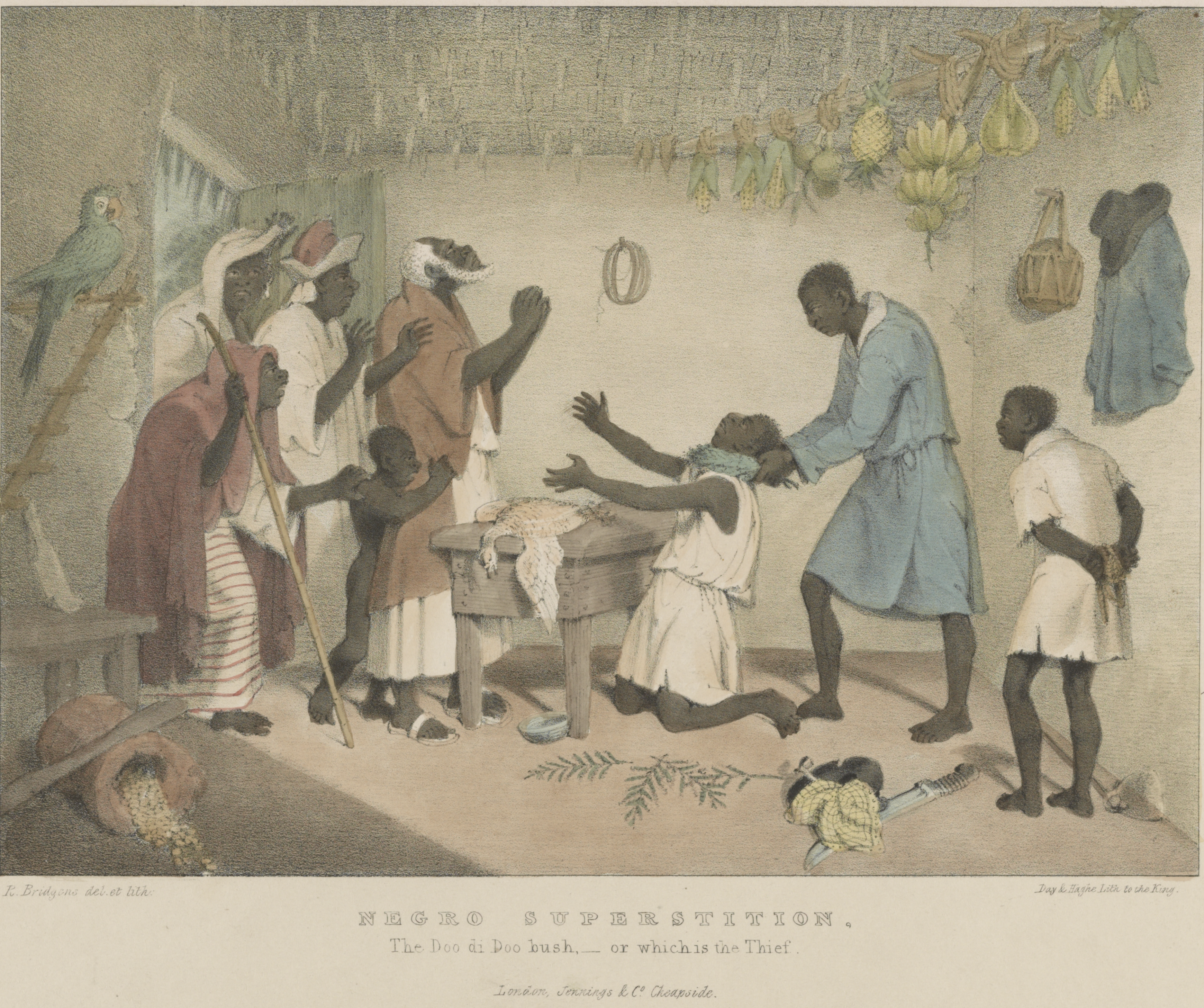
Many West Africans drew on the distinctive pluralistic and experimental religious outlooks of their homelands as they created community with the strangers among whom they had been enslaved.29 Some gods, such as the Vodún of today’s Benin (whose name lies behind the English word “voodoo”) or the Orishas of Nigeria, were elaborately defined by means of comprehensive oral traditions (including songs and dances), and their distinctively oral cosmologies were carried with their peoples across oceans. Other deities were tied to specific places, and so the dehumanizing and destabilizing violence of the slave trade separated people from those places and those powers
One of the earliest arguments Protestant Christians waged over the question of slavery was whether or not enslaved people could be (or should be) converted to Christianity at all. The Bible verse 1 Corinthians 7:22 holds that no Christian can be a slave, as all are liberated through Jesus Christ. For Christians, Protestant and Catholic alike, baptism was the liberatory act that made people Christians. Thus, the question of whether or not baptism conveyed material or spiritual emancipation needed to be settled by law. In 1667, the colonial Virginia Assembly ruled that “the conferring of baptisme doth not alter the condition of the person as to his bondage or ffredome,” thus paving the way for Indigenous and African conversion to proceed without enslavers’ worrying that baptism would grant the enslaved legal freedom.30
The social construct of race developed through European and African encounters during the seventeenth and eighteenth centuries, and initial distinctions of human difference were based on religious status rather than skin color. But by the end of the seventeenth century, race soon replaced religion as the most important arbiter of who could and could not be enslaved.
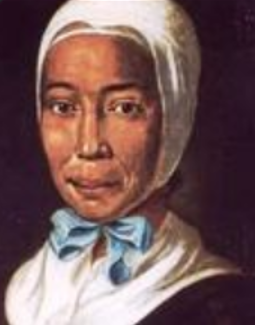
Yet, several individuals born into slavery and later freed became influential in the development of Black Christianity and individual Black churches. Moravians, members of a Protestant sect that hailed from the Bohemian Crown Lands, established a mission to minister to enslaved people in the Dutch West Indies in 1732. Rebecca Protten, a Black woman, became influential in the Moravian Christianization efforts on St. Thomas. Due to her formerly enslaved status, she was able to access several locations and communities that white missionaries were not. Her early evangelical efforts were influential in the development of the Black church in the Atlantic.31
Catholic empires were as invested in the transatlantic slave trade, though they differed from Protestants in their early stances on enslaved baptism.32 Early African contact with Catholic merchants and missionaries established an enduring Black Catholic tradition. The Portuguese had been active along the coast of West Africa since the mid fifteenth century. The type of Christianity they introduced in Africa stood relatively close to Indigenous African religions. At that time, the African continent was still firmly in the hands of Africans. The early dissemination of Christianity in continental Africa was, thus, primarily the result of Portuguese and African alliances.
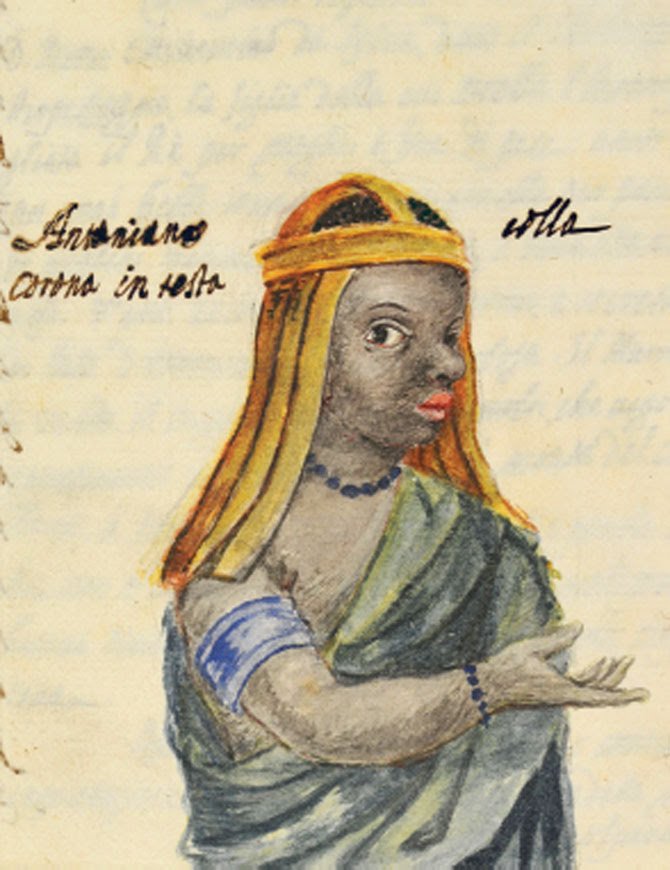
As a result of Portuguese influences in Africa, a significant minority of the enslaved population in the Americas had been baptized as children and were very familiar with Christianity. An example can be found in the eighteenth-century Virgin Islands, where Christian Oldendorp, a missionary of the Moravian Church, noted that some of the enslaved Africans on these Caribbean islands were already familiar with Christianity. From conversations with a man from Kongo, Oldendorp learned that “most people in his land went to a Christian church and were baptized and married by a priest.” The man also informed Oldendorp that the Kongolese “had priests of their own nation, who baptized people, organized Masses, could read, and had their own religious books.”33 Oldendorp further learned that it was common “among blacks who came from Portuguese countries . . . particularly those from Kongo” to perform “a kind of baptism” and that they even engaged in missionary work among other Africans, whom they “teach, absolve, and baptize.”34 This case reveals that some enslaved African communities in the Americas took Christianization into their own hands and built their own congregations.
New York was also the site of a significant colonial Black Catholic population. In August 1733, Jacobus van Cortlandt placed a runaway slave advertisement in the New-York Gazette in an attempt to recover Andrew Saxon. Saxon was first described with the standardized language of the time, but then Van Cortlandt made a surprising reference to the fact that Saxon “professeth himself to be a Roman Catholic” and that “the shirts he had with him … are marked with a cross.”35 By marking his shirts with a cross, Saxon clearly did not make a secret of his faith. Saxon’s story becomes even more intriguing if we connect him to the city’s earliest Black community, at the time when New York was still called New Amsterdam. There, the entire Black population had Iberian Catholic baptismal names and were eager to give newborn children a Christian baptism.
Christianity was not the only tradition that enslaved and formerly enslaved people practiced. Islam was introduced in the Americas via the arrival of enslaved Muslims, the evidence of which endured in naming practices and anecdotal evidence of enslaved people’s rituals of prayer, fasting, and dietary restrictions.36 Historian Michael Gomez estimates that 200,000 Africans came to North America from areas heavily influenced by Islam during the slave trade.37 Moreover, because of the emphasis Muslims placed on education and literacy, enslaved Muslims were likely able to make converts amongst other enslaved people.
Frequently, enslaved people held to their indigenous beliefs despite attempts from both Protestants and Catholics to eradicate them. To understand West African religion in the period of the slave trade requires an appreciation of three qualities of their societies: pluralism, flexibility, and orality. Taking these three qualities together, thrust into new multiethnic societies in the Americas, many West Africans drew on their cultural toolkits to create community out of the strangers among whom they had been placed. At the same time, however, they did not hesitate to blend traditional African religions or Islam with elements of Christianity as they tried to heal the psychic wounds of slavery.
As the trafficking of enslaved Africans expanded in the seventeenth and eighteenth centuries, Afro-Atlantic Catholics from areas with a historically strong Portuguese influence adopted a syncretic form of Christianity that blended Catholic rituals with Indigenous African elements. Muslim Africans did the same as well. As members of a global religion, these Indigenous Muslim Africans were often literate and able to make connections with fellow believers of different ethnicities in the course of their removal from their homelands. Though pluralist experimentation was typically discouraged in Islamic traditions, which, like Christianity, insisted upon exclusivity as a matter of principle, the centuries preceding the Atlantic slave trade saw long periods of West African religious tolerance between Indigenous religions and Islam punctuated by sharp crackdowns intended to purify the faith.38 Disappeared to the Americas and cut off from the Muslim communities of their homelands, many Muslim Africans participated in Christian church life, with their children sometimes becoming Christians themselves.
Most African Americans would eventually become Christians, but that does not mean that they had simply assimilated into European Christianity. On the contrary, over centuries of painstaking experimentation, African Americans of all religious backgrounds sifted through various religious raw materials, including multiple Christian traditions, African religions, expressions of Islam, and Indigenous North American cosmologies, translating all of these into a unique and authentic version of religious practice that spoke to their experiences and needs.39 In other words, the Black Church was a multiethnic church from the very beginning.
VIII. Judaism in Colonial America
Though the vast majority of settler colonists in colonial North America were Christian, they were not the only religious group to make a life for themselves. The first community of Jews in colonial America arrived in New Amsterdam in September 1654 aboard the Ste. Catherine. These twenty-three refugees fled the Brazilian town of Recife after Portugal reconquered it from the Dutch and expelled its Jewish inhabitants. As Peter Stuyvesant was hesitant to grant these refugees a permanent foothold, their arrival constituted one of the earliest tests of New Netherlands’ famed religious tolerance. Ultimately swayed by the argument that religious toleration would attract more settlers and grow New York’s economy, Stuyvesant backed off. In 1655, the refugees won the right to establish a Jewish cemetery, and in 1682 they were permitted a specific place for communal worship. Outside of New Netherlands, other early Jewish settlers sought refuge in Newport, Rhode Island. Though conflicting reports exist about the exact date that Jews arrived in the tolerant New England colony, efforts to establish a cemetery in the 1670s confirms their early presence.40
Early on, Sephardim (Jews of Iberian descent) exercised religious and cultural hegemony, although Ashkenazim (Jews hailing from Germany and Poland) constituted the majority by the 1720s. Unlike in many European contexts, the two groups mingled extensively and intermarried due to their small numbers. They also shared in synagogue and communal governance. The synagogue constituted the epicenter of Jewish communal life, and each Jewish community had one by the end of the colonial period. More than just a locus of religious worship, the synagogue distributed kosher meat, matzo during Passover, and alms to the poor. It was also the place where sons would be religiously educated. Overall, the synagogue saw itself as the representative body of the entire Jewish community. And since Jews needed a synagogue if they hoped to live as Jews, much power was concentrated in the synagogue’s oligarchical leadership. They doled out ritual honors and controlled access to the rites of circumcision, marriage and burial. Colonial America had no trained rabbis, so wealthy laypersons governed religious matters in their stead.
As with all other religious groups in colonial America, degrees of religious observance varied widely amongst Jewish settlers. Yet active participation in religious life was a means of personal survival. Slowly, the Jewish population began to grow. In 1700, around two hundred Jews lived in colonial America. Three-quarters of a century later, at the dawn of the Revolution, that number had grown to around 2,500 in a broader population of two and a half million.
IX. Conclusion
Religion in colonial America was eclectic and resilient. Though Protestants and Catholics made early inroads in North America in the sixteenth and early seventeenth centuries, and their numbers continued to grow, whether by the arrival of European colonists or the conversion of Indigenous and African-descended people. However, Christians were far from the only religious group in North America. Jewish settlers arrived in New Amsterdam in 1654 and enslaved Muslims introduced Islam to the Americas. Despite the violent ruptures of settler colonialism and the transatlantic slave trade, Native American and African practitioners retained many of their indigenous spiritual practices, often creating syncretic traditions by incorporating aspects of Christianity into native practice. Others resisted the imposition of Christianity in its totality and successfully rebelled against Christian colonialism, as did Po’pay and his allies in the 1680 Pueblo Revolt.
Both Catholic and Protestant leaders alike feared that the other would not only gain more converts, but they worried that permanent Catholic or Protestant footholds were existential threats to the empires to which they each belonged. Within Protestantism, debate raged as to which practice most properly expressed true religion. Though the Church of England, and its missionary arm, the Society for the Propagation of the Gospel, worried that Dissenters such as the Quakers were threats to the Church of England’s position, Protestant pluralism flourished in Britain’s North American colonies. The English Civil Wars of 1642-1651 spawned a number of radical new Protestant sects that found religious relief abroad, while the Toleration Act of 1689 granted freedom of worship to Protestant nonconformists throughout the British Empire. Meanwhile, Protestant settlers in New England challenged the idea of a Puritan orthodoxy as early as the 1630s, when Rhode Island and Connecticut broke off from Massachusetts Bay Colony. The Middle Colonies in particular offered legal protections for most Christians to worship in relative freedom without fear of incarceration or expulsion.
Yet the reality of religious pluralism existed beside the reality of violence for religious practitioners of all kinds in colonial North America. Puritans justified settler violence enacted upon Indigenous people as holy war, recasting the Pequot War (1636-38) and King William’s War (1675-76) as divine retribution; likewise, they explained the events of the 1692 Salem Witch Panic as punishment for their religious impurity. Catholics and Protestants alike similarly justified the daily violence of Indigenous dispossession and slavery as a civilizing mission that could easily be accommodated within a Christian worldview.
As the eighteenth century wore on and religious bodies such as the Church of England successfully established state religions along the eastern seaboard, the religious inhabitants of colonial North America prayed, venerated, gathered, resisted, and rebelled. They were members of a religious plurality that would diversify even more with the coming events of the Great Awakening and the proliferation of evangelical traditions.
X. Reference Material
This chapter was edited by Katy Telling, with content contributions by Philip P. Arnold, Sandy Bigtree, Dan Howlett, Caitlin McGeever, Nathan Rives, J. Seth Schermerhorn, John Howard Smith, Katy Telling, Christopher Peter Trigg, Anca Wilkening, and Ben Wright.
Recommended Reading
Notes
- Cotton Mather, A family well-ordered, or, An essay to render parents and children happy in one another handling two very important cases (Boston, 1699), 3-4. ↩︎
- Many supposed converts integrated elements of Christianity within longstanding Indigenous traditions. For a sophisticated discussion about the idea of conversion, see Katharine Gerbner, Christian Slavery: Conversion and Race in the Protestant Atlantic World (University of Pennsylvania Press, 2018), pp. 6- 7. ↩︎
- Juliana Barr, Peace Came in the Form of A Woman: Indians and Spaniards in the Texas Borderlands (University of North Carolina Press, 2007), 44. ↩︎
- See the definition of “praying town” used in EBSCO, “Praying Indians,” as of 2026. https://www.ebsco.com/research-starters/religion-and-philosophy/praying-indians. ↩︎
- Douglas Winiarski, “Native American Popular Religion in New England’s Old Colony, 1670-1770,” Religion & American Culture Vol. 15, No. 2 (Summer 2005), 158. ↩︎
- Susan Juster, A Common Grave: Being Catholic in English America (University of North Carolina Press, 2025). ↩︎
- Joe S. Sando and Herman Agoyo, eds., Po’pay: Leader of the First American Revolution. (Clear Light Publishing, 2005). ↩︎
- Declaration of Pedro Hidalgo, Soldier, Santa Fe, August 10, 1680, in Charles Wilson Hackett, ed., Revolt of the Pueblo Indians of New Mexico and Otermín’s Attempted Reconquest, 1680-1682, trans. Charmion C. Shelby, 2 vols. (University of New Mexico Press, 1942), 1:7. ↩︎
- Ramón Gutiérrez, When Jesus Came, the Corn Mothers Went Away: Marriage, Sexuality, and Power in New Mexico, 1500-1846 (Stanford University Press), 133. ↩︎
- Society for the Propagation of the Gospel, An account of the Society for Propagating the Gospel in Foreign Parts, established by the Royal Charter of King William III. With their proceedings and success, and hopes of continual progress under the most happy reign of her most excellent majesty Queen Anne (London: Printed by Joseph Downing, 1706), 17, Internet Archive (from Princeton Theological Seminary), https://archive.org/details/accountofsociety00soci/page/16/mode/2up. ↩︎
- John K. Nelson, A Blessed Company: Parishes, Parsons, and Parishioners in Anglican Virginia, 1690-1776 (University of North Carolina Press, 2001), 18. ↩︎
- For more on the material culture of Southern Anglicanism, see Lauren F. Winner, A Cheerful and Comfortable Faith: Anglican Religious Practice in the Elite Households of Eighteenth-Century Virginia (Yale University Press, 2010); “History Bytes: Church Pews,” Newport Historical Society, as of 2026, https://newporthistory.org/history-bytes-church-pews/#:~:text=Most%20early%20churches%20and%20meeting,History%2C%20listed%20at%20%2323. ↩︎
- For more on the process of establishing the Church of England in British North America, see chapter 4 “The Renewal of Christian Authority” in Jon Butler, Awash In A Sea of Faith: Christianizing the American People (Harvard University Press, 1990), 98-128. ↩︎
- Letter from Charles Eden to David Humphreys, October 8, 1717, North Carolina Letter Book of the Society for the Propagation of the Gospel in Foreign Parts, Vol. II, p. 292-293, Colonial and State Records of North Carolina, Documenting the American South, University Library, The University of North Carolina at Chapel Hill, https://docsouth.unc.edu/csr/index.php/document/csr02-0151. ↩︎
- David D. Hall, A Reforming People: Puritanism and the Transformation of Public Life in New England (University of North Carolina Press, 2011), 38-39. ↩︎
- Michael P. Winship, Hot Protestants: A History of Puritanism in England and America (Yale University Press, 2018), 97-99. ↩︎
- Sydney V. James, Colonial Rhode Island: A History (Scribner, 1975), 25. ↩︎
- Patricia Bonomi, “Religious Pluralism in the Middle Colonies,” Divining America, TeacherServe©, National Humanities Center, as of 2026, https://nationalhumanitiescenter.org/tserve/eighteen/ekeyinfo/midcol.htm. ↩︎
- “Pieter Stuyvesant, c. 1612-1672, Director General of New Netherland, 1647-1664,” Historical Society of New York Courts, as of 2026, https://history.nycourts.gov/figure/pieter-stuyvesant/. ↩︎
- The background information for the Flushing Remonstrance is courtesy of the Historical Society of the New York Courts, “The Flushing Remonstrance,” accessed April 18, 2026. https://history.nycourts.gov/about_period/flushing-remonstrance/. ↩︎
- “The Case of the Church of England in Carolina,” London: c. 1705, John Carter Brown Library. ↩︎
- “Declaration of Nathaniel Bacon in the Name of the People of Virginia, July 30, 1676,”Massachusetts Historical Society Collections, 4th ser., 1871, vol. 9: 184–87, collected in History Matters, George Mason University, archived in the Roy Rosenzweig Center for History and New Media, as of 2026, https://historymatters.gmu.edu/d/5800.html. ↩︎
- “Cases of conscience concerning evil spirits personating men, witchcrafts, infallible proofs of guilt in such as are accused with that crime. All considered according to the scriptures, history, experience, and the judgment of many learned men / by Increase Mather, president of Harvard College at Cambridge, and teacher of a church at Boston in New-England.” In the digital collection Early English Books Online 2. University of Michigan Library Digital Collections, as of 2026, https://quod.lib.umich.edu/cgi/t/text/text-idx?c=eebo2;idno=B43422.0001.001, 66. ↩︎
- Emerson W. Baker, A Storm of Witchcraft: The Salem Trials and the American Experience (Oxford University Press, 2015). ↩︎
- Paul Boyer and Stephen Nissenbaum, Salem Possessed: The Social Origins of Witchcraft (Harvard University Press, 1974); and Forum: Salem Repossessed in The William and Mary Quarterly 65, no. 3 (2008): 391-534. ↩︎
- Baker, A Storm of Witchcraft; Mary Beth Norton, In the Devil’s Snare: The Salem Witchcraft Crisis of 1692 (Vintage, 2003); and Emerson W. Baker and James Kences, “Maine, Indian Land Speculation, and the Essex County Witchcraft Outbreak of 1692,” Maine History 40, no.3 (2001): 158-189. ↩︎
- David Eltis and David Richardson, Atlas of the Transatlantic Slave Trade (Yale University Press, 2019), “Part 1.” ↩︎
- Jacob Olupona and Stephen J. Stein, “Some Notes on African Religious Traditions from the Fourteenth Century Onward,” in The Cambridge History of Religions in America, ed. Stephen J. Stein (Cambridge University Press, 2000), 96–110. ↩︎
- For an overview of African religions in the Americas, see: Michael A. Gomez, Exchanging our Country Marks: The Transformation of African Identities in the Colonial and Antebellum South (University of North Carolina Press, 1998). ↩︎
- “An act declaring that baptisme of slaves doth not exempt them from bondage” (1667), in The Statutes at Large, ed. William Waller Hening (R. & W. & G. Bartow, 1823), 2:260. ↩︎
- John F. Sensbach, Rebecca’s Revival: Creating Black Christianity in the Atlantic World (Harvard University Press, 2005). ↩︎
- Or at least Matthew Cavedon points towards Iberian Catholics’ embrace of enslaved baptism as “a way to induce slave conformity.” Matthew Cavedon, “Kongolese Sacred Sovereignties and Legalities in the Early Modern Trans-Atlantic,” Religions 16, no. 444 (2025): 1-37, 12. ↩︎
- Christian Georg Andreas Oldendorp, Historie der caribischen Inseln Sanct Thomas, Sanct Crux und Sanct Jan, insbesondere der dasigen Neger und der Mission der evangelischen Brüder unter densleben, eds. Gudrun Meier, Stephan Palmié, Peter Stein, and Horst Ulbricht, 2 volumes (VWB, 2000), 1:445–48. ↩︎
- Oldendorp, Historie der caribischen Inseln, 1:446–47; 2, book. 2, 758. ↩︎
- The New-York Gazette, August 27, 1733. ↩︎
- Michael Gomez, “Muslims in Early America,” Journal of Southern History 60, no. 4 (1994): 671-710, 674. ↩︎
- Gomez, “Muslims in Early America,” 682. ↩︎
- Michael Gomez, African Dominion: A New History of Empire in Early and Medieval West Africa (Princeton University Press, 2018). ↩︎
- The term “translation” here means more than linguistic recoding. A term used in the field of World Christianity to differentiate cultural accommodation of the Christian message from “diffusion,” or imposing one’s original message, “translation” requires active intellectual engagement by the people who will ultimately own the message. Lamin Sanneh, Translating the Message: The Missionary Impact on Culture (Orbis, 2009). ↩︎
- Michael Hoberman, “Exiles by the Streams of Babylon: Newport Jews in the Colonial Era,” History Now 71 (Summer 2024), The Jewish Legacy in American History, Gilder Lehrman Institute of American History, as of 2026. https://www.gilderlehrman.org/history-resources/essays/exiles-streams-babylon-newport-jews-colonial-era. ↩︎