
You are reading a working draft of The Palace of Thundering Gods, a living history project built through scholarly collaboration. Please click here to help improve this chapter.
I. Introduction
Americans have generally resisted describing the nation as an empire. Yet the metaphor has proved irresistible. Thomas Jefferson envisioned the nation as an “Empire of Liberty.” Historians have characterized the Protestant reform movements of the antebellum era have as a “Benevolent Empire,” and Protestant influence in America as a “Righteous Empire.”1
In the decades after the Civil War, the United States maintained at least four imperial or proto-imperial projects: Westward expansion and settlement, segregationist white supremacy, foreign intervention, and the importation of foreign labor.2 Religion suffused all four. Westward expansion and settlement fostered new types of Christianity and spawned conflict with Indigenous religions, segregation enforced legal white supremacy and inspired black religious resistance, foreign intervention facilitated globe-spanning networks of missionaries, and immigration brought new Catholics, Jews, and members of non-Western religious communities to the United States. These developments prefigured some of the most significant themes of American religion in the following century.
America’s new birth of empire invoked both Christ’s call to be “born again” and Abraham Lincoln’s promise that the Civil War offered “a new birth of freedom.”3 Yet what seemed new had older roots. Westward expansion, American involvement in the wider world, and immigration were all features of American history before the Civil War and Reconstruction. Many religious patterns continued, including the maintenance of white, Anglo-Saxon Protestantism among the nation’s cultural elite, the religious sanctification of capitalism and inequality, and the sense of exceptionalism in both the nation’s mission to save the world and the role of Christianity in that mission. At the same time, this era was one of growing institutional and social consolidation for Black Christians, expansion for Catholics, and the beginning of deep division among Protestants. It was an era of expansive global missions and shifting norms for women in religious leadership. It also brought new levels of diversity and pluralism not just in politics but in religious life, as well.
II. Religion in the North
In the wake of Reconstruction, Christianity helped reshape the nation’s political, cultural, and social makeup. Many Northern whites were eager to, in the words of one historian, “reforge the white republic” and emphasize common bonds between Northern and Southern whites through a shared Protestant Christianity.4 The sentiment came to dominate the preaching of Henry Ward Beecher, a New York City Congregationalist pastor and the most popular postwar speaker until his death in 1887. He urged leniency for the South and called for a “new era of liberty” in which white Southerners would be “believed and trusted” for their good intentions.5 Similar hopes were shared by the era’s most popular revivalists, including Dwight L. Moody in Chicago and Sam Jones in Georgia.

It was Moody, however, who most ably set the Northern trajectory. Moody was typical of white Northerners who personally disliked the rising segregation in the South that became known as “Jim Crow” but took no action in resisting it. In one account of an 1876 revival in Augusta, Georgia, Moody remarked that he did not like a “dividing fence” to segregate non-white attendees. “I see you have not gotten over your rebellious feelings yet,” he lamented to a white Southern organizer, who proudly responded that he would be a “rebel until I die.” Though disapproving, Moody dropped the matter. Twenty years later, near the end of his career, Moody continued to allow dividers when preaching in the South, even as he complained about “so plain a distinction.” In one 1895 Texas revival he created an impromptu Black choir of the Black attendees who sang for the crowd of 8,000.6
Moody’s personal opposition to segregation was subdued in part because he shared in the common white American tendency toward racism. But his life’s work was to rally white Protestants in both the North and South to global missions and revivalism. To do this, he believed, white Northerners and Southerners had to transcend, or otherwise put aside, their sectional differences. Moody urged whites to turn away from racial politics and toward “mercy and grace.” He wanted to eliminate barriers for white Christians cooperating, even if this came at the expense of racial reform and integration. “Talk not of this sect and that sect, of this party and that party,” he enjoined his fellow Chicagoans, “but solely and exclusively of the great comprehensive cause of Jesus Christ.”7 This reconciliation agenda pushed Northern white Protestantism to accept both Jim Crow in the South and the de facto segregation in the North.
Moody’s reach was wide in the 1880s. He founded his own church in Chicago, the Moody Bible Institute and other educational institutions, an annual conference called the Northfield Conference, a press called the Moody Colportage Book Association, and multiple revival circuits. And he empowered an entire generation of leaders to follow in his stead, from gospel hymnist Ira B. Sankey to Reuben Torrey, the foremost revivalist of the first decade of the 1900s. During the Civil War, Moody had worked for the United States Christian Commission, which was part of the Young Men’s Christian Association (YMCA). His connections to the YMCA and the Young Women’s Christian Association (YWCA) remained deep throughout his career and helped spread his revivals. His influence was massive. By the time of his death in 1899 he was claimed as an inspiration by theological conservatives, liberals, Social Gospel leaders, and even Unitarians.
This broad sweep of Moody’s popularity reveals what one historian has called the “Spirit of the Age” in American Christianity: that the Holy Spirit was working through revivals, missions, organizations like the YMCA, and advances in Biblical studies to propel Protestant Christianity into a global religion. Many Protestant leaders in the 1870s and 1880s were convinced that their movement was an ascendant force for good in the world.8
Yet the era also brought developing critiques of received traditional Protestantism. Intellectual currents from Europe, including Darwinian evolution and Biblical higher criticism, challenged Protestant orthodoxy. The “Spirit of the Age” began to dissipate through doctrinal and theological controversies that divided white Protestants into modernist and conservative camps, especially in the Northern Baptist and Northern Presbyterian denominations. Arguments over Darwinism, higher criticism, the growing popular doctrine among conservatives of premillennialism, and the emerging defense of Biblical inerrancy animated denominational seminaries like Princeton Theological Seminary and the University of Chicago Divinity School. There, conservatives like Charles Hodge at Princeton and modernists like William Rainey Harper at Chicago sought to synthesize and unify doctrinal stances and postures in the face of developing scientific and historical findings.
.jpg)
Liberal Protestants like John William Draper and Andrew Dickson claimed that there was an inherent conflict between “religion and science,” by which they meant traditional religious beliefs skeptical of modern science and their preferred, scientifically informed Protestantism. In order to rescue Christianity, they believed that they must liberate the gospel from narrow-minded dogmatics who insisted on traditional forms of biblical literalism.
These beliefs inspired a serious backlash. For example, in 1892-93, the Presbyterian theologian Charles Augustus Briggs was tried, acquitted, and eventually defrocked for heresy by the presbytery of New York for his views of Biblical authority and authorship that were deemed too liberal to conform to Presbyterian standards.9 American Protestantism strained against itself.
These arguments had serious consequences. For instance, the rise of premillennialism among conservative Protestants significantly shaped popular religious culture. This doctrine held that Jesus would return soon to establish the prophesied millennial kingdom described in Revelation 20. Many Protestants after the Civil War, including Dwight Moody, adopted a version of premillennialism influenced by dispensationalism, which interprets God’s relationship with humanity through two chosen peoples: Israel and the Church.
These ideas fueled American interest in early Zionism—the migration of Jews to the Holy Land to establish a political presence. One notable early American supporter was evangelist William E. Blackstone from Chicago, who was so dedicated to this view that he organized the 1891 Blackstone Memorial. This petition, signed by hundreds of prominent Americans, urged President Benjamin Harrison to help establish a humanitarian Jewish refuge in Palestine, especially for those suffering pogroms in Eastern Europe under the Russian Czar. The widespread signatures reveal not just the influence of dispensationalism during this period but also America’s longstanding fascination with Jews and the Holy Land. In this way, dispensationalism grew amid a fertile cultural environment, where it would exert significant influence in subsequent decades.10

Outside the white Protestant North, other religious communities grew, too, even amid discrimination. Immigration from Germany and Eastern Europe meant that the population of American Jews grew from around 15,000 in 1850 to more than 250,000 by 1880 and nearly half a million just ten years later in 1890. In Europe, antisemitism was often couched in explicitly religious terms, such as the fabricated practice of blood libel, the allegation that Jews killed Christian babies to use their blood in religious rituals. By contrast, American prejudice more often attacked Jewish communities’ perceived wealth, connections to the banking sector, or influence over the American economy. In 1877, the Hilton-Seligman Affair enshrined in law the right to discriminate against Jews staying in hotels, and the law remained in effect until the 1950s. Antisemitism permeated American politics, even reaching beyond Jewish communities. For example, in the 1896 presidential election, Grover Cleveland was accused of enriching Jewish syndicates against the popular interest during a banking crisis.11
Despite antisemitism, Jews established a distinct Jewish-American identity and importantly shaped the wider culture in the period. In 1875, the Hebrew Union College was established in Cincinnati. It was the United States’ first rabbinical seminary and became the site of debates within the Jewish community between more assimilation-friendly Reformed Jews and more traditional Jews who adhered to Biblical and cultural distinctiveness. These tensions were laid bare in 1883, when the first graduating class of rabbis was treated with a non-kosher banquet: shrimp, frogs’ legs, and dairy-meat dishes, all forbidden in Jewish religious law. While the particulars of the menu have been subject to debate over the years, this “Trefa” (non-kosher) banquet became notorious in Jewish media. Many who heard of the event felt it had strayed too far from Jewish tradition, leading some moderate leaders to found the Jewish Theological Seminary in New York in 1886 to train rabbis in a more traditional, historically grounded Judaism and forming the core of what would become the American Jewish Conservative Movement.12
Jews also began to influence American culture beyond their own communities. In 1883, Emma Lazarus composed her poem “The New Colossus,” while working at the Hebrew Emigrant Aid Society. Celebrating the unique features of American pluralism, the poem ended with its famous lines:
Keep, ancient lands, your storied pomp!” cries she
With silent lips. “Give me your tired, your poor,
Your huddled masses yearning to breathe free,
The wretched refuse of your teeming shore.
Send these, the homeless, tempest-tost to me,
I lift my lamp beside the golden door!13
A poignant symbol of America’s openness to immigrants of all faiths and backgrounds, the poem remains affixed to the base of the Statue of Liberty.
The most dramatic demographic shift in American religion during this period was the explosive growth of Roman Catholicism. Fueled by successive waves of immigration, the Catholic population in the United States roughly tripled between 1860 and 1890, growing from approximately three million to nine million. Irish and German Catholics had dominated in earlier decades, but by the 1880s they were joined by growing numbers of Italians and Eastern Europeans whose arrival further diversified the American church.
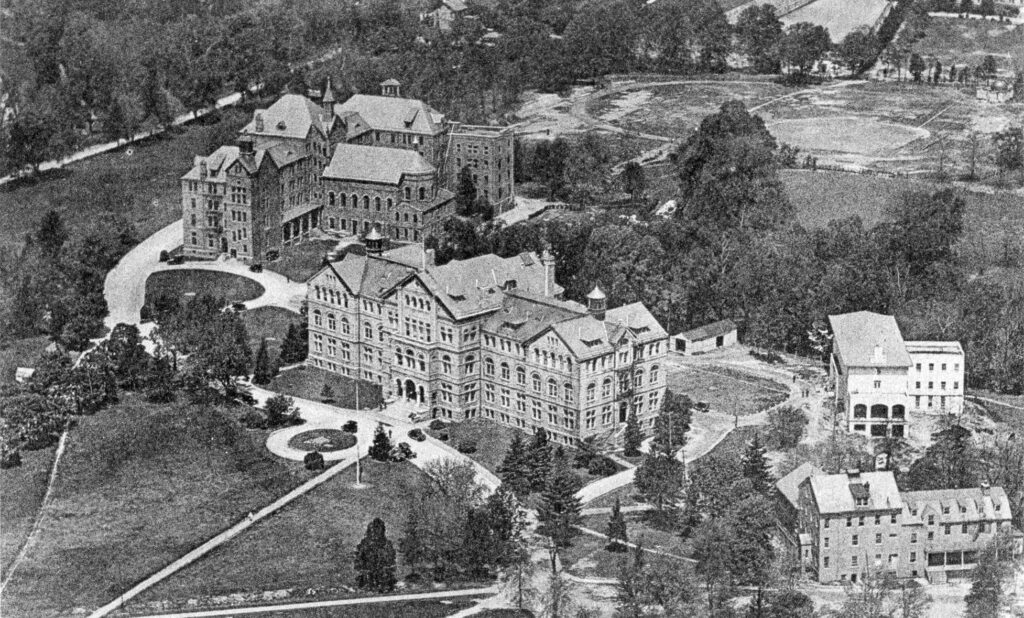

This rapid expansion required substantial institutional infrastructure. At the Third Plenary Council of Baltimore in 1884, fourteen archbishops and over sixty bishops ordered each parish to set up its own school. This decree helped to develop 3,500 parochial schools by the end of the century and what became the largest private educational system in the U.S. The Council also approved a standardized English catechism and planned for the Catholic University of America, which opened in Washington D.C. in 1889. These initiatives created a parallel institutional world—a Catholic counterpart to the Protestant establishment—that elicited both admiration and concern among Protestants. Nativists saw the Catholic growth as confirming fears of a “Romanist” threat to republican values. Conversely, Catholic leaders like Archbishop James Gibbons believed that the church’s expansion showed that American institutions were, as the Council’s pastoral letter stated, highly favorable to Catholic growth.14
III. Religion in the South
The Confederate defeat of 1865 lingered, and in many ways became central to Southern identity. The “Lost Cause” became the name for a powerful myth, developed by white Southerners immediately after the war. In the 1870s this myth grew into something of a civil religion. The Lost Cause romanticized the Confederacy. It rewrote the cause of the war from the protection of slavery to the pursuit of states’ rights, and it legitimized the continuation of racial segregation through Jim Crow laws. For white Southern Christians, the Lost Cause was not just a political myth but was also theological. The Confederacy’s loss was reinterpreted not as divine judgment on slavery but as divine testing of a righteous people. Southern ministers routinely cast the defeated Confederacy as God’s chosen people undergoing divine chastisement — tested, as ancient Israel had been, but not forsaken. No figure embodied this fusion of faith and Confederate memory more vividly than Father Abram Ryan, the Catholic “poet-priest of the Confederacy,” whose poem “The Conquered Banner” (1865) — set to the meter of a Gregorian hymn — rendered the Confederate flag as a sacred relic and its defenders as holy martyrs.15
This version of Southern civil religion combined Protestant imagery and language with Confederate remembrance. Its “saints” included Confederate leaders like Robert E. Lee and Stonewall Jackson (the latter’s chief of staff, Robert Lewis Dabney, was a Presbyterian minister and key figure along with Ryan in Christianizing the Lost Cause myth). Sacred days involved Confederate Memorial Day observances, and “liturgies” featured monument dedications and reunion speeches with Christian themes of sacrifice, martyrdom, and divine purpose. The United Confederate Veterans was founded in 1889 and the United Daughters of the Confederacy in 1894. Both of these popular organizations received endorsements and support from ministers and staged quasi-religious rituals to establish the boundaries of historical memory and religious meaning. By 1885, ninety-four Confederate monuments had been erected and dedicated across the South, with an additional 406 established by 1912. Most of these included speeches by ministers or used Christian language centered on sacrifice and resurrection. They also justified segregation and white supremacist terrorism.
![A monument to the memory of dead Confederate soldiers and the "Lost Cause." Four bronze men stand watch on the four corners, while a Jefferson Davis statue is shown at the top. Beneath is the phrase,
"SOUTHERN CONFEDERACY
Formed by following states withdrawing from the Union
South Carolina
December twentieth
Eighteen Hundred and Sixty."
An inscription at the base of the first part, reads "CONFEDERATE DEAD."
The second section of the statue bears the inscription:
"FOR STATES RIGHTS
GUARANTEED UNDER THE CONSTITUTION
THE PEOPLE OF THE SOUTH, ANIMATED BY THE SPIRIT OF 1776, TO PRESERVE THEIR RIGHTS,
WITHDREW FROM THE FEDERAL COMPACT IN 1861. THE NORTH RESORTED TO COERCION.
THE SOUTH, AGAINST OVERWHELMING NUMBERS AND RESOURCES,
FOUGHT UNTIL EXHAUSTED,
DURING THE WAR THERE WERE TWENTY TWO HUNDRED AND FIFTY SEVEN ENGAGEMENTS;
IN EIGHTEEN HUNDRED AND EIGHTY TWO OF THESE, AT LEAST ONE REGIMENT TOOK PART.
NUMBER OF MEN ENLISTED:
CONFEDERATE ARMIES 600,000; FEDERAL ARMIES 2,859,132
LOSSES FROM ALL CAUSES
CONFEDERATE, 437,000; FEDERAL, 485,216.
1861 [a seal] 1865."](https://www.thunderinggods.com/wp-content/uploads/2026/07/image-23-1-817x1024.jpg)
#/media/File:Confederate_Dead_Monument_-_Texas_State_Capitol_grounds_-_Austin,_Texas_-_DSC08299.jpg)
The growing civil religion of white Southerners was accompanied by growing institutional religion, as well. The Southern Baptist Convention (SBC) was created in 1845 after a sectional split with Northern Baptists largely over the issue of slavery. The SBC originally had about 300,000 members. By the 1890s, its membership exceeded 1.5 million. The growth is more stunning because it happened amid a mass exodus of Black Baptists. Back in 1845 nearly a third of Southern Baptists were Black. By the 1890s, there were almost no Black people left in the SBC. The state of Georgia exhibited perhaps the most dramatic version of this history. The Georgia Baptist Convention went from 95,000 members in 1860 to just 37,500 by 1870 due to war losses, economic devastation, and the departure of Black congregations. Yet a half century later, it had nearly 300,000 members and 2,500 churches.16
Like Southern Baptists, Southern Methodists had also split in the 1840s and did not reunify after the war. Instead, they consolidated as a distinctly regional denomination, professionalizing their operations and building centralized bureaucracies for missions, publishing, and education. Despite periodic overtures, Southern Methodists rejected reunion with the Methodist Episcopal Church until 1939, nearly a century after the 1844 split. The regionalism that dominated in both white Baptist and Methodist circles was itself a form of institutional consolidation, functioning as pillars of white Southern identity. The white Protestant denominational borders reinforced sectional distinctions.
White Southern churches provided a theology that functioned as the moral framework for the emerging Jim Crow order. They did not merely fail to resist segregation but actively blessed it as consistent with divine order. Robert Lewis Dabney, the Lost Cause mythmaker and a onetime moderator of the Southern Presbyterian denomination, argued that racial hierarchy was scripturally mandated and that granting Black clergy equal standing would corrupt the church. In this sense, white Southern Protestantism—Baptist, Methodist, and Presbyterian—was building an empire of its own: a comprehensive institutional infrastructure that mirrored and reinforced the racial and social hierarchy of the New South.
Black Americans increasingly fled this white Southern Protestant “empire” over the 1870s and after. They also moved toward greater independence and autonomy in their church life. Black Baptists began forming independent churches immediately after emancipation, then organized their own state conventions. North Carolina was the first in 1866. These state conventions finally consolidated into the National Baptist Convention in 1895. The same pattern happened among the Southern Methodists. For example, in 1860, the Methodist Episcopal Church (South) counted about 207,000 Black members, nearly all enslaved. By 1866, only 49,000 remained. By 1870, most of those had departed on relatively amicable terms to form the Colored Methodist Episcopal Church (now the Christian Methodist Episcopal Church). They joined a competitive religious marketplace for Black Methodism that also included the African Methodist Episcopal Church and the African Methodist Episcopal Church Zion, which combined counted more than half a million members by the end of the century.17
By the 1880s Black Christians had established new denominations, especially in the South, and become leaders in the holiness (and later Pentecostal) forms of Christianity. Denominations began establishing independent colleges, such as Lane College, founded by the Colored Methodist Episcopal Church, and Morris Brown College by the African Methodist Episcopal Church.
This institutional growth enabled Black Protestants to further distinguish their religious beliefs and practices and for churches to become the center of Black culture. Churches and denominations created their own presses, missions’ agencies, and reform societies. For many white Protestants, the independence allowed them to tolerate, even bless, the work so long as segregation was maintained. For other whites, particularly in the South, Black Christianity of any form was resisted and treated with violence. In other church settings where institutional separation was not so easy, white leaders resisted Black Christian growth. A group of Black Catholics meeting in Washington, DC in 1889 lamented “the fact that the sacred rights of justice and humanity are still sadly wounded” in light of Jim Crow segregation.18
Although the South was predominantly Protestant, a distinct Catholic presence persisted, mainly in Louisiana and Maryland. New Orleans hosted the most established Catholic community, influenced by French and Spanish colonial history and featuring a complex racial hierarchy with notable Creole Catholics. The 1884 Third Plenary Council of Baltimore—the same 1884 gathering of bishops that mandated parochial schools—largely adapted to regional racial norms, allowing Southern dioceses to maintain segregated parishes and schools. Catholic religious orders, such as the Sisters of the Blessed Sacrament, provided education for Black and Native American Southerners despite resistance from white Catholics. The same order also helped found Xavier University in New Orleans, the only historically Black and Catholic university in the U.S.
Southern Jews, a much smaller group than Catholics in the South, held a complex and often contradictory social position. They were sometimes more welcome in Southern white civic than they were in the North, yet they also remained vulnerable to antisemitism and the region’s racial hierarchy. Those who owned enslaved people before 1865 often identified strongly with the Confederacy and the Lost Cause mythology. However, acceptance was uncertain, and lynch mobs targeted American Jews; for example, Samuel Bierfield, a merchant, became the first American Jew to be lynched on August 15, 1868, in Franklin, Tennessee. These acts of violence contributed to the appeal of Reform Judaism among Southern Jews, who appreciated its Americanizing approach and relaxed dietary laws as a means of integrating into Southern civic culture while preserving their religious identity.
IV. The West
The historian Fredrick Jackson Turner’s famously observed at the 1893 Chicago’s World Fair that the American frontier had “closed.” The decades leading up to Turner’s declaration witnessed continued expansion of white settlement in the lands west of the Mississippi River, and especially west of the Rocky Mountains. Colorado achieved statehood in 1876, while North and South Dakota, Montana, Washington, Idaho and Wyoming entered the union in 1889 or 1890. Utah, whose first white settlers were Mormons in the 1840s and their descendants, finally gained statehood in 1896.
Compared to both the Northern and Southern United States, western lands were far more sparsely populated—with less infrastructure, religious or otherwise—and far more pluralistic in religious and ethnic makeup. In addition to the Mormons, who comprised the largest new religious movement in the US at some 150,000 in 1880, western lands were also inhabited by Latin Americans, Native Americans, and Pacific Rim immigrants. This meant that Protestantism, while remaining the dominant form of religion, existed alongside a wide range of other Christian traditions, like Catholicism and Mormonism, as well as other religious practices and beliefs like Indigenous spiritualities and Buddhism.
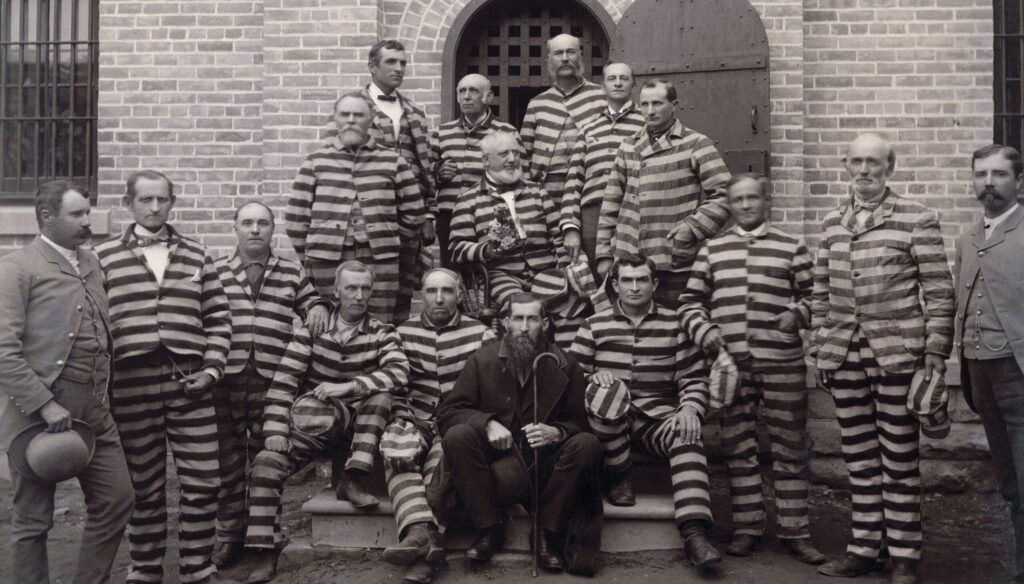
The last decades of the 19th century brought major changes to Mormonism. During this period the Church of Jesus Christ of Latter-day Saints shifted from isolation or hostility to the federal government to increasing accommodation with the United States government. In 1879, the Supreme Court ruled unanimously that religious belief could not justify polygamy. Some Mormons responded through resistance and hiding. For example, church president John Taylor went into hiding to avoid being arrested. Others insisted that the church should change. In 1890 the church announced that it would no longer authorize plural marriage. This decade also brought many Mormons into national political culture, and in 1894, Congress allowed Utah to draft a state constitution. By the end of the 1890s, many Mormons saw themselves as both fully Mormon and fully American. Others continued to struggle with the loss of plural marriage and viewed the nation with suspicion.

Mormons were not alone in the West, as the Catholics, the nation’s largest group, also exerted considerable influence. A case study on Catholic sisters illustrates the complex relationships between gender, religion, and economic realities in the region. Few sisters served in western territories during the colonial period, but when the Vatican realigned its governance structures after the Mexican-American War in 1848, the territory fell under the purview of the U.S. Catholic Church. Pope Pius IX appointed new bishops to meet the needs of both the resident Spanish-speaking population and the rapid influx of European immigrants who sought land, minerals, and economic opportunity. They recruited European priests and sisters to participate in the daunting task of strengthening the church in this vast new territory, building churches, schools, hospitals, and other facilities described by one historian as “an empire of interlocking institutions that constituted Catholic social services.”19 Sisters served in cities, mining towns, farming communities, and on newly established government reservations for indigenous people. Often the first to establish social services in many western communities, sisters shaped the institutions that laid the foundation for, eventually, the welfare state.20
While bishops connected them with sympathetic donors when they could, sisters in western territories were often left to their own devices to sustain themselves and their institutions. In Los Angeles, the Daughters of Charity built relationships with the German, Californio-Mexican, Irish, and American elite to raise funds for their school and orphanage. They also contracted with the county’s board of supervisors to care for indigent patients at the Los Angeles Infirmary, which later became St. Vincent’s Hospital.21 Sisters in other locales followed similar patterns, building relationships with local residents and government officials who wished to cooperate on issues of mutual interest.
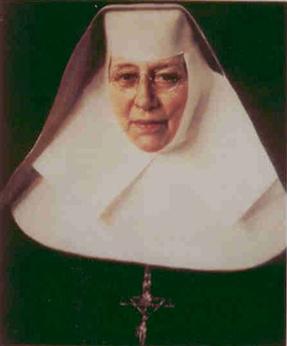

While most Catholic sisters came from working-class backgrounds, the experiences of Mother Katharine Drexel illustrate the impact that a well-funded religious community could have in the west. The daughter of a Philadelphia banking tycoon, Katharine Drexel founded the Sisters of the Blessed Sacrament for Indians and Colored People (SBS) in 1891. Dedicating her inheritance to the work of educating African American and Native American Catholics, Drexel donated between 15 and 20 million dollars to fund the construction of dozens of schools, convents, and churches. Drexel’s business sense, political acumen, and philanthropic business model influenced the development of the entire system. Through her contributions and expertise, Drexel shaped Catholic Native American policy for five decades. Drexel believed that Catholic residential schools could save souls and help produce educated American citizens. But her actions had unintended consequences. Removing students from their families and requiring them to renounce their language, culture, and traditions caused incalculable damage, individually and collectively.
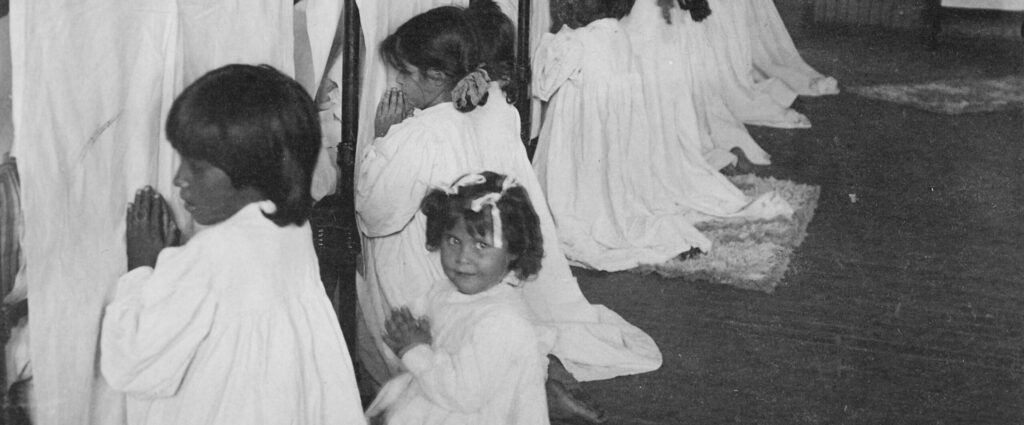

These religious and economic realities were felt in a different, but no less illustrative way by Native Americans, many of whom resisted the US government and white settlement. Yet Indigenous responses were also complicated by overlapping influences, including new, old, and blended religious traditions. The blending, sometimes called syncretism, can be seen in Peyotism, the set of religious beliefs and practices among some Native Americans that utilize the hallucinogenic effects of the dried tops of cactuses growing in northern Mexico and south Texas. Peyote “buttons” are considered both a sacred medicine for healing purposes, and when ingested produce a mild hallucinogenic sensation to serve as an aid in ritual worship. The complex of religious practices associated with peyote began in ancient Central America and spread, over centuries, to North American tribes, especially in the Comanche, Kiowa, and Kiowa-Apache what would become Oklahoma.22


By the nineteenth century, the peyote ceremony that developed among the Comanche and Kiowa became known as the “Half Moon” ceremony, named for the crescent shape of the altar for the peyote. As Peyotism spread among tribes located on reservations in Oklahoma Territory and parts of Indian Territory (now the state of Oklahoma), Christian elements began to be added to the ceremony by various peyote leaders. A Caddo-Delaware spiritual leader named John Wilson stretched the arms of the crescent altar, so his version became known as the “Big Moon” ceremony. This syncretic ceremony included a cross, new songs, and concrete ethical teachings that appealed to Christian Native Americans located in northeast Oklahoma and Kansas.
As Peyotism continued to spread to the Northern Plains, a Winnebago named John Rave continued to modify the Big Moon ceremony with the overt addition of Christian symbols and meaning. His peyote ritual became known as the “Cross Fire” ceremony. Rave also added Christian texts and Christian hymns into the peyote ceremony. Winnebago Albert Hensley added the presence of an open Bible displayed on the altar next to the peyote cactus. The Christian elements of the peyote ceremonies spread further west. Native American beliefs often allowed an individual to be both a Peyotist and a member of a specific Christian church, rather than adhering to a single religious practice.
Even as Peyotism accommodated Christian symbols and teachings, white federal officials became aware of the religious practice in the 1880s, especially after the widespread implementation of the reservation system and the Dawes Allotment Act in 1887. Peyotism became a target of Native American religious identity that federal officials and reformers, both white and Native American, wanted to eradicate. Even as the cultural and racial frontiers had expanded for Christian Native Americans themselves in this period, the concept of pluralism was far more limited for Indigenous people.
![A masthead reads, "Frank Leslie's Illustrated Newspaper. Beneath that are arched stores with the phrase "Golden Gate of Liberty." The doors are clearly shut and a Chinese man sits outside atop a box. He has a long braid down his back, a hat, and is wearing dark pants and a tunic. He leans on his hand, which rests upon his leg. The box he sits upon says "order" and two boxes behind him say, "peace" and "sobriety." To his left is a bound bag that is labeled "industry." A sign to his right reads "Notice-Communist Nihilist-Socialist Fenian & Hoodlum welcome but no admittance to Chinamen." The phrase across the bottom of the page, reads "The only one barred out. Enlightened American Statesman.-"We must draw the line somewhere [with emphasis], you know."
This cartoon by Frank Leslie reveals the strong anti-Chinese sentiment in the United States at the turn of the century.](https://www.thunderinggods.com/wp-content/uploads/2026/07/Chinese-exclusion-cartoon-820x1024.jpeg)
A third scene of religious innovation in the West was the growing presence of Eastern religions, especially Buddhism. By 1880 more than 100,000 Chinese people were living in the United States, most in California. Anti-Chinese sentiment was rampant and motivated congress to pass the Chinese Exclusion Act in 1882.23 The law banned the entry of Chinese laborers into the United States and forbade people of Chinese descent already living in the United States from becoming American citizens via naturalization, but not, importantly, through birthright citizenship. Although the act originally prohibited immigration and naturalization for only ten years, a series of later laws first broadened the immigration ban to include “all persons of the Chinese race’ and later extended its provisions indefinitely.”24 As intended, the Chinese Exclusion Act brought a significant decline in the population of Chinese Americans. The act was not repealed until the passage of the 1943 Magnuson Act.
Exclusion was grounded in deeper cultural and religious prejudices of the period. Bret Harte’s 1870 poem “The Heathen Chinee” gained popularity and became a shorthand for stereotyping Chinese people despite the author’s satirical intention. Some politicians, such as California senator Eugene Casserly, recited the poem as part of their justification to prevent Chinese immigration to the United States.25 In a report to the California State Senate by its special committee on Chinese immigration, politicians repeated well-known missionary Rev. S. V. Blakeslee’s warnings about the danger of the Chinese presence in the United States: “… in a few years, … these Chinese, yet being heathen, must surely become enfranchised as citizens … to shape the government to their preferences, and this, too, while they retain their heathen religion, prejudices, vices, and clannish spirit.”26 The label of “heathen” and its associated qualities, such as ignorance, deceit, and an inability to assimilate, became attached to all Asian immigrants.
Two remarkable essays in the 1887 North American Review illustrated how these debates were understood by Chinese Americans. Wong Chin Foo, a journalist, rejected the idea that Christianity was superior to the Confucian ethics with which he was raised. He noted the widespread American traditions of warfare, racism, and economic exploitation and juxtaposed those with the values he was taught including honesty, self-discipline, and reciprocity. Ultimately, Wong called for a multireligious nation, claiming that Chinese religious traditions deserved respect.27 Yan Phou Lee agreed that Americans treated Chinese immigrants unjustly. Yet he advanced the opposite argument regarding religion. Lee explained his Christian conversion and why he found Christianity to be superior to Chinese religions.28
“Heathenism,” positioned as an antonym of Christianity, framed the Buddhism of Asian immigrants as false for some, but as an intriguing for others.29 Throughout the late nineteenth century, scholarly and popular fascination with Buddhism and knowledge from the “Orient” continued unabated. White American and European scholars expanded Western knowledge of Buddhism through studies and translations. On the East Coast, in New York City, these interests led a group that included Henry Steel Olcott, a discharged US Army Colonel, and Helena Blavatsky, an author and spiritualist medium, to form the Theosophical Society in 1875. As one historian explains, “The Society devoted itself to the study of comparative religion, philosophy, and science; the promotion of universal brotherhood; and the investigation of unexplained natural and psychic phenomenon, especially the latent powers of the human mind…The Theosophical Society argued a kind of perennialism that was part of larger religious discourses of the time, a strategy aimed at reconciling apparent differences between religious traditions by proposing universalistic alternatives.”30 Within a decade, the Theosophical Society had shifted its headquarters to India. While some American Theosophists remained loyal to the Adyar-based Theosophical Society, the movement split into different branches and theosophical lodges could be found across the United States.
Back on the West Coast, Japanese immigration had started in the 1860s and increased significantly by the late nineteenth century. Japanese immigration to both Hawai’i and the West Coast was influenced by the social, cultural, and political changes taking place during the Meiji era (1868–1912) in Japan.31 Beginning in 1890, the number of Japanese immigrants and natural-born citizens in the United States increased over the next 20 years from 2,000 to 127,000. These Buddhist organizations, like the Japanese immigrants themselves, were primarily of the Jōdo Shinshū tradition of Buddhism (Shin Buddhism).32 By the turn of the century, Shin Buddhist priests would found the Young Men’s Buddhist Association. This organization would eventually become the Buddhist Church of San Francisco and the North American Buddhist Mission (renamed Buddhist Churches of America during World War II).33
In these three case studies of the Catholic sisters, Peyotism, and the growth of Buddhism, we see the openness and limits of the West. With less infrastructure and more fluid religious practices, these communities adapted to the land, laws, and norms in new ways. These examples illustrate how the West produced and limited religious innovation.
V. Missionaries
In the decades before the Spanish-American War (1898), American missionaries played a key role in expanding American influence abroad by challenging local customs and advocating for religious liberty in regions such as China, Japan, Hawai’i, the Ottoman Empire, Persia, and Mexico. In their efforts to promote Christianity (most often forms of Protestantism), missionaries often clashed with local authorities, criticizing local religious practices and laws. When conflicts arose, these missionaries turned to their government for aid, often dragging the U.S. government into complex diplomatic entanglements. This involvement sometimes led to the establishment of new U.S. consulates, further extending American influence. As one diplomat, Whitelaw Reid claimed, missionaries were both “troublesome and influential.”34
In Japan, for instance, missionaries contributed to the lifting of the ban on Christianity. Following Commodore Matthew Perry’s 1850s gunboat diplomacy, which ended Japan’s maritime restrictions and imposed an unequal treaty, the Japanese government was eager to transform the nation. Japan allowed some Protestant missionaries to serve as agents of westernization. The Meiji Restoration, beginning in 1868 and culminating in the Meiji Constitution in 1889, furthered this westernization. Yet the Japanese grew suspicious of American missionaries, further restricting their role and access in the 1870s. American missionaries responded by urging President Ulysses Grant to fight these restrictions in the name of religious freedom. When Japanese envoys visited Grant to showcase Japan’s progress, he emphasized the American values of “freedom of thought & of conscience, & a liberal toleration in matters of religion,” suggesting that Japan adopt similar principles.35 This contributed to lifting the ban on Christianity in Japan in 1873. In the following decade, American missionaries produced the first Japanese translations of the Bible and achieved the highest recorded rates of conversion in Japan. Their success, in turn, prompted a sharp rise in Japanese nationalist and anti-Christian sentiment in the late 1880s and 1890s, among both Japanese officials and the nascent Japanese Christian community.36
West of Japan, American missionaries in China became deeply entangled in the contradictions of overseas religious and geopolitical activism. Here, again, American missionaries called for religious liberty while sheltering under the protection of unequal treaties imposed by Western military force. This contradiction eventually made missionaries targets of anti-imperialist backlash. All the while, they invested in creating the infrastructure of churches, schools, and charities that became vital to the growth of Chinese society. The “treaty port” system, formalized after the Opium Wars that ended in 1860, gave American missionaries legal protection on Chinese soil under extraterritoriality clauses—meaning missionaries operated under American rather than Chinese law. This complex relationship between religious and political status implicated missionaries in the growing Chinese distrust of foreign religious and commercial presence. This distrust would explode in 1899 with the Boxer Rebellion that targeted Chinese Christians and Western missionaries. In the years before the rebellion, these same missionaries were active in pressing the Qing government for religious liberty protections for Chinese converts. Evan after the two-year rebellion forced major changes, missionaries continued to encourage the use of Western imperial pressure to pursue increased access under the rhetoric of individual conscience.37
A third example of Hawaii offers the starkest case of missionary activity collapsing into outright political conquest. In Hawaii, the children and grandchildren of New England Protestant missionaries became the sugar planters and political actors who overthrew Queen Lili’uokalani in 1893, raising questions about where religious influence ended and imperialism began. American missionaries had been on the island since 1820, and many also invested in the sugar industry. Partly due to the interests of sugar planters, a constitution was forced on the monarchy in 1887 nicknamed the “Bayonet Constitution.” In 1893, Queen Lili’uokalani, a native Hawaiian and a Christian, introduced a new constitution that would have significantly relocated power to the monarchy and to Hawaiians.
She was deposed in January 1893 by American businessmen who formed a “Committee of Safety” meant to protect their privileges. American Marines were deployed to the island the day before the coup and ensured armed resistance by the queen was impossible. The queen protested her deposition to the U.S. government, and the Cleveland administration concluded that the Marines had acted improperly and that the queen should be restored. But Congress refused. The tangling of religious, racial, and economic factors had driven the monarchy from power, paving the way for Hawaii’s annexation by the U.S. in 1898 as part of the Spanish-American War.38
These examples reveal a broader pattern of how Christianity, American values, and U.S. influence intertwined during this period. In American hands, religious liberty was both a genuine belief and a tool of imperialism. In Japan, missionaries invoked religious freedom to open a closed society, leading to American commercial and diplomatic opportunities. In China, missionaries relied on treaties gained through military force and then used those treaties to defend converts, making the church structurally reliant on imperial power, despite individual missionaries’ dislike of this dependence. In Hawaii, the missionary movement became an entrenched class, with its initial descendants becoming sugar barons who prioritized economic interests in the 1893 overthrow of the island’s Christian queen.
The broader pattern is that Americans in this period genuinely believed that religious liberty, American democracy, and Christian civilization were identical. The coherence of this view meant that missions and American power felt like two harmonizing aspects of the same Christian imperial cause, which made it difficult for missionaries or their supporters to recognize when they had crossed from persuasion into coercion, or from conversion into conquest. The same Protestant establishment that blessed, or at least acquiesced to, Jim Crow at home was simultaneously exporting its version of religious liberty abroad.39
These same patterns would produce tensions on the mission field itself. For example, the influential Missionary Review of the World repeatedly highlighted acts of lynching and connected the plight of Black Southerners to Black South Africans oppressed by the British and Boers. Its longtime editor beginning in 1892 was Arthur T. Pierson, a close associate of Dwight Moody and an early advocate of the Student Volunteer Movement.40 In addition to editing the Review, Pierson helped to found Africa Inland Mission in 1895, which would become one of the largest Protestant missions in Africa in future years. Pierson was convinced that the poor treatment of Blacks in the U.S. had stunted the effectiveness of American missionaries abroad. “The Christian missionary makes slow progress in Africa,” he wrote in 1887, “because he can offer the negro no true brotherhood except in another world.”41 While Pierson’s perspective was not necessarily prevalent, his logic pointed to a deeper challenge experienced by Americans inside and outside the Christian missions—legally enforced white supremacy in the United States were inseparable from American actions outside the United States.
VI. Women and Power
Inequalities haunted American religion beyond Protestantism as well. American Catholics and Jews each had their own histories, while also sharing similar tensions and patterns with the Protestant majority. The distinctive roles of women in religious life are a key example. Women participated in religiously and racially distinct (if not outright segregated) institutions. Yet they were aware of each other’s efforts, and their work shared commonalities. As Americans erected colleges, hospitals, and houses of worship in the late nineteenth century, women played roles as fundraisers and creators of associations. American women exercised outsized influence on religious and social life through organizations like the Woman’s Christian Temperance Union, Methodist deaconess homes, Catholic religious orders, Jewish Reform sisterhoods, and the Woman’s Convention of the National Baptist Convention.
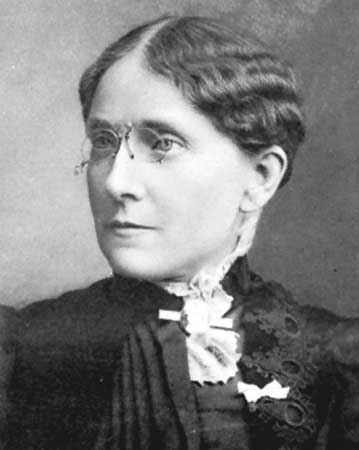

The Woman’s Christian Temperance Union, to take the era’s most consequential example, was founded in 1874 to unite the power of female moral influence and political action in protesting the dangers of alcohol. Its first president, Frances Willard, a Methodist laywoman, argued that promoting temperance, especially among men, protected women and children from domestic violence. She led the WCTU into a “do everything” policy that linked temperance with other efforts such as labor reform and women’s suffrage. Meanwhile, in her own church, Willard was among five women elected as lay delegates to the 1888 Methodist Episcopal General Conference. The Conference refused to seat the women but did authorize a deaconess program for unmarried women to serve the church. These women were to be set apart, ideally living together in community, wearing a uniform garb, and receiving for their services only a small allowance.42
The imperial moment opened an unexpected avenue for women’s religious authority: the foreign mission field. Barred from ordination and formal leadership at home, Protestant women found that overseas missions offered a space where their labor was indispensable and their authority harder to circumscribe. The new Woman’s Foreign Missionary Societies allowed women to fundraise, organize, and ultimately direct their own missionary operations largely independent of male denominational control. Methodists founded their society in 1869 (which expanded into multiple Methodist denominations) while Baptist women organized in 1871. By 1890, women constituted the majority of American Protestant missionaries abroad. Yet this expansion of female agency was inseparable from the racial, gendered, and imperial assumptions of the age. Women missionaries frequently framed their work as the rescue of non-white and non-Christian women from patriarchal Asian or Pacific cultures, positioning American Protestant womanhood as the civilizational standard. The result was a genuine but circumscribed role: women gained real institutional authority and public voice through missionary work, but largely by embracing rather than challenging the imperial framework that made that work possible.43
It is not a coincidence that these Protestant deaconesses and missionaries resembled the image of Catholic nuns. Although most Catholic women found their vocations in marriage and motherhood, with the Virgin Mary as divine model, Catholic sisters were the publicly visible manifestation of Catholic women’s religious authority in the nineteenth and twentieth centuries. The millions of arriving Catholics compounded the need for churches, hospitals, and schools. Already called to minister to the sick and wounded during times of disease and war, by the late nineteenth century, Catholic sisters were administering and staffing large hospitals. When U.S. Catholic bishops decreed in 1884 that every parish should build its own school, religious women were deployed to help make this a reality. From the mid-nineteenth century to the late 1960s, Catholic women seeking meaningful work had vastly more opportunities within the Church than outside it.44
Reform Judaism, influenced by earlier German Jewish immigrants, introduced innovations beyond non-kosher eating to include mixed gender seating and women’s participation in new synagogue choirs. This did not extend to synagogue leadership. At the same time, as Reform leaders de-emphasized the Jewish dietary laws and the home-centered Shabbat, they eroded the importance of Jewish domestic space over which women had traditionally presided. Jewish women found a new avenue for religious activities in the temple sisterhoods that surged in popularity in the 1890s. Sisterhoods attached women more closely to their local temples as they provided a space for comfortable American Reform women to aid needier Eastern European Jewish immigrants. Nationally, the women of the sisterhoods founded the National Council of Jewish Women, an outgrowth of the Jewish Women’s Congress held during the 1893 World’s Parliament of Religions. The NCJW, composed primarily of upper- and middle-class Reform women, sought to further social reform and education in Judaism and Jewish culture.45
In this same period, Black Baptist women, who had their religious authority circumscribed within the local church, pushed to expand it in associations. As African Americans developed their churches after emancipation, the role of the community in church decision-making declined, as authority concentrated in the person of the male minister. The deaconesses, who sometimes participated in matters of local church discipline, had limited authority to affect the outcomes. Yet even as Black women’s authority within the local church diminished, they shouldered the fundraising that enabled to development of these institutions as well as launched several new institutions to be run by and for women. By 1900, women delegates from local churches, district associations, and state conventions had formed the Woman’s Convention, an auxiliary to the National Baptist Convention that had been formed in 1893 to bring together sectional Baptist bodies, representing more than one million of their sisters.46
Beyond serving as a training ground for exercising future political and religious power, women’s associations enabled women to do real work in education, charity, healthcare, and the institution building that marked the era. In doing so, they exposed a tension of American religious life that would become more discussed in later periods: the same churches and denominations that formally excluded women from ordained leadership were functionally dependent on female labor to sustain themselves. Women built the schools, staffed the hospitals, raised the funds, and organized the congregations. The gap between formal authority and practical indispensability would prove difficult to maintain, and the organizational confidence women developed in this period would become the basis for more direct challenges to religious and political exclusion in the decades ahead.
VII. World’s Parliament of Religion
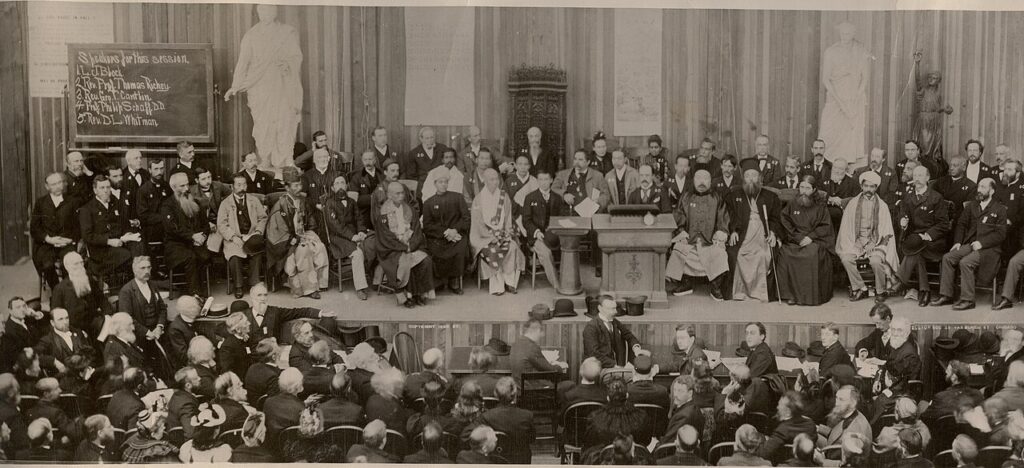
The year 1893 featured a dramatic staging of the religious trends we have been discussing. It took place in Chicago, at the World’s Parliament of Religions. Coinciding with the Chicago World’s Fair the same year, this gathering of religious leaders included some of the leading representatives of Christianity and Judaism. But the representation extended well beyond these two traditions, and their many branches. Leaders of Eastern religions, growing in presence in some parts of the United States, were also featured. Swami Vivekananda, an Indian monk and philosopher, introduced Americans to the Vedas, the foundational scriptures of Hinduism, Krishna, and Vedantic philosophy. Anagarika Dhamapala, a Buddhist writer with connections to the American creators of Theosophy, promoted Buddhism’s “middle path” between hedonism and aestheticism. Both Vedanta societies and the Young Men’s Buddhist Association were founded in the U.S. in their wake.47
Apart from representing a broad diversity of religions and thus shifting the focus away from Christianity for American attendees, the gathering’s ethos was defined by its diversity. The ecumenical movement increasingly attracted the attention of white Protestant denominational leaders who aimed to unify their institutions around a broader, modern interpretation of the gospel and Christian mission. At that time, this sense of potential inspired ideas even greater than merely uniting Northern and Southern Methodists or Baptists and Congregationalists. It encompassed evangelizing the world with this form of Protestant belief. This call aligned with Dwight Moody’s call for sectional and interdenominational cooperation for missions, primarily through revivals and gospel preaching. The spirit of mission persisted as both revivalist and ecumenical Protestants relied heavily on American money, values, and geopolitical influence, extending their reach further and reaching larger numbers across every continent.
The World’s Parliament of Religions was also the beginning of organized interfaith dialogue. The need or desire to speak across faith lines was relatively new in the nineteenth century. Its origins in 1893 were in part due to the religious convictions of the parliament’s organizer, the Swedenborgian layman Charles Carroll Bonney. Swedenborgianism, the mystical theological tradition founded on the visions of the eighteenth-century Swedish philosopher Emanuel Swedenborg, held that divine truth was not the exclusive property of any single tradition. This conviction made Bonney genuinely interested in non-Christian religions at a moment when most of his contemporaries were focused on converting the world. It is telling that someone on the fringes of American Protestantism, rather than at its center, imagined the Parliament into existence.48
Yet the Parliament also illustrated the limits of the openness it celebrated. The voices most prominent on its platform were those with the cultural fluency and institutional backing to travel to Chicago and perform their traditions for a largely white Protestant audience. Vivekananda’s commanding English and Dharmapala’s Western education enabled them to use a Protestant-friendly comparative religious vocabulary. The traditions that had no such representatives — like the Peyote practitioners of the Plains, the Chinese Buddhists of San Francisco’s Chinatowns, the Black Baptist women who had been building institutions across the South — were largely absent. The Parliament’s cosmopolitanism, in other words, had a class and racial ceiling that mirrored the broader contradictions of the era.
VIII. Conclusion
The tensions in American religion all became painfully clear in 1893. In this same year, American businessmen overthrew the Hawaiian queen, Frederick Jackson Turner declared the frontier closed, and the World’s Parliament of Religions gathered in Chicago. American religious life stood at a threshold. The imperial projects of continental, overseas, and civilizational expansion had shaped religion for decades, but they were now about to accelerate dramatically. The Spanish-American War loomed in the offing. Religious Americans had been wrestling with their understandings of race, nation, gender, tradition, and the boundaries of the sacred itself. Their beliefs on these issues would soon be tested on a genuinely global stage. The Parliament, for all its limits, had at least made one thing undeniable: the religious world was larger than American Protestantism had imagined. The coming century would demand a reckoning with that fact.
IX. Reference Material
This chapter was edited by Daniel G. Hummel, with content contributions by Ralph Craig, Lisa Jane de Gara, Daniel G. Hummel, Chanhee Heo, Jenny Wiley Legath, Minami Nishioka, Kristine Gunnell, Lisa Barnett, and Ben Wright.
Recommended Reading
- Edward J. Blum, Reforging the White Republic: Race, Religion, and American Nationalism, 1865–1898 (Louisiana State University Press, 2005).
- Paul Boyer, Urban Masses and Moral Order in America, 1820–1920 (Harvard University Press, 1992).
- Emily Conroy-Krutz, Missionary Diplomacy: Religion and Nineteenth-Century American Foreign Relations (Cornell University Press, 2024).
- Janine Giordano Drake, The Gospel of Church: How Mainline Protestants Vilified Christian Socialism and Fractured the Labor Movement (Oxford University Press, 2024).
- Timothy Gloege, Guaranteed Pure: The Moody Bible Institute, Business, and the Making of Modern Evangelicalism (University of North Carolina Press, 2015).
- Sarah Barringer Gordon, The Mormon Question: Polygamy and Constitutional Conflict in Nineteenth-Century America (University of North Carolina Press, 2010).
- Jennifer Graber, The Gods of Indian Country: Religion and the Struggle for the American West (Oxford University Press, 2018).
- Evelyn Brooks Higginbotham. Righteous Discontent: The Women’s Movement in the Black Baptist Church, 1880-1920 (Harvard University Press, 1994).
- Matthew Frye Jacobson, Whiteness of a Different Color: European Immigrants and the Alchemy of Race (Harvard University Press, 1998).
- Gale L. Kenny, Christian Imperial Feminism: White Protestant Women and the Consecration of Empire (NYU Press, 2024).
- James T. Kloppenberg, Uncertain Victory: Social Democracy and Progressivism in European and American Thought, 1870–1920 (Oxford University Press, 1988).
- Jenny Wiley Legath, Sanctified Sisters: A History of Protestant Deaconesses (NYU Press, 2019).
- Jackson Lears, Rebirth of a Nation: The Making of Modern America, 1877–1920 (Harper Perennial, 2010).
- Joseph L. Locke, Making the Bible Belt: Texas Prohibitionists and the Politicization of Southern Religion (Oxford University Press, 2017).
- Kathryn Gin Lum, Heathen: Religion and Race in American History (Harvard University Press, 2022).
- Wilfred M. McClay, The Masterless: Self and Society in Modern America (University of North Carolina Press, 1994).
- Thomas J. McCormick, China Market: America’s Quest for Informal Empire, 1893–1901 (Ivan R. Dee, 1990).
- David Mislin, Saving Faith: Making Religious Pluralism an American Value at the Dawn of the Secular Age (Cornell University Press, 2015).
- Frank A. Ninkovich, Global Dawn: The Cultural Foundation of American Internationalism, 1865–1890 (Harvard University Press, 2009).
- Andrew Preston, Sword of the Spirit, Shield of Faith: Religion in American War and Diplomacy (Alfred A. Knopf, 2012).
- Ernest R. Sandeen, The Roots of Fundamentalism: British and American Millenarianism, 1800–1930 (University of Chicago Press, 1970).
- Jonathan D. Sarna, American Judaism: A History (Yale University Press, 2005).
- Leigh Eric Schmidt, Restless Souls: The Making of American Spirituality, 2nd ed. (University of California Press, 2012).
- Grant Wacker, “The Holy Spirit and the Spirit of the Age in American Protestantism, 1880–1910,” Journal of American History 72, no. 1 (1985): 45–62.
- Judith Weisenfeld, Black Religion in the Madhouse: Race and Psychiatry in Slavery’s Wake (New York University Press, 2025).
Notes
- Martin E. Marty, Righteous Empire: The Protestant Experience in America (Doubleday, 1970). ↩︎
- Walter F. LaFeber, The New Empire: An Interpretation of American Expansion, 1860-1898 (Cornell University Press, 1998). ↩︎
- Abraham Lincoln, “Gettysburg Address,” November 19, 1863. ↩︎
- Edward J. Blum, Reforging the White Republic: Race, Religion, and American Nationalism, 1865-1898 (Louisiana State University Press, 2005). ↩︎
- Quoted in Obbie Tyler Todd, The Beechers: America’s Most Influential Family (Louisiana State University Press, 2024), 215, 213. ↩︎
- Quoted in Blum, Reforging the White Republic, 141. ↩︎
- Dwight Lyman Moody, The New Sermons of Dwight Lyman Moody (Goodspeed, 1880), 14. ↩︎
- Grant Wacker, “The Holy Spirit and the Spirit of the Age in American Protestantism, 1880-1910,” Journal of American History 72, no. 1 (1985): 45–62. ↩︎
- James C. Ungureanu, Science, Religion, and the Protestant Tradition: Retracing the Origins of Conflict (University of Pittsburgh Press, 2019). ↩︎
- Daniel G. Hummel, The Rise and Fall of Dispensationalism: How the Evangelical Battle over the End Times Shaped a Nation (Eerdmans, 2023). ↩︎
- Jonathan D. Sarna, When General Grant Expelled the Jews (Nextbook, 2016); Gary Phillip Zola, We Called Him Rabbi Abraham (Southern Illinois University Press, 2014). ↩︎
- Lance A. Sussman, “The Myth of the Trefa Banquet: American Culinary Culture and the Radicalization of Food Policy in American Reform Judaism” American Jewish Archives Journal 57, no 1 (2005): 29–52. ↩︎
- Emma Lazurus, “The New Colossus,” https://www.poetryfoundation.org/poems/46550/the-new-colossus/. ↩︎
- Patrick W. Carey, Catholics in America: A History (Rowman & Littlefield, 2008). ↩︎
- Charles Reagan Wilson, Baptized in Blood: The Religion of the Lost Cause, 1865-1920 (University of Georgia Press, 2009). ↩︎
- James Adams Lester, A History of the Georgia Baptist Convention, 1822-1972 (Executive Committee, Baptist Convention of the State of Georgia, 1972). ↩︎
- John M. Giggie, After Redemption: Jim Crow and the Transformation of African American Religion in the Delta, 1875-1915 (Oxford University Press, 2007). ↩︎
- Quoted in Mark A. Noll, A History of Christianity in the United States and Canada, Second Edition (Eerdmans, 2019), 317. ↩︎
- Ann Braude, Sisters and Saints: Women and American Religion (Oxford University Press, 2008), 73. ↩︎
- Anne Butler, Across God’s Frontiers: Catholic Sisters in the American West, 1850-1920 (University of North Carolina Press, 2015). ↩︎
- Kristine Gunnell, Daughters of Charity: Women, Religious Mission, and Hospital Care in Los Angeles, 1856-1927 (De Paul University Vincentian Studies Institute, 2013). ↩︎
- Thomas C. Maroukis, The Peyote Road: Religious Freedom and the Native American Church (University of Oklahoma Press, 2010); Omer C. Stewart, Peyote Religion: A History (University of Oklahoma Press, 1987). ↩︎
- Rick Fields, How the Swans Came to the Lake: A Narrative History of Buddhism in America, Second Edition (Shambhala Publications, 1992). ↩︎
- Thomas A. Tweed and Stephen Prothero, eds., Asian Religions in America: A Documentary History (Oxford University Press, 1999), 74–75. ↩︎
- Peter Kearly Kim, “It’s ‘Ah Sin’ to be Yellow in America: Theatrics of Racial Humor in Protesting Injustice,” in Studies of American Humor, New Series 3, No. 18 (2008), 26. ↩︎
- “Address of Rev. S. V. Blakeslee,” in Chinese Immigration: Its Social, Moral, and Political Effect. Report to the California State Senate of Its Special Committee on Chinese Immigration (1878), 243. ↩︎
- Wong Chin Foo, “Why Am I a Heathen?” The North American Review 145, no. 369 (1887): 169-179. ↩︎
- Yan Phou Lee, “Why I Am Not a Heathen. A Rejoinder to Wong Chin Foo,” The North American Review 145, no. 370 (1887): 306-312. ↩︎
- Kathryn Gin Lum, Heathen: Religion and Race in American History (Harvard, 2022). ↩︎
- Scott A. Mitchell, Buddhism in America: Global Religion, Local Contexts (Bloomsbury Academic, 2016), 38. ↩︎
- Thomas Calobrisi, “The History of Buddhism in the United States,” in The Oxford Handbook of American Buddhism, eds. Ann Gleig and Scott A. Mitchell (Oxford University Press, 2024), 40. ↩︎
- See Jesse J. Lee, “Pure Land Buddhism in America,” in The Oxford Handbook of American Buddhism, eds. Ann Gleig and Scott A. Mitchell (New York: Oxford University Press, 2024), 129–43. ↩︎
- See Mitchell, Buddhism in America, 52. See also Scott A. Mitchell, The Making of American Buddhism (Oxford University Press, 2023), 36–39. ↩︎
- Quoted in Andrew Preston, Sword of the Spirit, Shield of Faith: Religion in American War and Diplomacy (Knopf, 2012), 194. ↩︎
- Ulysses S. Grant, The Papers of Ulysses S. Grant, ed. John Y. Simon, vol. 23 (Southern Illinois University Press, 2000), 35. ↩︎
- A. Hamish Ion, American Missionaries, Christian Oyatoi, and Japan, 1859-73 (UBC Press, 2009); 143-146. ↩︎
- Preston, Sword of the Spirit, Shield of Faith. See also, Emily Conroy-Krutz, Missionary Diplomacy: Religion and Nineteenth-Century American Foreign Relations (Cornell University Press, 2024). ↩︎
- Noenoe K. Silva, Aloha Betrayed: Native Hawaiian Resistance to American Colonialism (Duke University Press, 2004). ↩︎
- Emily Conroy-Krutz, Missionary Diplomacy. ↩︎
- Dana L. Robert, Occupy Until I Come: A. T. Pierson and the Evangelization of the World (Eerdmans, 2003). ↩︎
- Arthur T. Pierson, Evangelistic Work in Principle and Practice (Baker & Taylor, 1887), 219. ↩︎
- Christopher H. Evans, Do Everything: The Biography of Frances Willard (Oxford University Press, 2022). ↩︎
- Gale L. Kenny, Christian Imperial Feminism: White Protestant Women and the Consecration of Empire (NYU Press, 2024). ↩︎
- Jenny Wiley Legath, Sanctified Sisters: A History of Protestant Deaconesses (NYU Press, 2019). ↩︎
- Mary McCune, The Whole Wide World, Without Limits: International Relief, Gender Politics, and American Jewish Women, 1893-1930 (Wayne State University Press, 2005); Laura Yares, Jewish Sunday Schools: Teaching Religion in Nineteenth Century America (NYU Press, 2023). ↩︎
- Evelyn Brooks Higginbotham. Righteous Discontent the Women’s Movement in the Black Baptist Church, 1880-1920 (Harvard University Press, 1994). ↩︎
- Thomas Albert Howard, The Faiths of Others: A History of Interreligious Dialogue (Yale University Press, 2021). ↩︎
- Leigh Eric Schmidt, Restless Souls: The Making of American Spirituality, Second Edition (University of California Press, 2012). ↩︎