

You are reading a working draft of The Palace of Thundering Gods, a living history project built through scholarly collaboration. Please click here to help improve this chapter.
I. Introduction
How do we tell the origin story of religion in North America? When does the story begin? Or, perhaps, even more importantly, where? Who is involved, and who isn’t? Holding these questions in mind, listen to Kiowa writer N. Scott Momaday tell of the dawning of religion in the southern Plains:
“The night the old man Dragonfly came to my grandfather’s house, the moon was full. It rose like a great red planet above the black trees on the crooked creek. Then there came a flood of pewter light on the plain, and I could see the light ebb toward me like water, and I thought of rivers I had never seen, rising like ribbons of rain. And in the morning Dragonfly came out from the house, his hair in braids and his face painted. He stood on a little mound of earth and faced east. Then he raised his arms and began to pray. His voice seemed to reach beyond itself, a long way on the land, and he prayed the sun up. The grasses glistened with dew, and a bird sang from the dawn. This happened a long time ago. I was not there. My father was there when he was a boy. He told me of it. And I was there.”1
It is said that “the past is a foreign country,” and indeed it is.2 As in Momaday’s story, it is a country full of rivers we have never seen: not just rivers of water, but rivers of experience, rivers of power, rivers of meaning. Many of these converge in the river we call “religion,” a word that is, at best, a shorthand for a multiplicity of experiences, beings, and processes that can seem immense, intimate, and otherworldly. The history of American religion is not just a few hundred years of churches, synagogues, temples, and mosques. It involves millennia of Indigenous spiritual practices that ranged widely across time and space. As Momaday’s story tells us, the rivers of religion in the Americas run deep with history and meaning.
II. Creation
How did the world begin? According to one Haida story, shared by many Indigenous nations of the Pacific Northwest, a trickster Raven created much of it. Raven made islands by dropping pebbles in the sea and found the first humans inside clamshells. In an oft-told story, Raven stole the Sun from a great chief. Other and birds replanted the northern forests after the glacial retreat at the end of the last ice age, and led people to new lands where they found forests and shellfish and salmon and beaver. People of these nations honored their animal guides with totem poles and other forms of carving.3
On the other side of the continent, a story from the Haudenosaunee tells of many beings forming a habitable world for humans. Skywoman fell from a hole in Sky World, and geese mobilized to catch her. Turtle offered their back as a place to land, and Muskrat dove to the bottom of the water world to retrieve mud to build earth upon Turtle. On Turtle’s back, Skywoman danced nimbly, forming the terrestrial world out of the Muskrat’s mud. This collaborative creative act made the continent that many Indigenous peoples of the Eastern Woodlands call Turtle Island, or what others know as North America.4
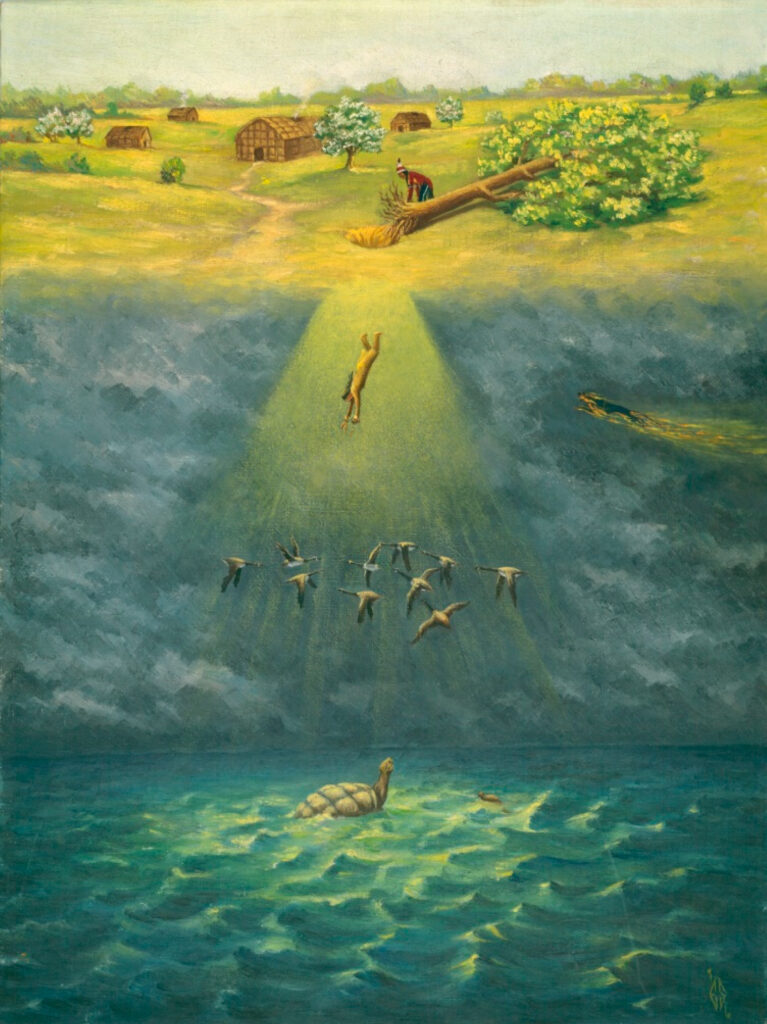
These are only three of the thousands of stories Indigenous peoples tell of their deep time connection with North America. Indigenous stories carry and convey history, but they are thick, spirited histories in which innumerable beings, including humans, animals, spirits, and the earth itself, all play a part. Stories like these are vital components of “Indigenous religious traditions.” They speak to the historical processes, sometimes subtle, sometimes dramatic, through which Indigenous people experienced their spiritual worlds.
III. Place, Power, Protocol
Generalizing can obscure the many unique qualities of individual Indigenous traditions. However, it is possible to identify “family resemblances” among Indigenous religious traditions, especially in the unique interplay between three key concepts: issues of place, of power, and of protocol.5 In this model, “place” refers to both specific landscapes and their characteristics, “power” is a mode of communion between human and other-than-human worlds, and “protocol” refers to ethical systems guiding how people participate in relationships of power.6
Human existence depends on a robust understanding of place. The Karuk Nation along the Klamath River in present-day California embraces the seasonal features of the river as the essential lifeblood of both the people and the river’s salmon, who provide a key symbol for Karuk identity and a model for living life properly. They honor the river through ceremonies involving prayers, fasting, and dances. Through these ceremonies, they call on the river to heal the earth and restore the environment so that it may nurture the people.7
Power has broad applications too. Though it is often used as a synonym for dominance, Indigenous peoples have conceptualized power in multiple ways, including creative power, visionary power, and destructive power. Within Indigenous cosmologies, power invokes consciousness beyond humans. The world is populated by spirited animals, plants, and presences connected to the landscape. For instance, Kachinas, the spirit beings of Pueblo societies, impact the growth of plants, support fertility, and invigorate Pueblo societies at the deepest levels. There is material evidence of Kachina dolls since 1300 CE in Hopi archaeological sites. Further south, another group of Mesoamerican deities appears in material culture, such as the god of rain, known variously as Tlaloc to the Mexica (Aztec), Chac to the Maya, and Cocijo to the Zapotec. Mesoamerican rain spirits populate the archeological record of the early Postclassic Period, dating to approximately 900 CE. Each is distinctive in its own ways, reflecting the lands to which they are connected. For instance, Chac dwells in ancient sinkholes where drinking water could be found in the Yucatán Peninsula. These sacred places are called cenotes. Across the Indigenous Americas, places accrue significance through the spirits that inhabit them. Cenotes and mountains, kivas and temples are all examples of sites where power is concentrated and may be accessed through ceremony.
Place and power connect directly to the concept of protocol, which may be formalized in ceremonial practice. Just as sites are connected with spirit beings and with stories of creation or emergence, protocols and ceremonies are potent communicative forms that express human intentions and responsibilities and reinforce relationships with spirited entities and cosmic forces. Indigenous peoples practiced these rituals at both the common household or family level as well as in organized, external spaces with ritual specialists called “medicine people.” However, this is only an approximation of the many roles, responsibilities, and titles that medicine people have in Indigenous traditions.
The canoe nations of the Pacific Northwest including the Makah, Kwakiutl, Tlingit, and Haida identify a complex system of reciprocity that these navigators enact when they visit neighboring nations. Songs, speeches, and gift exchanges seal relationships that tribal communities acknowledge as their ancestral traditions. In addition to human-to-human etiquette and propriety, these nations use songs, dances, and prayers to express gratitude to oceans, rivers, and sea creatures, thanking them for the gifts they provide the people. Another way of expressing gratitude for the abundance in this region is the potlatch, a ceremonial feast in which wealth is revealed by the quality and quantity of food, regalia, furs and crafts that they offer.8

While it is important to understand how pre-colonial Indigenous peoples oriented themselves to place, power and protocol in an ongoing quest for balance and harmony, such a state was hardly a given.9 Rather, as in every part of the world, attaining and maintaining thriving societies required visionary leadership, technological ingenuity, spiritual insight and, at times, extraordinary acts of personal and communal sacrifice. In many instances, these were in short supply. There are ample stories of times of conflict and crisis across the continent.
A Laguna Pueblo story tells of a time when a young man who liked to play with magic came to town.10 By performing a series of astonishing spectacles, he diverted the people’s attention away from the life-sustaining ceremonies with which they had been entrusted. As a result, Earth Mother gathered her plants, animals, and rain and departed to a third world away from ours. The lush high desert quickly turned into a scorched and barren wasteland, and the people began to suffer and starve. It took the combined efforts of Hummingbird, Fly, and Buzzard, and multiple trips to the third world to convince Earth Mother to return and bring back life to the people and the land. When Earth Mother finally returned, she told the people:
“Stay out of trouble from now on.
It isn’t easy to fix things up again.
Remember that
The next time
Some Ch’o’yo magician comes to town.”11
This story highlights the integral connection between ceremony, political struggle, and ecological crisis. It reminds Pueblo people how easily neglect and carelessness can turn catastrophic and the tremendous effort it requires across multiple domains and species to set the world back in order.

To the Northeast, the Haudenosaunee story of the coming of the Peacemaker and the formation of the Haudenosaunee Confederacy begins during an era of strife. Relations were strained to the point of collapse among and between the Seneca, Onondaga, Cayuga, Oneida, Mohawk, and the earth. When the Creator sent the Peacemaker to repair relations among the nations, the first challenge he encountered was crossing Lake Ontario. To do this, he carved a canoe out of white stone and paddled across – a seemingly impossible vessel for a seemingly impossible task. Then, traveling from community to community, he made his eloquent appeal for peace, with a particular focus on the most belligerent and warped people, both in terms of body and spirit. One of his first supporters was the conflict-loving woman, Jikonhsaseh, who accepted his message and became the first Clan Mother. The Peacemaker’s most formidable opponent was Tadodaho, a man so evil he had snakes as hair and had committed murder. Yet, at long last, confronted by the Peacemaker, Jikonhsaseh, and a man named Hiawatha who was related to those murdered, Tadodaho realized he had met his match. He had a change of heart so profound that it reverberated across the nations and through the generations. He became the first presider over the Grand Council of the fifty chiefs of the Haudenosaunee Confederacy who buried their hatchets and accepted the Law of Peace. The Peacemaker planted a white pine tree as a living witness to this new way of being and relating. Hiawatha created a belt made from purple and white wampum shells which materialized the potency of the covenant of the people with each other, with the water and with the forests.12
IV. Ceremony
Such were the existential crises and conflicts that Indigenous peoples confronted long before the arrival of Europeans. And it was through these that they obtained some of their most powerful insights and received their most potent ceremonies, including the following.
Thousands of people gathered in the immense central plaza of Cahokia. Many arrived from surrounding settlements with food, fuel, pottery, and other offerings. Massive amounts of food sat in ceramic jars and fire burned around the plaza. Performances, including speeches, dances, and music, entertained the multitude as the great feast began. Venison, fish, turkey, maize, fruits, nuts, and more were consumed by the multitude. After the celebration, the ritual continued with a prompt and respectful cleaning of the plaza. The refuse was carefully gathered and buried. Scholars disagree as to whether these events were used by leaders to assert their power or whether these events were bottom-up articulations of community identity. Either way, these gatherings and ceremonial feasts help create a sense of cultural unity around the peak of Cahokia in 1050 CE. These rituals bound together the largest city to exist north of the Rio Grande River until 1800.13
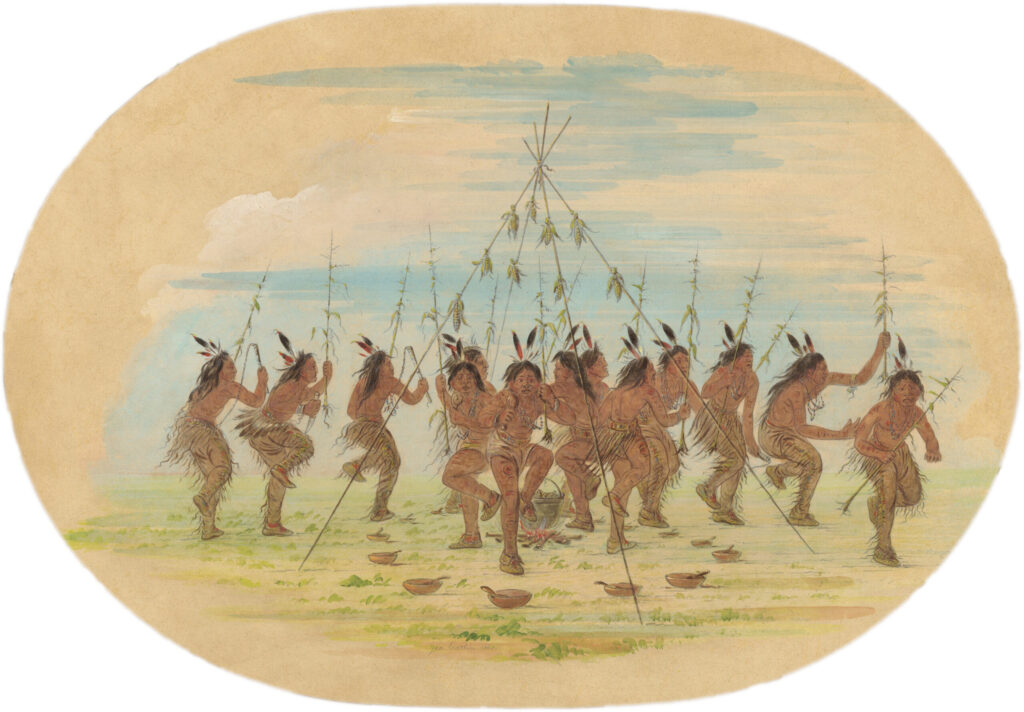

Further to the south and east, other Indigenous people practiced a similar feasting ritual. As the summer ended and maize began to ripen, the Green Corn Ceremony, sometimes known as the Bust, began. No one was allowed to eat this new harvest until the ritual was complete. But first, the community had to purify themselves. Families discarded broken materials, swept their homes, and generally cleaned their community and their souls. Many people fasted and avoided sex. Elders prepared special medicine using herbs and roots. Fires were put out to symbolize the end of the old cycle. And then elders lit a new flame that others used to light their own fires, connecting families, the community, and cosmos as a whole. After this purification, the party began. Dancing, singing, drumming, games, and more reverberated through the community. The harvest was then taken, and daily life resumed.14
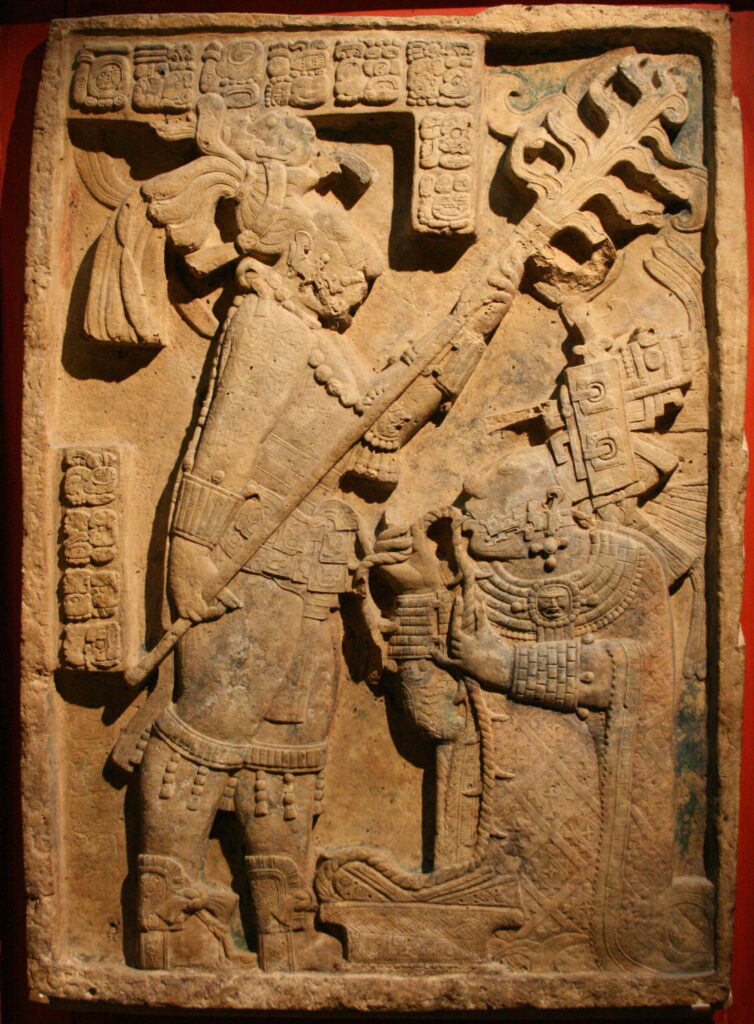
Still further to the south, one night in the mid-720s CE, the ruler of Yaxchilan, Itzaamnaj B’ahlam II and his wife Lady K’ab’al Xook, adorned themselves in elaborate regalia invoking spirits, animals and ancestors, and made their way into a fire-lit chamber. K’ab’al Xook knelt in front of Itzaamnaj B’ahlam II and offered him her tongue. Taking a blade-tipped rope laced with obsidian barbs, he drove the point through the tongue’s pink flesh. When the blood sacrifice was complete, K’ab’al Xook returned to her feet with less blood in her veins, but much more power; power she would carry into her long life as a royal woman.15
The lintel that memorializes Lady K’ab’al Xook’s ritual is one of many testaments to the range of bloodletting techniques commonly practiced in Mesoamerican cultures. Through these practices, people forged visceral connections with each other and their spirited worlds through carefully orchestrated, and importantly non-fatal, ritual performances. These included blood offerings by bleeding earlobes, tongues, and other body parts.
For contemporary First Nations peoples, Native American nations and tribes, and Indigenous Mesoamericans, these stories are not traces of a bygone past nor are their worlds ended; their stories are rivers of meaning and power that continue to vitalize nations and worlds across vast geographies and form vital connections between ancestors, contemporary communities, and future generations.
As Momaday tells us: “I was not there. My father was there when he was a boy. He told me of it. And I was there.” We were not there when Skywoman danced the world into existence on Turtle’s back, or the morning Dragonfly prayed the sun up over the plains, or the night Lady K’ab’al Xook performed her ritual. We were not there to witness the blossoming of human societies and their “religions” on this continent. Nor were we there when worlds, long separated by oceans, clashed together.
V. European Conflict
On July 24th, 1534, a group of Indigenous people enjoyed their prime fishing spot in the mouth of the St. Lawrence River, and watched with interest, then alarm, as Jacques Cartier and his French-commissioned crew conducted a ceremony around their newly erected 30-foot cross. The next day, Donnacona, a leader of the Indigenous community Cartier identifies as Stadaconans, approached the ship “and made to us a harangue showing us the cross and marking the said cross with his two fingers, and then showed us the country all about us as if he wished to say all the country was his, and that we should not plant the said cross without his leave.”16
This encounter reveals a conflict that would vex Indigenous-European relations for centuries: Europeans understood religion through a heaven-dwelling God, often (though not always) accompanied by the conviction that God had given the earth as an inheritance to the people of his kingdom. Indigenous people believed spiritual power emerged from the navigating and sustaining of an intimate relationship with spirited places.17 When people from across the Atlantic began arriving in the North American continent, the push and pull between these perspectives remade the world.18
Europe had, for centuries, experienced transformative religious conflicts between varieties of Christian, Judaic, and Islamic religious traditions. After nearly eight centuries of Muslim rule, the capture of Grenada in 1492 by Christians meant that Spanish Jews and Muslims were given the choice to either convert or be forcibly expelled from their homes.
The conquest of Grenada occurred the same year as Christopher Columbus’s Spanish-sponsored voyage to, by happenstance, the Taíno island of Guanahaní. Columbus exported Spain’s systematic persecution of non-Catholics across the ocean.19 The Tribunal of the Holy Office of the Inquisition, chartered just a few decades earlier by Pope Sixtus IV, gave a theological and legal structure to this violent persecution.20 The Spanish Inquisition echoed other forms of religious violence in neighboring European lands. Throughout the continent, Jews experienced persecution through false accusations of horrific crimes, as did individuals accused of witchcraft.
The rise of the Ottoman Empire in Eastern Europe, Western Asia, and North Africa contributed to a climate of fear and hostility toward Muslims and the Islamic world within Christian Europe.21 And, as various reform movements, including the (Protestant) Reformation and the responding Catholic Reformation (or Counter-Reformation), challenged existing power structures, wars broke out in Europe, spilling blood for over a century, from 1522 to 1648.
Meanwhile, the recent availability of mass-produced books exposed Europeans to philosophical, scientific, and religious ideas from Greco-Roman antiquity and the Islamic world.22 Johannes Gutenberg, a metalworker and craftsperson, combined centuries of printmaking to produce the first mechanical moveable-type printing press around 1440. The machine was used first to print Gutenberg’s version of the Bible, in 1455, and six decades later to disseminate Martin Luther’s theological manifesto, The Ninety-Five Theses.23 Thus began the Protestant Reformation.
VI. Religion in England
In England, Luther’s ideas proved less influential than King Henry VIII’s personal vendetta against the Pope. After Pope Clement VII refused to allow Henry to annul his marriage to Catherine of Aragon, Henry rejected papal authority, and by 1534, Henry was named the supreme head of the Church of England.
On a theological level, the new Church of England had a lot in common with the Roman Catholic Church it replaced. For many English Protestants, the two were too similar, and these tensions would cause conflict over the coming centuries. Yet Henry’s seizure of monasteries from 1536 to 1540 brought radical change. Vast tracts of land and the expensive buildings they hosted were confiscated, and much of the wealth of the church flowed to the Crown and its allies.24
For many English people, this was a dramatic and sometimes traumatic change. These tensions caused one of the most significant rebellions in all of English history. In 1536, as many as 30,000 villagers, nobles, clergymen, and merchants all banded together behind the lawyer Robert Aske. They marched through northern England in protest of what they saw as an attack on the true faith. Eventually, however, this movement, called the Pilgrimage of Grace, was suppressed, and Aske and others were executed. Crushing the rebellion proved Henry’s authority over matters of religion.25
After Henry died in 1547, the advisors to his young son Edward VI made even more dramatic changes, including issuing the Book of Common Prayer, which united practice among adherents to the Church of England, called Anglicans. Many of the more dramatic changes which occurred under Edward were quickly reversed after he died in 1553 and his half-sister Mary I restored Catholicism in England.
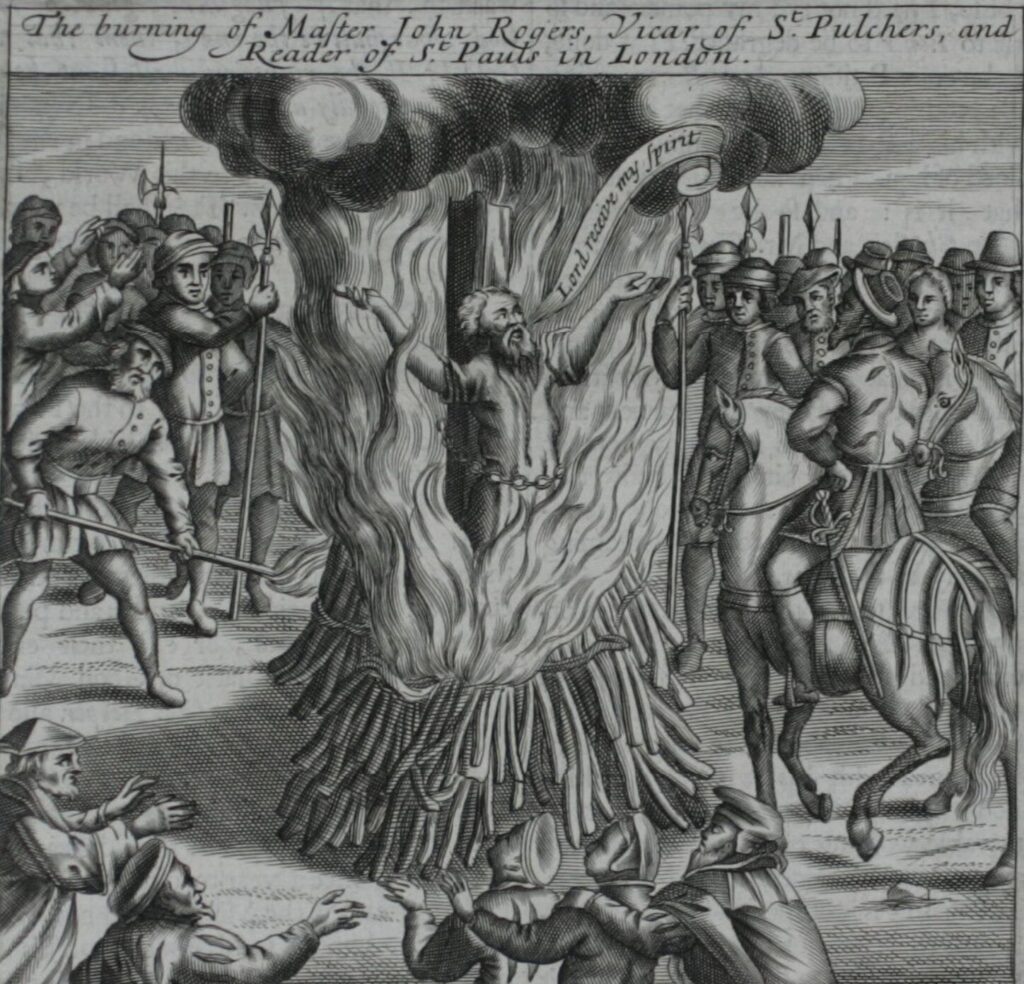
Mary’s government ordered the execution of nearly 300 men and women. These deaths were memorialized in a widely read book commonly called Foxe’s Book of Martyrs that fueled generations of hatred toward Catholicism among English Protestants.26 Mary herself died after only five years, and her successor Elizabeth I adopted a less coercive approach than either Edward or Mary. In what became remembered as the Elizabethan Settlement, England adopted a moderate Protestant theology that maintained many traditional Catholic ceremonies while asserting the supremacy of the Crown over the church.27
Religious life in England centered not on decrees from the halls of power but rather the rhythms of the local parish church. The Book of Common Prayer included scripture in English and united the nation as parishioners across the nation generally recited the same prayers and followed the same religious calendar.
VII. Iberian Catholicism at Sea
Partly because of its religious instability, England remained behind several other European nations in engaging the rest of the world. Spain, and especially Portugal, led the way. Technologies included new shipbuilding, navigation, and cartography, alongside the rise of banking, which helped enable the emergence of a new merchant class. The caravel, a small, shallow-riding ship developed in the early 1500s, allowed the Portuguese to embark on significant nautical voyages south first to the Canary Islands, then along the coast of Western Africa, around the southernmost tip of the continent, and eventually to the Indian subcontinent.28 European traders connected with traffickers in the Bight of Benin and elsewhere in Western Africa, exchanging both people and material goods.29

These markets birthed the Atlantic slave trade. From the early sixteenth century to around 1650, this trans-oceanic trade in human life was dominated by agents of the Iberian Peninsula, but sustained by English, French, and Dutch investment, as each nation attempted to establish a colonial footing in the Western hemisphere.30 Across this period, Portuguese-African alliances disseminated a form of Christianity that ran alongside, rather than replaced, Indigenous African religions.
The Indigenous West African religious worlds these European colonizers encountered were multifaceted and diverse, containing innumerable overlapping and distinct cultures and peoples. In this early modern period, these worlds were rooted in oral traditions that were highly respected and sometimes even privileged over the written word. Islam had also been present in West Africa since the 8th century, and Muslims enjoyed considerable influence due to widespread literacy, among other factors.
Daily life, even in remote regions, often involved accommodating and even drawing on different cultures, languages, and religions. For example, for protection from evil spirits, someone might wear verses from Muslim scripture, sewn into a leather pouch, while also offering sacrifices to one or more local gods for help in overcoming a disease, and simultaneously honoring traditional protocols so as not to offend an ancestor. Flexibility with practices, and even beliefs, brought religious experimentation. For example, if a god or an ancestor was petitioned to heal a disease, but did not answer the prayer, the community might try a different god, until they found something that worked. West Africans brought this experimental mindset into both Christianity and Islam, despite hostility from some adherents.
As Europeans spread outward from their continent towards Africa and especially the Americas, they were immediately confronted with people and places beyond their stories and cosmologies. Where did Indigenous peoples fit in the family tree of biblical human genealogy? Did they show any traces of a “correct” understanding of God? Were they salvageable and saveable? If so, how? These were the kinds of questions Europeans pondered and debated at length. In the Valladolid debates in the mid-sixteenth century, Bartolomé de las Casas and Juan Ginés de Sepúlveda battled over Indigenous humanity. In North America, seventeenth-century Puritans debated whether Indigenous peoples could be truly converted or whether they must undergo a complete civilizing program first.31
Indigenous peoples’ humanity was at stake in these debates, but Indigenous people almost never had any say in the matter. But, there are moments when Europeans put their questions directly to Indigenous people. In 1679, two Dutch Labadist priests asked a Lenape elder named Jasper “where he believed he came from. He answered: from his father.”32 The Dutchmen, like many of their European contemporaries, had little appreciation for Indigenous humor, or for Indigenous cosmologies. The priests roundly dismissed Jasper’s story when he related that the Earth was formed when a tortoise surfaced out of a vast ocean: “the tortoise gradually raised its round back up high, and thus the earth became dry” and that humans had been formed out of a tree that grew atop the tortoise’s earthen back.33
The first Dutch Reformed pastor to arrive in Mannahatta (or, to him, New Amsterdam) in 1628 proposed an ominous solution for Indigenous souls: “they ought in youth to be separated from their parents; yea, from their whole nation. For without this, they would forthwith be as much accustomed as their parents to their heathenish tricks and devilries.”34 With little capacity to consider Indigenous people or cosmologies on their own terms, European colonists of nearly every nation labeled these people “heathen,” and dismissed their ceremonies as “sorcery” and “witchcraft.”35


The Catholic Church, the dominant authority in Western Europe, used papal decrees such as the 1493 bull Inter caetera to lend religious legitimacy to these colonial projects.36 Later, papal bulls, or letters, would provide the theological foundations to a settler-colonial legal framework known today as the Doctrine of Discovery.37 Pope Nicholas V wrote the first two: Dum Diversas, in 1452, and Romanus Pontifex, in 1455. The bulls authorized European monarchs like King Alfonso V of Portugal to “invade, search out, capture, vanquish, and subdue” anyone deemed a Muslim or pagan, forcing them into “perpetual slavery.”38 The Pope also stated that the lands of such individuals were to be “converted” for the “use and profit” of those monarchs. In short, any place and any non-Christian person must surrender both lands and peoples to the Portuguese crown. Through conquest and missionary efforts, the Catholic Church managed to grow in influence despite losing power to reform movements within Europe. Catholicism became what some historians have called “the world’s first truly global religion.”39
VIII. English Colonies
Forty-five years after the 1534 Act of Supremacy, in a harbor somewhere slightly north of the present-day San Francisco Bay, a male Miwok leader delivered an oration in the Coast Miwok language, accompanied by a performance of bloodletting by a group of Miwok women, to a company of Englishmen who had cast anchor in their waters.40 Upon this, Church of England priest Francis Fletcher, chaplain for Sir Francis Drake’s voyage circumnavigating the globe, responded to their Indigenous hosts with a series of Anglican “prayers, singing of psalms, and reading of certain chapters in the Bible,” projecting for likely the first time Anglican doctrine on North American soil.41
Jamestown, established in 1607, was England’s first permanent colonial settlement in North America and one of the first strongholds of Anglicanism on the continent.42 Powhatan religious practice touched every aspect of communal life, including death, illness, farming, warfare, and political authority. English colonists described the beliefs of these people by saying that they acknowledged a creator called Ahone and a spiritual force of chaos called Okee or Okeus. The English often misinterpreted Indigenous beliefs by forcing them into Christian categories, trying to see Ahone as God and Okee as Satan. But the Powhatan people did not divide the world into simple categories of good and evil, and instead they saw spiritual power as more complex and omnipresent. Similarly, the English interpreted Powhatan religious leaders, called kwiocusuk, as ministers when instead they are better understood as teachers, healers, or ritual directors.43
A famous example of English misunderstandings of Indigenous religious practice comes from the writing of John Smith. Smith was taken captive in December of 1607 and brought to a place called Werowocomoco on what came to be called the York River. Religious leaders there performed a ritual to evaluate the meaning of Smith’s presence among them. Smith claimed that the chief’s young daughter Matoaka (also known as Pocahontas) then saved his life, but given his misunderstandings of what was happening, it is unlikely that he had much of any idea of what was happening in these rituals.44
![A woodcut of Native Americans in a longhouse. A man with a headress sits elevated facing the foreground. Two figures sit at his side and 19 others are below, crowded around a fire. Across the bottom of the image is "Powhatan [in large bold letters] followed by Held this state & fashion when Capt. Smith was delivered to him prisoner 1607." To the right, Appamatuck is identified as a small settlement.](https://www.thunderinggods.com/wp-content/uploads/2026/08/Powhatan_john_smith_map-712x1024.jpg)

The events at Werowocomoco follow a pattern of cultural misunderstanding that accelerated as Virginians seized more and more land to cultivate tobacco. Tobacco was a labor-intensive crop, and soon Virginians brought Africans to perform the hard labor. Due to those long-standing relationships between European Christianity and Indigenous African religion mentioned earlier, a significant minority of these African laborers did not experience Christianity as a foreign religion. Many had been baptized as children, grown up with Afro-Catholic rituals around Christmas and Easter, knew the Lord’s Prayer in their local languages, were familiar with European burial rituals, and sometimes turned for solace to the Virgin Mary.
Unlike the Spanish, White Virginians tried to aggressively prevent enslaved people from practicing or participating in religions they deemed dangerous, especially Christianity. One Virginian law decreed in 1667, “baptisme doth not alter the condition of the person as to his bondage or ffreedome,” providing a unique theological justification for the lifelong and inheritable form of racialized enslavement practiced by Anglo-American colonizers.45
The People of the First Light, or the Wampanoag, experienced a different form of English settlement in their homelands to the north.46 In November of 1620, a group of English Puritans came aground the abandoned Wampanoag village of Patuxet, tucked in the curve of present-day Cape Cod Bay, and declared “blessed the God of Heaven who had brought them over the vast and furious ocean, and delivered them from all…perils and miseries.”47
According to the Mayflower Compact, the Puritan settlers said that they had come to North America to honor God and spread Christianity by establishing a colony in what they called the northern part of Virginia. To accomplish those goals, they agreed to join together as a “Civil Body Politic”—a self-governing political community—and to create and obey laws that would help them achieve those religious purposes.48
Among the most powerful dissenters to the Church of England were a group of English Protestants whose theological roots lay with the French Reformation leader John Calvin, who pushed for a more thorough Reformation. Two groups of English Calvinists settled in what became Massachusetts. The first were Separatists who had given up on the Church of England and abandoned the nation of their birth, first for the Netherlands and then for Plymouth, Massachusetts. These people are now remembered as Pilgrims. A slightly later group of English Calvinists still believed that the Church of England could be saved, or purified. These people, called Puritans, occupied lands stretching from what is now called Salem and Boston. After just a few decades, both communities of Calvinists would blend.49
Puritans believed that God commanded them to seize and “improve” Native American lands.50 Religious leader and first governor of the Massachusetts Bay Colony, John Winthrop told his fellow colonists in 1630 that “the eyes of all people are upon us.” He believed that success would come when “men shall say of succeeding plantations, ‘may the Lord make it like that of New England,’” for he and his constituents would strive to create a “city upon a hill.”51 As scholar Carolyn Merchant puts it, to the minds of those like the New England Puritans, “God had authorized human dominion over the earth.”52
In actualizing their claims to Wampanoag, Nipmuc, Narragansett, and Pequot lands, Puritan and Pilgrim settlers relied primarily upon efforts to missionize, and eventually assimilate, the Indigenous peoples of whom they were guests. But this process proved slower than they expected, and so Puritan settlers turned to genocidal violence. During the Pequot War of 1636-38, colonists sought to annihilate Pequot peoples from their lands.53 Just forty years later, widespread Indigenous resistance mounted by Wampanoag leader Metacomet confined English settlement in the region to coastal holdings.54 But over the course of what became known popularly as King Philip’s War (1675–1678), Puritans retaliated by decimating local Native communities, murdering thousands of Native peoples, imprisoning others on islands, or selling whole communities into enslavement.55
Simultaneously, a conflict over religious authority gripped Puritan New England from 1636 to 1638. Reverend John Wheelwright, Anne Hutchinson, and their followers mounted religious opposition to their colony’s leaders and ministers. These events are known as the Antinomian Controversy.56 Hutchinson, a Puritan woman, stoked outrage for hosting private meetings for women to discuss and comment on sermons and New England civic life. She was eventually convicted of heresy and exiled from the colony alongside Wheelwright.57
By the end of the seventeenth century, American Puritanism was slowly absorbed into other Protestant denominations. The Half-Way Covenant of 1662 and the rise of evangelicalism meant that, by the eighteenth century, their beliefs and their politics meant that they no longer were Puritans.58
IX. Indigenous Responses
The influx of very different peoples, materials, epidemics, and religiosities challenged Indigenous spiritual systems. On a winter’s day in 1647 on Cape Cod, three decades after an epidemic called the Great Dying that killed tens of thousands of Northeast Native people, a Nauset man told Puritan missionaries about a dream he had years earlier.59 In his dream, a white man arrayed in black clothing came to him, brandishing an “English book” and declaring “that God was moosquantum or angry with them and that he would kill them for their sinnes.” The Nauset man questioned the Englishman about the safety and provision of his family until the imposing Englishman “smil’d upon him, and told him that he and his Papooses should be safe, and that God would give unto them mitcheu (i.e.) victuals and other good things so he awakened.”60 Notably, for the Nauset man, dreamwork, nourishment, responsibility, and religiosity were all integrally connected. The Nauset man’s dreamworld experience is one of innumerable instances in which Indigenous people plunged into the cosmological borderlands between Indigenous and colonial realms and redirected the detrimental force of colonial religiosity toward Indigenous power.
In the borderlands between Indigenous nations and New France, Kateri Tekakwitha, a Mohawk woman living from 1655 to 1680, and Marie Rouensa, a Kaskasia woman living from 1677 to 1725, often pressed their Catholic practice well beyond the colonial comfort zones of their French Jesuit spiritual directors and connected with Indigenous cosmographies of the Great Lakes.61 The Powhatan woman Matoaka (known also as Pocahontas) traveled to England in 1616 at age twenty as a devout Anglican and Indigenous diplomat, turning the Atlantic Ocean into a space where there was no clear-cut boundary between gender roles, Indigeneity, power, and cosmology. And she was not alone.62
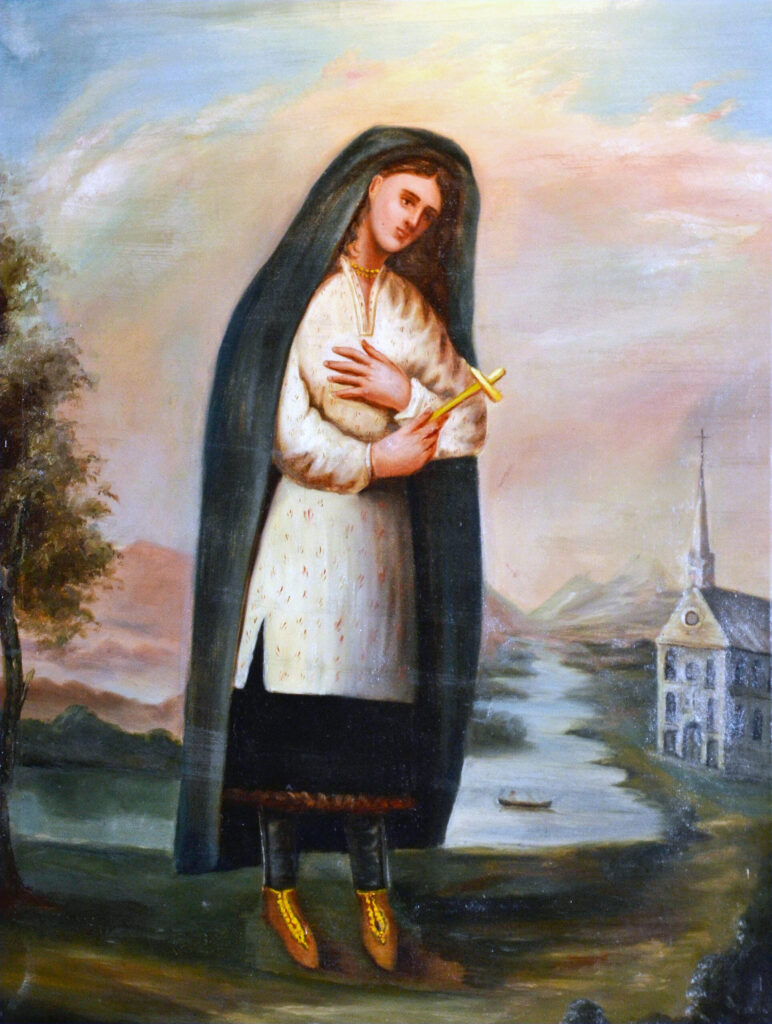
In the mid-seventeenth century Northeast, the Mashpee Wampanoag tribe decided together to incorporate a Christian Indian Town to maintain social cohesion.63 Later in the eighteenth century, under the influential leadership of Mohegan Presbyterian clergyman Samson Occom, Native Christians in southern New England determined that they would not only be better off removing themselves from settler society, but would also be better missionaries to their Native Haudenosaunee kin than the English, and founded an entire Native Christian nation they called Brothertown.64 These Borderlands Indigenous movements complicate the categories of religious studies as well as historical periodization.
These cosmological and physical borderlands were navigated also by Africans and African Americans who had been violently taken from their Indigenous homelands. The twelve million Africans enslaved across the Atlantic generally fall into two religious camps, with some overlap between the two. The first is Islam, and the second is the constellation of beliefs described as traditional African religions.
As the trafficking of enslaved Africans expanded in the seventeenth and eighteenth centuries, Afro-Atlantic Catholics from areas with a historically strong Portuguese influence adopted a syncretic form of Christianity that blended Catholic rituals with Indigenous African elements.
Muslim Africans did the same as well, except with a head start of about 700 years. As members of a global religion, these Indigenous Muslim Africans were often literate and able to make connections with fellow believers of different ethnicities in the course of their removal from their homelands. Though pluralist experimentation was typically discouraged in Islamic traditions, which, like Christianity, insisted upon exclusivity as a matter of principle, the centuries preceding the Atlantic slave trade saw long periods of West African religious tolerance between Indigenous religions and Islam punctuated by sharp crackdowns intended to “purify” the faith.65 Disappeared to the Americas and cut off from the Muslim communities of their homelands, many Muslim Africans participated in Christian church life, with their children sometimes becoming Christians themselves.
Over centuries of painstaking experimentation, African Americans of all religious backgrounds sifted through various religious raw materials, including multiple Christian traditions, African religions, expressions of Islam, and Indigenous North American cosmologies, translating all of these into a unique and authentic version of religious practice that spoke to their experiences and needs.66
From the homelands of the Wampanoag to the waters of the Miwok and since the earliest days of Indigenous-European interaction, Christian cosmology could compel some of the greatest atrocities against Indigenous people. But it could also check some of the most vicious aspects of colonization. Colonists used religious arguments to justify violence against Indigenous peoples, including separating children from their parents, dispossessing them of their best lands, pressing them into unfree labor, suppressing religious ceremonialism, regulating and punishing sexuality, and, in some cases, destroying Indigenous lives and communities altogether.67 At the same time, within each colonial enterprise, some colonists and communities sought more humane and peaceable engagements with Indigenous people, as seen, for example, in Las Casas’ A Short Account of the Destruction of the Indies (1542), Roger Williams’ A Key into the Language of America (1643), and in Moravian experiments of alternative kinship and community in Lenape homelands in the eighteenth century.68
Violence and coercion washed over American lands in the sixteenth through the eighteenth centuries. So too did resourcefulness and creativity. Sometimes it was unclear where violence ended, and creativity began. In the Southwest, Pueblo villages incorporated Catholicism deep into the fabric of their social and ceremonial life; so much so that even in the aftermath of the Pueblo Revolt of 1680, a Pueblo person (likely a woman) drew a simple but striking image on a rock wall: a feminine bust rendered in pared-down, form-forward Pueblo fashion and with the distinct crown of the Virgin Mary.69 Exactly a century before, in 1580, a Mixtec-Christian community near Oaxaca painted a riveting map of their cosmos after a massive epidemic.70
X. Conclusion
Indigenous spiritual stories flow together like rivers we can see, and like rivers we cannot see. The 1613 Two Row Wampum Belt, recording a treaty between the Haudenosaunee and their Dutch guests, captures one path for understanding the origins of American religious history. As Ray Fadden Tehanetorens explains:
“These two rows symbolize two paths or two vessels, traveling down the same river [of life] together. One, a birch bark canoe, will be for the Indian People, their laws, their customs, and their ways. The other, a ship, will be for the white people and their laws, their customs, and their ways. We shall each travel the river together, side by side, but in our own boats. Neither of us will make compulsory laws or interfere in the internal affairs of the other. Neither of us will try to steer the other’s vessel.”71
Of course, much of the early history of colonization involved considerably more coercion. European settlers attempted to replace Indigenous beliefs with their own. Despite tremendous violence, they never fully succeeded.
XI. Reference Material
This chapter was edited by Saffron Sener and Anthony Trujillo, with content contributions from Molly Harbour Bassett, Elisha Chi, Matthew Crow, Jeroen Dewulf, Petra Peter Gardella, Paul Grant, Dennis Kelley, Rebecca Mendoza, Piper Milton, Emily Pothast, Saffron Sener, Anthony Trujillo, and Ben Wright.
Recommended Reading
- Ned Blackhawk, The Rediscovery of America: Native Peoples and the Unmaking of U.S. History (Yale University Press, 2023).
- Ryan Carr, Samson Occum: Radical Hospitality in the Native Northeast, Religion, Culture, and Public Life (Columbia University Press, 2023).
- Jorge Cañizares-Esguerra, Puritan Conquistadors: Iberianizing the Atlantic, 1550–1700 (Stanford University Press, 2006).
- Eamon Duffy, The Stripping of the Altars: Traditional Religion in England, 1400–1580 (Yale University Press, 1992).
- Michael Gomez, African Dominion: A New History of Empire in Early and Medieval West Africa (Princeton University Press, 2018).
- Allan Greer, Property and Dispossession: Natives, Empires and Land in Early Modern North America (Cambridge University Press, 2018).
- Jennifer Scheper Hughes, The Church of the Dead: The Epidemic of 1576 and the Birth of Christianity in the Americas, North American Religions (New York University Press, 2021).
- Robin Wall Kimmerer, Braiding Sweetgrass: Indigenous Wisdom, Scientific Knowledge and the Teachings of Plants (Milkweed Editions, 2013).
- Tracy Neal Leavelle, The Catholic Calumet: Colonial Conversions in French and Indian North America (University of Pennsylvania Press, 2011).
- Dana Lloyd, Land Is Kin: Sovereignty, Religious Freedom, and Indigenous Sacred Sites (University of Kansas Press, 2023).
- Kathryn Gin Lum, Heathen: Religion and Race in American History (Harvard University Press, 2022).
- Jean M. O’Brien, Dispossession by Degrees: Indian Land and Identity in Natick, Massachusetts, 1650–1790 (Cambridge University Press, 1997).
- Helen C. Rountree, “Powhatan Priests and English Rectors: World Views and Congregations in Conflict,” American Indian Quarterly 16 (1992): 485–500.
- Jace Weaver, The Red Atlantic: American Indigenes and the Making of the Modern World, 1000–1927 (University of North Carolina Press, 2014).
- Rachel M. Wheeler, To Live upon Hope: Mohicans and Missionaries in the Eighteenth-Century Northeast (Cornell University Press, 2008).
Notes
- N. Scott Momaday, Earth Keeper: Reflections on the American Land (Harper, 2020), 7. ↩︎
- This is a reference to the opening lines of the L.P. Heartley novel, The Go-Between (1953). ↩︎
- Bill Reid, The Raven Steals the Light (University of Washington Press, 1984). “Quileute Tribe,” Quileute Tribe, as of 2024, https://quileutenation.org/stories-and-tales/. ↩︎
- Robin Wall Kimmerer, Braiding Sweetgrass: Indigenous wisdom, scientific knowledge and the teachings of plants (Milkweed Editions, 2013). “Creation Story: As told by Amos Christjohn,” Oneida, as of 2026, https://oneida-nsn.gov/our-ways/creation-story/. ↩︎
- See Ludwig Wittgenstein, Philosophical Investigations, translated by G. E. M. Anscombe (Macmillan, 1958) for his use of this concept. Here “family resemblances” follows the conventions of Humanities and Social Science discourse. ↩︎
- Dennis Kelley, “If Native American Religious Traditions Are Place-Based, How Do ‘Urban Indians’ Practice Their Religion?” in Indigenous Religious Traditions in 5 Minutes, eds. Molly H. Bassett and Natalie Avalos (Equinox Publishing, 2022), 140. ↩︎
- Dana Lloyd, Land Is Kin: Sovereignty, Religious Freedom, and Indigenous Sacred Sites (University of Kansas Press, 2023); and J. Greeley, “Water in Native American spirituality: Liquid life — blood of the earth and life of the community,” Green Humanities: A Journal of Ecological Thought in Literature, Philosophy & the Arts, 2 (2017): 157-179. ↩︎
- Sara Florence Davidson, Potlatch as Pedagogy: Learning through Ceremony (Portage & Main Press, 2018). ↩︎
- Vine Deloria Jr., “Sacred Lands and Religious Freedom,” American Indian Religions: An Interdisciplinary Journal 1, no. 1(1994): 73-83. ↩︎
- Julianna Barr, “There’s No Such Thing as ‘Prehistory’: What the Longue Durée of Caddo and Pueblo History Tells Us about Colonial America,” The William and Mary Quarterly 74, no. 2 (2017): 203-240. ↩︎
- Leslie Marmon Silko, Storyteller (Penguin, 1981), 111. ↩︎
- This is a synopsis of the story related by the Onondaga Nation. “History,” Onondaga Nation, as of 2026, https://www.onondaganation.org/history/. ↩︎
- Timothy R. Pauketat et al, “The Residues of Feasting and Public Ritual at Early Cahokia,” American Antiquity 62, no. 2 (2002): 257-279. ↩︎
- Charles M. Hudson, The Southeastern Indians (University of Tennessee Press, 1976) and Patricia Galloway, Choctaw Genesis, 1500-1700 (University of Nebraska Press, 1995). See also Robbie Ethridge, From Chicaza to Chickasaw: The European Invasion and the Transformation of the Mississippian World, 1540–1715 (University of North Carolina Press, 2010). ↩︎
- Lintel 24, c.723-726, The Yaxchilan Lintels, The British Museum, London, as of 2026, https://www.britishmuseum.org/collection/object/E_Am1923-Maud-4. ↩︎
- James Phinney Baxter, Jean François de La Roque Roberval, and Jean Alfonce, A Memoir of Jacques Cartier, Sieur de Limoilou: His Voyages to the St. Lawrence, a Bibliography and a Facsimile of the Manuscript of 1534 with Annotations, (Dodd, Mead & Co. 1906) 112. ↩︎
- See: Vine Deloria Jr., “Thinking in Time and Space” in God Is Red (Grosset & Dunlap, 1973); Brian Burkhart, “Philosophical Colonizing” in Indigenizing Philosophy through the Land: A Trickster Methodology for Decolonizing Environmental Ethics and Indigenous Futures (Michigan State University Press, 2019); Pamela E. Klassen, “Back to the Land and Waters: Futures for the Study of Religions.” Religion 50, no.1 (2020): 90–96; Jennifer Graber and Pamela E. Klassen, “North America, Turtle Island, and the Study of Religion,” Numen 67 no.2–3 (2020): 313–25. ↩︎
- Michel-Rolph Trouillot, “North Atlantic Universals: Analytical Fictions, 1492-1945,” The South Atlantic Quarterly 101, no. 4 (2002): 854; and An Yountae, “A Decolonial Theory of Religion: Race, Coloniality, and Secularity in the Americas,” Journal of the American Academy of Religion 88, no. 4 (2020): 947–80. ↩︎
- Encyclopædia Britannica Online (2020), under “Reconquista,” https://hvd.primo.exlibrisgroup.com/permalink/01HVD_INST/726dgh/cdi_britannica_eb_62907. ↩︎
- Lu Ann Homza, ed., The Cambridge Companion to the Spanish Inquisition (Cambridge University Press, 2026). ↩︎
- David S. Areford, The Viewer and the Printed Image in Late Medieval Europe (Ashgate, 2010); and Charles Zika, The Appearance of Witchcraft: Print and Visual Culture in Sixteenth-Century Europe (Routledge, 2007). ↩︎
- Peter Stallybrass, “‘Little Jobs’: Broadsides and the Printing Revolution,” in Agent of Change: Print Culture Studies After Elizabeth L. Eisenstein, eds. Sabrina Alcorn Baron, Eric N. Lindquist, and Eleanor F. Shevlin (University of Massachusetts Press, 2007); Christopher Wild and Ulrike Strasser, “Introduction,” in Cultures of Communication: Theologies of Media in Early Modern Europe and Beyond, eds. Helmut Puff, Ulrike Strasser, and Christopher Wild (University of Toronto Press, 2017). ↩︎
- James Moran, Printing Presses: History and Development from the Fifteenth Century to Modern Times (Faber, 1973). ↩︎
- G. W. Bernard, The King’s Reformation: Henry VIII and the Remaking of the English Church (Yale University Press, 2005). ↩︎
- Eamon Duffy, The Stripping of the Altars: Traditional Religion in England, 1400–1580 (Yale, 1992). ↩︎
- John N. King, Foxe’s Book of Martyrs and Early Modern Print Culture (Cambridge University Press, 2006). ↩︎
- Diarmaid MacCulloch, The Later Reformation in England, 1547–1603, 2nd ed. (Palgrave Macmillan, 2001). ↩︎
- David Eltis and David Richardson, Atlas of the Transatlantic Slave Trade (Yale University Press, 2019). ↩︎
- Eltis and Richardson, Atlas of the Transatlantic Slave Trade, “Part 1.” ↩︎
- Eltis and Richardson, Atlas of the Transatlantic Slave Trade, “Part 1.” ↩︎
- Nelson Maldonado-Torres, “AAR Centennial Roundtable: Religion, Conquest, and Race in the Foundations of the Modern/Colonial World,” Journal of the American Academy of Religion 82, no. 3 (2014): 636–65; and Linford D. Fisher and Lucas Mason-Brown, “By ‘Treachery and Seduction’: Indian Baptism and Conversion in the Roger Williams Code,” The William and Mary Quarterly 71, no. 2 (2014): 175. ↩︎
- Jasper Danckaerts and Peter Sluyter, Journal of a Voyage to New York and a Tour in Several of the American Colonies in 1679-80 (The Society, 1887), 150. ↩︎
- This is one of many creation stories from Eastern Woodlands Indigenous nations that tells why North America is often referred to as “Turtle Island.” Danckaerts and Sluyter, Journal of a Voyage to New York, 150-151. ↩︎
- Letter of Jonas Michaelius, 1628, in Narratives of New Netherland, 1609-1664, ed. J. Franklin Jameson (Barnes & Noble, 1953), 122-133. ↩︎
- Kathryn Gin Lum, Heathen: Religion and Race in American History (Harvard University Press, 2022); Jorge Cañizares-Esguerra, Puritan Conquistadors: Iberianizing the Atlantic, 1550-1700 (Stanford University Press, 2006). ↩︎
- Pope Alexander VI, “Inter caetera,” May 4, 1493, in Encyclopedia Virginia, Virginia Humanities, under “Inter caetera, by Pope Alexander VI (May 4, 1493),” as of 2026, https://encyclopediavirginia.org/primary-documents/inter-caetera-by-pope-alexander-vi-may-4-1493/. ↩︎
- Indeed, in the 1823 U.S. Supreme Court case of Johnson v. M’Intosh, Miller writes that, “the U.S. Supreme Court repeatedly stated in Johnson that the Doctrine and the loss of rights suffered by Indian Nations were based on the justifications of Christianity and civilization.” [Robert J. Miller, “The Doctrine of Discovery: The International Law of Colonialism,” The Indigenous Peoples’ Journal of Law, Culture, & Resistance 5 (2019): 35–42, 38.] And as Indigenous studies scholar Joanne Barker (Lenape) notes “The rights to jurisdiction and territory were modeled on concepts of individual personal freedom and linked to both secular and Christian ideologies about civilization.”[Joanne Barker, “For Whom Sovereignty Matters,” in Sovereignty Matters: Locations of Contestation and Possibility in Indigenous Struggles for Self-Determination, ed. Joanne Barker, Contemporary Indigenous Issues (University of Nebraska Press, 2005), 1–31, 3.] Indigenous and African peoples — always deemed less civilized than Christian Europeans — were not granted rights to their religion, culture, families, or original territories. The doctrine of discovery is a principle of international law that continues to dispossess Indigenous peoples today. ↩︎
- Frances Gardiner Davenport, ed., European Treaties Bearing on the History of the U.S. and Its Dependencies to 1648 (Carnegie Institution of Washington, 1917), https://archive.org/details/europeantreatie00paulgoog, 23. Today, Guanahaní is known as the island of San Salvador. ↩︎
- Wild and Strasser “Introduction” in Cultures of Communication. ↩︎
- Christopher Hodgkins, “Stooping to Conquer: Heathen Idolatry and Protestant Humility in the Imperial Legend of Sir Francis Drake,” Studies in Philology 94, no. 4 (1997): 428-464; and “Coast Miwok,” California Language Archive, as of 2026, https://cla.berkeley.edu/languages/coast-miwok.html. ↩︎
- Sir Francis Drake, The World Encompassed by Sir Francis Drake Collected Out of the Notes of Francis Fletcher, and Compared with Divers Others Notes that Went in the Same Voyage (Printed for Nicholas Bourne, 1652), 72; and Hodgkins, “Stooping to Conquer,” 430. ↩︎
- Karen Ordahl Kupperman, Roanoke: The Abandoned Colony (Rowman & Littlefield Publishers, 2007). ↩︎
- Helen C. Rountree, “Powhatan Priests and English Rectors: World Views and Congregations in Conflict,” American Indian Quarterly 16 (1992): 485–500. ↩︎
- John Smith, The Generall Historie of Virginia, New-England, and the Summer Isles (1624), book 3. See also Rountree, “Powhatan Priests,” and Helen C. Rountree, The Powhatan Indians of Virginia: Their Traditional Culture (University of Oklahoma Press, 1989). ↩︎
- Virginia General Assembly, “An act declaring that baptisme of slaves doth not exempt them from bondage” (1667), in The Statutes at Large; Being a Collection of All the Laws of Virginia from the First Session of the Legislature, in the Year 1619, ed. William Waller Hening (R. & W. & G. Bartow, 1823), 2:260, Encyclopedia Virginia, as of 2026, https://encyclopediavirginia.org/primary-documents/an-act-declaring-that-baptisme-of-slaves-doth-not-exempt-them-from-bondage-1667/. ↩︎
- jessie little doe baird, “History and Culture of the Mashpee Wampanoag,” Mashpee Wampanoag, as of 2026, https://mashpeewampanoagtribe-nsn.gov/culture. ↩︎
- Robert V. Hine and John Mack Faragher, Frontiers: A Short History of the American West (Yale University Press, 2007), 25; William Bradford, Of Plimouth Plantation, ed. Samuel Eliot Morison (Alfred A. Knopf, 1952), 61. ↩︎
- Bradford, Of Plimouth Plantation, 75-6. The “Northern Parts of Virginia” refers to the lands in and around present-day Plymouth, Massachusetts. ↩︎
- K. David Goss and A.A. Grishin, Colonial America: Facts and Fictions (Bloomsbury Publishing USA, 2021), 51. ↩︎
- John Winthrop, The History of New England from 1630 to 1649, ed. James Savage (Little Brown and Company, 1853), 30. ↩︎
- John Winthrop, “A Model of Christian Charity,” in A Library of American Literature: Early Colonial Literature, 1607-1675, eds. Edmund Clarence Stedman and Ellen Mackay Hutchinson(Charles L. Webster & Company, 1892), 304-307. ↩︎
- Carolyn Merchant, The Death of Nature: Women, Ecology, and the Scientific Revolution (Harper & Row, 1980) 131. ↩︎
- Benajamin Madley, “’Too Furious’: The Genocide of Connecticut’s Pequot Indians, 1636-1640” in The Cambridge World History of Genocide (Cambridge University Press, 2023), 215. ↩︎
- Jill Lepore, “What’s in a Name,” in The Name of War: King Philip’s War and the Origins of American Identity (Penguin Random House, 1998); See also: Ned Blackhawk, The Rediscovery of America: Native Peoples and the Unmaking of U.S. History (Yale University Press, 2023). ↩︎
- For a discussion over the naming of this conflict, see: Lisa Brooks, “Introduction: Language: Naming War” in Our Beloved Kin: A New History of King Philip’s War (Yale University Press, 2018), 7-10. ↩︎
- Karyn Valerius, “‘So Manifest a Signe from Heaven’: Monstrosity and Heresy in the Antinomian Controversy,” The New England Quarterly 83 no. 2 (2010), 179; David Hall, “Introduction” of The Antinomian Controversy, 1636–1638: A Documentary History (Duke University Press, 1990). ↩︎
- David Hall, “Introduction,” 6. ↩︎
- The Half-Way Covenant of 1662 was an agreement made by Puritan ministers that “allowed…parents who had themselves been baptized but not converted to bring their children to be baptized” [Jonathan Den Hartog, “Politics: Colonial Era,” in Encyclopedia of Religion in America (CQ Press, 2010), 1676]. As a result, baptism took on “not only religious but also political meanings for inducting members into the Puritan commonwealth,” and the strictures of Puritanism ties to the New England colonies softened [Hartog, “Politics: Colonial Era,” 1676]. Thomas S. Kidd, “What Happened to the Puritans?” Historically Speaking 7, no.1 (2005), 32. ↩︎
- On early epidemics see: David S. Jones, Rationalizing Epidemics: Meanings and Uses of American Indian Mortality since 1600 (Harvard University Press, 2004). ↩︎
- Thomas Shepard, The Clear Sun-Shine of the Gospel Breaking Forth upon the Indians in Nevv-England. Or, An Historicall Narration of Gods Wonderfull Workings upon Sundry of the Indians, Both Chief Governors and Common-People, in Bringing Them to a Willing and Desired Submission to the Ordinances of the Gospel; and Framing Their Hearts to an Earnest Inquirie after the Knowledge of God the Father, and of Jesus Christ the Saviour of the World. / By Mr. Thomas Shepard Minister of the Gospel of Jesus Christ at Cambridge in New-England. (London, England, 1648), 8-11. ↩︎
- Tracy Neal Leavelle, The Catholic Calumet: Colonial Conversions in French and Indian North America (University of Pennsylvania Press, 2011); Mary Dunn, “Making Miracles Efficacious: Katherine Tekakwitha, Miraculous Cures, and Relational Networks in Seventeenth-Century New France” in Religious Intimacies: Intersubjectivity in the Modern Christian West, eds. Brenna Moore and Mary Dunn (Indiana University Press, 2020), 65-86; Allan Greer, Mohawk Saint: Catherine Tekakwitha and the Jesuits (Oxford University Press, 2005). ↩︎
- Coll Thrush, Indigenous London: Native Travelers at the Heart of Empire (Yale University Press, 2016); Camilla Townsend, Pocahontas and the Powhatan Dilemma: an American Portrait (Hill and Wang, 2004); Jace Weaver, The Red Atlantic: American Indigenes and the Making of the Modern World, 1000-1927 (The University of North Carolina Press, 2014). ↩︎
- Jean M. O’Brien, Dispossession by Degrees: Indian Land and Identity in Natick, Massachusetts, 1650–1790 (Cambridge University Press, 1997); James Cedric Woods, “A Comparative Study of the Evolution of Tribal Governance at Mashantucket Pequot and Mashpee Wampanoag” (PhD diss., University of Connecticut, 2007), https://digitalcommons.lib.uconn.edu/dissertations/AAI3252606/. ↩︎
- Ryan Carr, Samson Occum: Radical Hospitality in the Native Northeast, Religion, Culture, and Public Life (Columbia University Press, 2023); Hilary E. Wyss and Anthony Trujillo, “Samson Occom, Joseph Johnson, and New England Native American Evangelicalism,” in The Oxford Handbook of Early Evangelicalism (Oxford University Press, 2022). ↩︎
- On West African Muslim imperialism, see Michael Gomez, African Dominion: A New History of Empire in Early and Medieval West Africa (Princeton University Press, 2018). ↩︎
- The term “translation” here means more than linguistic recoding. A term used in the field of World Christianity to differentiate cultural accommodation of the Christian message from “diffusion,” or imposing one’s original message, “translation” requires active intellectual engagement by the people who will ultimately own the message. Lamin Sanneh, Translating the Message: The Missionary Impact on Culture (Orbis, 2009). ↩︎
- Greer, Property and Dispossession; Deborah A. Miranda, “Extermination of the Joyas: Gendercide in Spanish California,” GLQ 16, no. 1–2 (2010): 253–84; Madley, “‘Too Furious’; Andrés Reséndez, The Other Slavery: The Uncovered Story of Indian Enslavement in America (Houghton Mifflin Harcourt, 2016); and Thomas Wickman, “Our Best Places: Gender, Food Sovereignty, and Miantonomi’s Kin on the Connecticut River,” Early American Studies: An Interdisciplinary Journal 19, no. 2 (2021): 215–63. ↩︎
- Rachel M. Wheeler, To Live upon Hope: Mohicans and Missionaries in the Eighteenth-Century Northeast (Cornell University Press, 2008). ↩︎
- Matthew Liebmann, Revolt: An Archaeological History of Pueblo Resistance and Revitalization in 17th Century New Mexico (University of Arizona Press, 2012), Chapter 7. Andrea McComb Sanchez, Of Corn and Catholicism: A History of Religion and Power in Pueblo Indian Patron Saint Feast Days (University of Nebraska Press, 2025). ↩︎
- Jennifer Scheper Hughes, The Church of the Dead: The Epidemic of 1576 and the Birth of Christianity in the Americas, North American Religions (New York University Press, 2021), Chapter 4. ↩︎
- Tehanetorens, Wampum Belts of the Iroquois (Ohsweken: Iroqrafts, 1983) 73-74. ↩︎