
You are reading a working draft of The Palace of Thundering Gods, a living history project built through scholarly collaboration. Please click here to help improve this chapter.
I. Introduction
Jonathan Edwards claimed that the millennium would commence in America, and by 1835, Rev. Lyman Beecher agreed. Born on the eve of the Revolution, Beecher’s enthusiasm for evangelism and moral reform led him to help found the Domestic Missionary Society in 1820 and the American Temperance Society in 1826. As Unitarianism eroded the reformed tradition in the Northeast, Beecher went west in 1832 to serve as the first president of Lane Theological Seminary in Cincinnati. From this seat, Beecher argued that America, “blessed with such experimental knowledge of free institutions, with such facilities and resources of communication,” was “destined to lead the way in the moral and political emancipation of the world” through its Christianization.1
In “A Plea for the West,” Beecher argued that America’s unique religious and civil liberties provided the opening for the work, but that the work itself was in the West. “[A] young empire of mind, and power, and wealth,” the Western territories of the growing nation offered opportunities for revenue, population growth, and political power. Beecher called for an investment of Protestant money and personnel in churches and schools to ensure that “moral culture” was part of this colonial rush. The fate of the nation and the world was at stake. As he put it, “the religious and political destiny of our nation is to be decided in the West.”2
For American Protestants like Beecher, it seemed like the dawn of a Christian empire was at hand. Beecher sensed the very real tensions inherent in a country founded as a republic on paper and an empire in practice, one in which all men were created equal under God but weren’t treated so under the law. This great diversity of religious belief and practice would test the national experiment by highlighting the contradictions built into its system of government,
Religious rhetoric seemed to support both the nation’s rapacious growth and the arguments of those who would curb it. It would provide a framework for challenging slavery and a framework for enlarging it. It would underpin efforts to reimagine fundamental institutions like the family and resist the entrenchment of market capitalism, and to enforce family norms and that same market capitalism. While the Civil War is often framed as a conflict between state and federal power, those were merely the units used to express a far more fundamental conflict that took place throughout the American empire: who, exactly, had been created equal—and was that equality to be found in this world, or only in the next?
II. Continuing Reform
The Second Great Awakening had swelled the ranks of many white Protestant churches in the United States, especially in the Northeast, and after the first quarter of a century, they seemed poised to expand further, fulfilling Beecher’s charge. The circuit riders and revival preachers who had lit fires in upstate New York looked to bring their tactics to the ever-advancing frontier. In fact, they believed it was imperative to do so. Even as they praised the growing wealth of the nation, many worried about the damage that unrestrained capitalism might do to the moral fabric of the nation. Protestant Christianity and family life were seen as bulwarks against that unraveling, and the frontier seemed to be a clear danger zone, populated disproportionately by single men animated by the pursuit of money, not the desire to create families and communities. Conversely, religious leaders also worried about the similar populations of single men and women who moved to the growing cities and industrial towns of the eastern seaboard, impelled there by the same forces that drove others westward.
The spirit of voluntarism and evangelism united many Protestants. Yet many agreements to work across denominational divides foundered in the 1830s. The 1801 Plan of Union that had bound Presbyterians and Congregationalists was dissolved in 1837 by the more theologically conservative wing of the Presbyterian Church, a dissolution which also resulted in the division of the Presbyterian Church itself, as “New Lights” persisted in the ecumenical collaboration and revivalism that their “Old Light” colleagues rejected.
Many claimed for their own denomination the mantle of the “primitive,” rooted in the practices of the early Church, or split away from their existing churches to restore it. Unitarianism, a primitive movement away from Congregationalism that included rejecting the Trinity, had solidified its place as one of the chief faiths of Massachusetts elites, even capturing the established churches that still received public funding. Methodists and Baptists developed primitive wings in the 1830s, both of which rejected ecumenical association. Others wanted to eliminate the denominational divisions that were dividing Christians and “restore” one church. To the west, two religious movements led by Barton Stone and the father-son pair of Thomas and Alexander Campbell joined forces in 1831 to do this. Stone and Alexander Campbell insisted that theirs was a movement without denomination, calling themselves “Christians” or “Disciples of Christ,” even as they hashed out key points of doctrinal agreement like adult baptism.3
Whether ecumenical or firmly denominational, the white Protestants who worked for the salvation of all continued to maintain strict racial boundaries in their earthly churches. In areas with free Black populations, primarily in the northern states, independent Black churches like the African Methodist Episcopal church saw significant growth in this period. Allen’s successor Morris Brown, worked to build a broader North American organization, welcoming Canadian churches full of formerly enslaved Black Americans.4
Shared across all of these churches was an optimism about the possibilities of individual salvation and, for some denominations, perhaps even perfection. The natural extension of this faith in the individual was the belief that society itself could be perfected through the collective workings of individual Americans. In 1836, Charles Grandison Finney distilled the optimism of the age into a call to his followers to go out into the world and do good: “Because you have all the powers of moral agency; and the thing required is, not to alter these powers, but to employ them in the service of your Maker. God has created these powers, and you can and do use them.”5 Lyman Beecher believed that he already knew what institutions were necessary for the maintenance of a moral society: the family, the school, the church, the marketplace, and the mission. Moral reform efforts were therefore best directed towards persuading or coercing individuals to operate within the boundaries of those institutions, which would in turn curb destructive impulses to intemperance and infidelity.
III. New Faiths
Ensuring the ability of all to read and understand the Bible had been a pillar of American Protestantism since the colonial period, but the boundaries of religious innovation had always been policed, socially and even legally. In this moment, however, it was as if the boundlessness of the American religious imagination had not only empowered individuals to receive grace through their own efforts, but also to re-imagine the nature of religious belief. This transformation unfolded through both individual revelation and individual reason, often at the same time.
The Unitarian belief that Christ’s divinity consisted in his perfection of the religious faculties that all human beings possessed laid the groundwork for the emergence of Transcendentalism’s rejection of all religious authority outside of the individual, whose soul contained all that was necessary for knowledge and understanding of the divine. Rather than chaos, Transcendentalists believed that this approach could—with the proper support—lead all humans to an understanding of the divine, whatever its nature. Despite its articulation and modern reputation as a quintessentially American set of beliefs, Transcendentalism’s roots lay in the writings of European philosophers and theologians, as well as ancient Sanskrit texts like the Bhagavad Gita, a product of the rich transatlantic print culture of the 19th century.6
The egalitarian impulses of the Second Great Awakening led to thousands of Americans affiliating with the Methodists and Free Will Baptists, who had rejected Calvinist views that salvation was only available to the elect. Other Americans were drawn to even more egalitarian religions like the Universalists, who believed that individual reason was sufficient for accessing the divine and that salvation was guaranteed to all, negating the need for individual conversion.
William Miller and his followers represented the fluidity of religious affiliation that was common in this period. Born into a Baptist family, Miller later became a Deist and struggled to reconcile these two faith traditions through intense Bible study. He claimed to have discovered the date and time of the Second Coming encoded as prophecy in the book of Daniel: October 22, 1844.7 Tens of thousands of Americans, mostly from evangelical Protestant traditions, came to believe in Miller’s prophecy. When Jesus did not return in 1844, a moment tactfully referred to as “The Great Disappointment,” most followers joined other churches, including smaller marginal groups like the Shakers, or became unbelievers. Others confidently attempted to wrangle the predicted date and the prophecy into something new, spawning a family of Adventist churches. One group believed Miller’s date had marked something important—the beginning of a period of judgment for humankind preceding the Second Coming—and established the Seventh-Day Adventist Church, keeping Saturday as the Sabbath. Miller’s prophecy and the adaptations of his believers illustrate the religious confidence and creativity of the period.
![A Chronological Chart on a tan, roughly woven fabric of the Visions of Daniel and John. This chart includes events from 700 BC to 2520 AD and predicts the end of days based on Biblical information and interpretation. On the top left is a large silhouette of a person that represents various kingdoms labeled: Babylon over the head, Mercia (across his chest, Persia (over his left folded arm), Grecia across the lower abdomen, and pagan Rome across his calves. The feed are covered with “The Ten Kingdoms.”
Just below the "The Ten Kingdoms" is a line separating the three kingdoms of the Ostrogoths 377, Vandals 407, and Heruli 476. To the right, the chart reads "These three kingdoms were taken by Justinian (a Greek) Emperor of Constantinople, whose decree made the Bishop of Rome, supreme head of the churches in 538." To the left of the line are the kingdoms of the Visigoths 378, Huns 356, Franks 407, Saxons 476, Sueves 407, Bergundians 407, and Lombards 384. Below that is an inscription that reads "These are the ten horns or kingdoms into which Rome was first divided; they are not mingled with the seed of men and do not cleave one to another. Daniel 2:43."
The language continues with “44th verse. And in the days of these kings, shall the God of heaven set up a kingdom, which shall never be destroyed, and the kingdom shall not be left to other people but it shall break in pieces and consume all these kingdoms and it shall stand forever. 45th verse. For as much as thou sawest that the stone was cut out of the mountain without hands, and that it breaks in pieces the iron, [a torn piece is missing] the brass, the clay, the silver and the gold, the Great God hath made known to the king [torn but missing piece added] what shall come to pass hereafter. And the dream is certain and the interpretation is therefore sure.
On the left side at the head and flowing downward is written “Daniel 2 Chapter. Thou art this head of Gold, 28 verse. 39 verse And after thee shall arise another kingdom inferior to thee. And another third kingdom of Brass which shall bear rule all over earth. 40 verse And the fourth kingdom shall be strong as iron.” Next to the silhouette are animals associated with each kingdom.
To the right of the silhouette are verses: “Daniel 7 chap 3rd verse. And four great beasts came up from the sea, diverse one from another. The first was like a lion and had eagles wings. The [?] held till the winds thereof were plucked and was lifted from the earth and made to stand upon the feet as a man, and a man’s heart was given to it. Images as described are shown with the large word “Babylon.” Underneath that is the “5th verse, And behold another beast, a second like to a bear, and it raises up itself on one side, and it had three ribs in the mouth of it between the teeth of it and they said thus unto it. Arise, devour much flesh.” Between the words top to bottom is the image described. To it’s right is labeled “Media and Persia” to the right of which is a ram. Above this image is “Vision of the Ram and the Goat. 8 chap, 20th Daniel. The ram which though sawest, having two horns are the kings of Media and Persia.” It continues, “21st verse. And the rough goat is the king of Grecia and the horn between his eyes is the first king. Now that being broken.” Here is another goat image as described below which the language continues, “whereas four stood up for it, four kingdoms shall stand up and of the nation, but not in his power. And in the latter time of their kingdom, when the trangressors are come to the full, a long pf foerce cpimtemamce amd imderstamdomg darl sentences shall stand up. And his power shall be mighty, but not by his and the holy people. And through his policy also destroy many, he shall also stand up against the. 7th verse. After this I saw in the night visions, and behold a fourth beast, dreadful and terrible and strong exceedingly; and it had great iron teeth. It devoured and brake in pieces and stamped the residue with the feet of it, and it was diverse from all the beasts that were before it, and it had ten horns. 23rd verse Interpretation of 7 verse. Thus he said the fourth beast shall be the fourth kingdom upon earth which shall be diverse from all kingdoms and shall devour the whole earth, and shall tread it down, and break it in pieces. And the ten horns out of this kingdom are ten kings that shall arise, and another shall rise after them and he shall be diverse from the first, and he shall subdue three kingdoms.” This has the beast described just below the passage.
In the center and to the right are columns of Biblical numbers and dates from top to bottom of the page. It reads “Israel carried captive 2 Chron. 33-11. 677 Commencement of the seven times. Leviticus 26:28 to 34. Overthrow of ancient Babylon. 4. 30-31. 538. 457 Going forth of the to restore and build Jerusalem. Ex ra 7-8. Commencement of 2300 days. Dan 8:9. Alexander the great overcame the Persians 332 years before Christ see Josephus Ant.1:11 c. 8.” A horn is labeled, “The little horn waxed exceeding great.” To the right of the horn is the number 164 and the phrase, “Death of Antiochus Epiphanes, who of course stood not up against the Prince of Princes; as he had been 164 yrs. Dead before the prince of princes was born.” Below that is 158, and “Time of the league, between the Jews and Romans, 158 years, before Christ 1st Mar 9th chap. 70-71.”
Below this is the image of a Crucifix with Jesus nailed to it. Intertwined with the image are the words, “Rome, Pagan & Papal. Own power and he shall destroy wonderfully, and shall prosper, and shall destroy the mighty he shall cause craft to prosper in his hand, and he shall magnify himself in his heart, and by peace shall be de-...but she shall be broken without hand. And the vision of the evening and the morning which is told is true; wherefore shut thou up the vision; for it shall be for many days. Of all the powers, named in these visions, none but Pagan Rome could stand up against the Prince of Princes, as this only prevailed, during the life of Christ. Syria became a province of Rome 65 yrs. Before Christ, see Whelpleys Compend, page 120. Of course Pagan Rome only could stand up against the Prince of Princes, Pagan Rome commences the little horn of Daniel 8-9, terminating the papacy at the end of 2300 days.
In the next column, “2520 7 times, 677 2 Chron, 33:11, 1843 Termination of 7 times. 2300, 457, 1843. Termination of 2300 days and end of Indignation Dan 8:11 to 20.” To the right of this “Leviticus 23:28 to 34, 12, 84 Months, 30 days denoting years, 2520. 7 times.” A passage from Rev. 12th, 34th verses “And there appeared another wonder in heaven; and behold a great red dragon, having seven heads and ten horns, and seven crowns upon his heads. And his tail drw the third part of stars (seen in an image) of heaven and did cast them to the earth, and the dragon stood before the woman which was ready to be delivered for to devour her child as soon as it was born, Matt 2nd: 13th verse. Arise, and take the young child and his mother and flee into Egypt and be thou there until I bring thee word. For Herod will seek the young child to destroy him.” Below this is the multi-headed red beast, below which is written, “16th verse Then Herod, when he saw that he was mocked of the wise men, was exceeding wroth and sent forth and slew all the children that were in Bethlehem, and in all the coasts therof, from two years old and under, according to the time which he had diligently inquired of the wise men. Thus Pagan Rome stood against Christ the Prince of Princes, and at last crucified him. Rev 13:1 And I stood upon the sand of the sea and saw a beast rise up of the sea, having seven heads and ten horns, and upon his horns ten crowns, and upon his heads the name of blasphemy. And the beast which I saw was like unto a leopard, and his feet were as the feet of a bear, and his mouth as the mouth of a lion and the Dragon gave him his power, and his seat, and great authority. Rev 13:5. And power was given unto him to continue forty and two months. 7th to make war with the saints, and to overcome them.
In the lower right, people labeled “Mahometans” are seen riding horses as well as another lion-like creature labeled “Papal Rome.” The passage for this image from Rev 9:7 “And the shapes of locusts were like unto horses prepared unto battle: on their heads, were as it were crowns like gold and their faces were as the faces of men. Firearms first used on horseback by the Turks (fact in history).”Just to the right of the Turk is an angel with a horn and the passage, “Rev 9th, 1st 606 year, 5th trumpet commenced sounding.” Symbolic numbering is seen again: “508 Taking away of daily Dan 12:11, 1335 Daniel 12:12, 1843 7th Trumpet 3rd Woe. Rev 11: 15.” An angel is again seen blowing a trumpet.
In the last of three columns near the top are the words "A Chronological chart of the visions of Daniel & John. Published by J.V. Himes, 14 Devonshire St. B.W. Thayer & Co. Lithography, Boston." The rest of the words are indecipherable. Attributed to Josua Vaughn Himes, 1843.
The bottom prominently reads “1843 GOD'S EVERLASTING KINGDOM 1843.”](https://commons.wikimedia.org/wiki/File:A_Chronological_Chart_of_the_Visions_of_Daniel_and_John.jpg)
While Miller saw no need for moral reform efforts, others who did questioned whether the fundamental institutions of human society were up to the task of creating a holy society. Anxieties over economic status and gender relations drove many to question the norms of American society. For some, these questions led them to affiliate with existing groups like the Shakers, whose communities grew significantly in this period. For others, their explorations led to new religiously inspired communities that experimented with ways of holding property, sharing responsibilities, and even constituting romantic and sexual relationships.
The Burned-Over District of Upstate and Western New York produced new experiments in living, including the utopian Oneida Community. Founded by John Humphrey Noyes in 1848, its residents practiced “complex marriage” (sexually open marriages) and communalism. Transcendentalists, inspired by the writings of the French intellectual Charles Fourier, established short-lived communities like Bronson Alcott’s Fruitlands and George and Sophia Ripley’s Brook Farm, both of which struggled to balance the challenging labor needed for material self-reliance against the desire for time spent on intellectual and spiritual growth. Brook Farm’s participants provide further examples of the spiritual mobility of this age. Isaac Hecker began as a Methodist, engaged in a period of searching at Brook Farm, and became a Catholic, while his friend-turned-frenemy Orestes A Brownson began life as a Presbyterian, became a Universalist, then went through a period of unbelief, and then embraced Transcendentalism, before finally becoming a Catholic.8
Raised in the Burned-Over District, Joseph Smith Jr. spent his young adulthood in a part of the country that would not have looked askance at most of Brownson’s religious wanderings. Smith was born to a Methodist mother whose conversion had come as the result of a vision in a dream. His father hailed from a family of Universalists and skeptics. Finding themselves in poverty as a result of bad harvests, medical bills, and getting swindled by a business acquaintance, Joseph and Lucy moved their family to Palmyra, New York, just east of Rochester. As a young man, Smith attended revivals and read the Bible but found himself spiritually unsatisfied. He gained a reputation for his visions and for using special stones that could lead to buried treasure.
Miller and Noyes reread the Bible to find new prophecies and new ways of imagining society, but Smith’s visions led him to a new scripture entirely. In 1823, a vision of an angel told him he was to be “the conduit for God’s voice,” and directed him to gold plates buried nearby that would, when translated, tell the history of those who had lived in North America in the distant past. Smith revealed these visions to his family; with their support, he translated the gold plates in secret with the use of seer stones over several years and published the Book of Mormon in 1830.

This deeply American religious text positioned Indigenous Americans as descendants of a family of dissenting Israelites. After his resurrection, Jesus ministered to these Native Americans. This, plus the unearthing of the plates from American soil itself, “sacralized and Christianized the ground upon which the young United States was built.” The text is dominated by named men, good and evil, and a distrust of democracy in favor of kingly and prophetic leadership, despite centering personal liberty and agency as key to salvation.9
Smith and his followers chose to establish a new church in 1830 and used all the tools of the First Amendment to build and defend it. Following further revelations that helped determine the organizational structure of this new denomination, Smith ordained other men as “elders,” giving them the authority to baptize. Over the next few years, Smith would issue hundreds more revelations, and a growing group of followers accepted these as scripture, even those that spoke to and expanded on Biblical stories. When his second elder questioned the church’s baptismal requirement, which was not found in the Book of Mormon, Smith received a revelation that commanded obedience to his revelation. Unsurprisingly, this bold new church ruffled the feathers of locals, and church members would soon embark on the first of several moves over the next fifteen years, transplanting themselves to Kirtland, Ohio in early 1831.
Only a few months later, in June 1831, Smith received a revelation declaring Missouri to be “the land of promise & the place for the City of Zion.” Thereafter, his followers began steadily relocating from Ohio to Missouri, even as converts from America and England swelled Kirtland’s population. Even after attempting to create Mormon-only counties in the state, relations between Latter Day Saints and their neighbors increasingly deteriorated. After a conflict that saw two Mormons and one state militiaman die, Missouri Governor Lilburn Boggs issued an executive order in 1838: “the Mormons must be treated as enemies, and must be exterminated or driven from the State, if necessary, for the public good.” Falling back across the river to Illinois, a new revelation inspired them to buy land along a bend in the Mississippi River. In 1840, these settlers received a charter for their newest Zion, a city called Nauvoo in Illinois. They built a temple—and built up a militia, using it and the legal rights of their city to protect Smith from extradition back to Missouri.10
One local newspaper editor was concerned that the Mormons had “[stepped] beyond the proper sphere of a religious denomination, and become a political body.”11 The editor was not wrong to see political ambitions. In addition to ensuring that followers voted as a bloc in local elections, Smith announced a bid for the presidency in 1844, while also presiding over a private group establishing a political kingdom of God in which priesthood leadership served as a living constitution.12
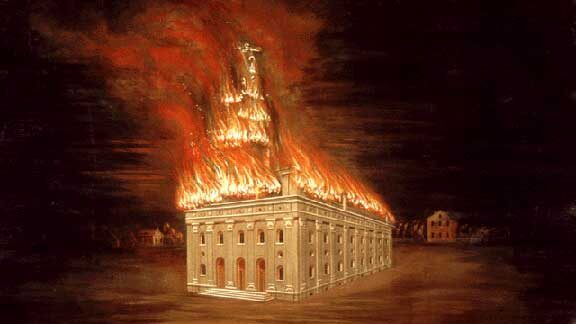

The downfall of Nauvoo would come from within the church’s membership itself. In June 1844, a group of Mormon dissenters published the only issue of the Nauvoo Expositor, which confirmed revelations that Smith had endeavored to keep secret for two years: that marriages sealed by the power of Mormon priesthood were vital, and that those marriages were to be polygamous, central to an “eternal patriarchal structure” that would populate the earth. Before Smith’s first wife Emma threatened him with divorce in 1843, he had married over thirty additional wives without her knowledge.13 The Nauvoo city council ordered the destruction of the Expositor‘s press, and the dissenters fled. But the damage was done. In the aftermath, Smith was charged with treason and imprisoned with several others in Carthage, Illinois. Two weeks later, men stormed the jailhouse and assassinated Smith alongside his brother Hyrum.
Over the next six months, “new citizens” moved in to stake a claim in Nauvoo; its city charter was revoked by January 1845, and the men charged with Smith’s murders were eventually acquitted. Feeling pressured and vulnerable, the majority of Latter Day Saints, now under the direction of Brigham Young, decided to abandon their newly finished temple. In early 1846, they headed West in waves towards a new home in the Salt Lake Valley, which appealed to them because it was outside of American jurisdiction. In this flight from their own oppression and towards a new Zion, they manifested their religious destiny by colonizing land already inhabited by others. Within a year, however, this area became part of the United States at the conclusion of the Mexican-American War. Church leaders immediately petitioned for statehood for the Utah Territory as the State of Deseret but were rebuffed for decades, in part because of their refusal to eliminate plural marriage.14
In this period of excitement, Americans believed they could reinterpret or discover new scripture and change our understanding of human history, economic relationships, the family, and salvation itself. Some even believed that humans could communicate with the dead. Many Americans were happy to dabble in folk religions and the occult alongside their existing affiliations, freely consulting mesmerists and clairvoyants and seers even as they went to services and revivals. They may even have seen Andrew Jackson Davis, the “Poughkeepsie Seer,” who began a new religious movement in the mid-1840s that came to be called Spiritualism. He attracted a significant following for his heterodox teachings about death, which he argued was pleasant, and the afterlife, which, like Universalists, he believed was open to all. But it was his ability to commune with ghosts and other psychic feats that drew people to him. This “Harmonial Circle” engaged in the typical patterns of missionary work: commissioning itinerant missionaries, publishing books and newspaper articles, and holding well-attended lectures.
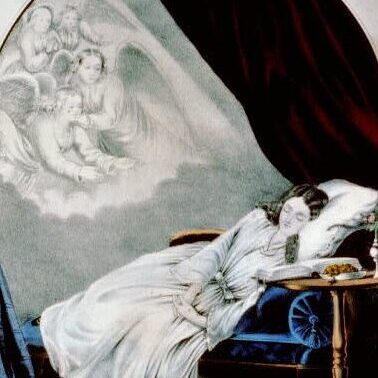

Unsurprisingly, the occurrence that brought Spiritualism into mainstream consciousness occurred in the Burned-Over District that had been home to Smith’s early revelations and Miller’s great disappointment. In 1848, Kate and Maggie Fox, 11 and 14 respectively, heard an eerie rapping within their walls, one that seemed to come from an immaterial mind that responded to queries. “Mr. Splitfoot,” as they named the spirit, revealed himself to be a peddler buried in the basement of their home.15 Soon the whole town was involved, and though a body was never found beneath the house, the girls became national celebrities and relocated to New York City, where Davis had also located his ministry. Spirit circles soon developed, as well as new societies organized around the movement, which found supporters in William Lloyd Garrison, the abolitionist, Horace Greeley, the newspaper editor, and Queen Victoria.
In an 1841 sermon, Unitarian William Ellery Channing traced the shape of Transcendentalism: “Thought frees the old bounds to which men used to confine themselves. . . . Men forget the limits of their powers. They question the infinite, the unsearchable, with an audacious self-reliance….”16 His assessment reflects much of this intellectual and spiritual moment, one in which Americans not only felt they could question with audacious self-reliance, but answer those questions with the same audacity.
IV. Conquest and Missions
When Lyman Beecher spoke in 1836 of “the West,” the United States claimed sovereignty over the territories known as the Old Northwest and the Old Southwest, most of which lay east of the Mississippi River. But “the West” was already much larger in the American imagination, and through imperial wars, would quickly grow to span the continent. This push for territorial acquisition was not without controversy, especially after the Missouri Compromise, but the argument published in John O’Sullivan’s 1845 newspaper was widely shared by white Americans: that it was their “manifest destiny to overspread the continent allotted by Providence for the free development of our yearly multiplying millions.” This belief in the territorial destiny of white America supposedly contained within it the belief in a sacred duty to convert the continent’s “heathens,” caring little for Native peoples’ own religious traditions that had served them for thousands of years. With money from the Boston-based American Board of Commissioners for Foreign Missions (ABCFM), the federal government’s Civilization Fund, and private fundraising campaigns on the Eastern Seaboard, missionaries fanned out across these new territories.17
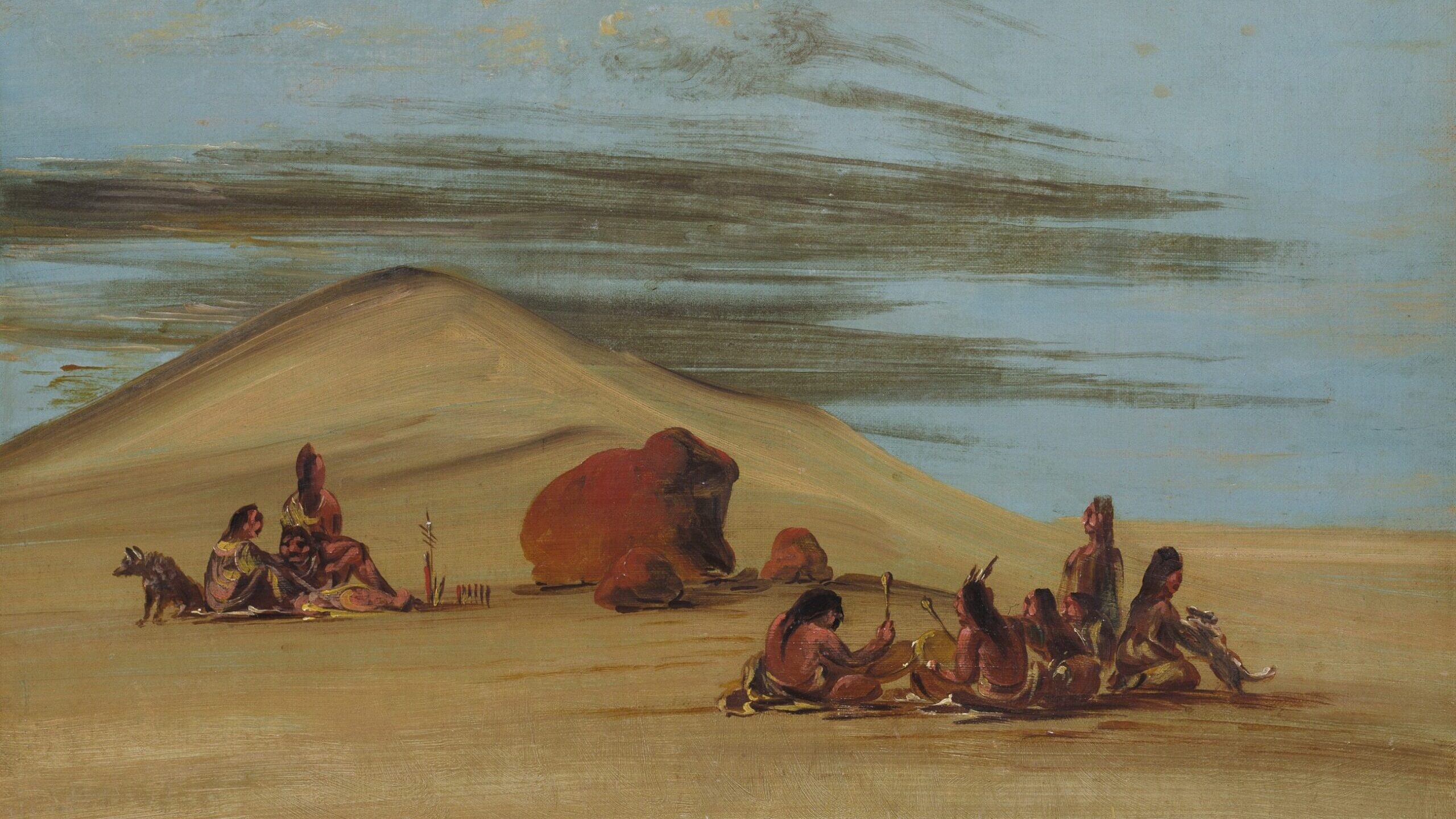
Missionary work west of the Mississippi had been underway since the earliest days of Spanish and French colonialism. U.S. missionary efforts in this period were rarely any Native group’s first “encounter” with Christianity. The responses to U.S. missionization and the territorial expansion that accompanied it were varied. The hundreds of Native communities in nineteenth-century North America interpreted the spirit world differently. The sheer diversity of Native America defies generalizations about Native reactions to the white American missionary impulse. Some Native people experimented with Protestant, Catholic, or Mormon ideas about religion according to communal and individual needs. Scholars have recently suggested that these experiences are best characterized as an ad hoc “affiliation” with, not a wholesale “conversion” to, Christian theology. Native people could be simultaneously Christian adherents and ongoing practitioners of established rituals in their communities.18
Native people east of the Mississippi followed a similar experimental approach, but their experiences at the very moment of Beecher’s plea demonstrate the clear limits to any affiliation. In the first decades of the 19th century, some among the Five Nations had permitted the Moravians, Presbyterians, and other Protestants to build churches in their towns, instruct their children in the English language, and teach them about concepts like monogamy, sin, and private property—including chattel slavery. Some became missionaries in their own right, mediating between God’s Word and Indigenous thought. In the face of attempts to remove them from their land, Cherokee women wrote extensively about their community’s Christian “progress” and appealed to white Americans through a shared love of Christ. Peggy Ann Scott’s 1817 letter to a federal official made it explicit: “Oh Sir, I implore you, for the sake of the dear crucified Savior, who shed his blood for the red, as well as white people.”19 But while Indigenous Christians might have shared in the same salvation, white Americans still felt divinely called to seize Native lands and destroy Native communities. Christianity could not save Native people from the hell of Removal and cultural genocide.
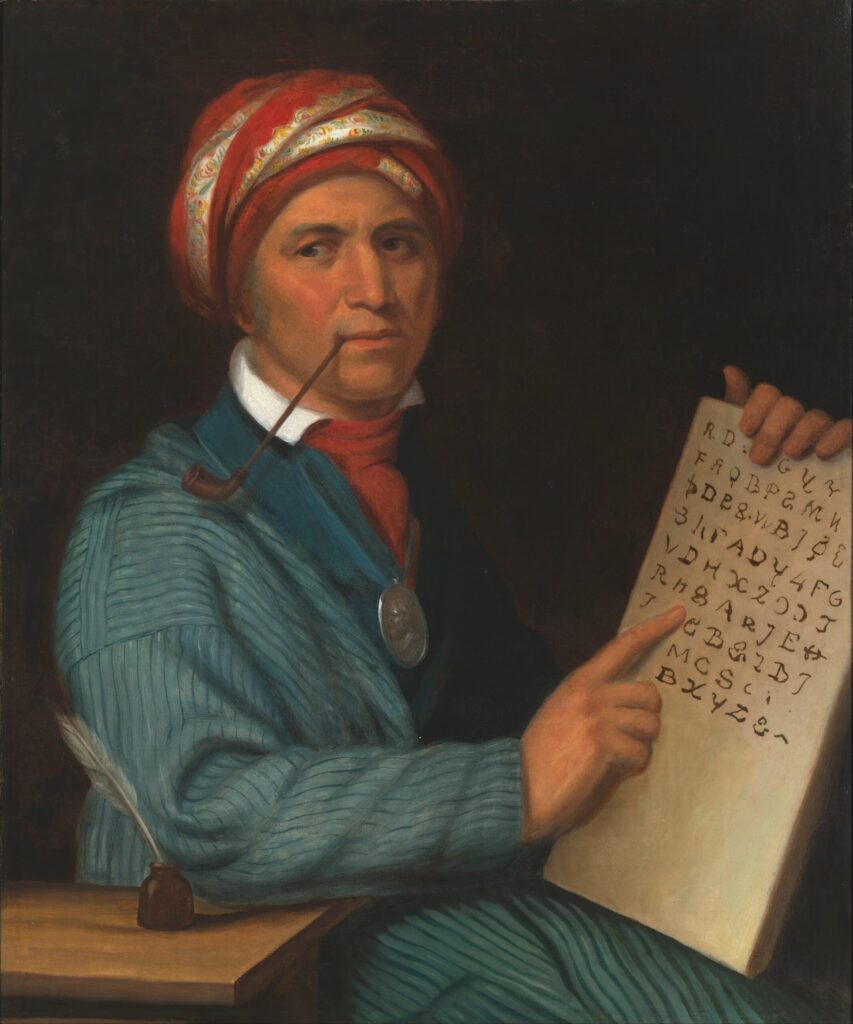
For white American missionaries who had worked among these groups for years, the efforts to remove them from their lands were a betrayal. ABCFM leaders like Jeremiah Evarts as well as public intellectuals like Ralph Waldo Emerson condemned Removal, but white Christian women were most active in the protest, drawing on writings of and implicitly mirroring the tactics of Cherokee women like Peggy Ann Scott. Lydia Sigourney, a poet and teacher in Hartford, Connecticut, collaborated with friend and fellow educator Catharine Beecher, Lyman Beecher’s eldest daughter, to launch a national petition drive opposed to Removal in 1829. Beecher argued that the Cherokee should be “protected and sustained in their rights [to become] a free and Christian people” by noting that this small “cherished relic of antiquity” posed no danger to white American power. Beecher argued Christian women must raise their voices to care for a “helpless race.”20
In the 1840s, the pace and scale of both displacement and missionary activity intensified. Federal forces continued to acquire and distribute Native land to white Americans. Numerous Protestant denominations raced to provide religious instruction, ranging from the Methodists and Baptists to the Quakers and Presbyterians and eventually the Mormons. In many of these new American territories, Catholic missionaries to Native groups had been present for centuries, as had Mexicans of Spanish descent who were born Catholics. The accession of Mexican territories added a multitude of Catholics to the American populace who were also seen as an important object of Christianization by Protestant missionaries. By the 1870s, there were more than seventy missions in or near Native communities between the Mississippi River and the Pacific Ocean, working to effect the spiritual and cultural transformation of Indigenous peoples.
V. Immigrants and Nativists
American Protestants could feel bullish about their missionary work in part because they seemed to have plenty of personnel. The revivals of the Second Great Awakening had led to a deeper churching of the American public, especially among the Methodists, who by 1850 represented the largest single denomination in the country. Looking west, they saw a frontier populated by non-Protestant Indigenous people and a rush of land-hungry—and later gold-hungry—men who needed religious care. But religious diversity was increasing in the East as well, and Beecher’s use of the word “plea” in his title indicates his belief in an existential danger: “This danger from an uneducated mind is augmenting daily by the rapid influx of foreign emigrants, unacquainted with our institutions, unaccustomed to self-government, inaccessible to education, and easily accessible to prepossession, and inveterate credulity . . .”21
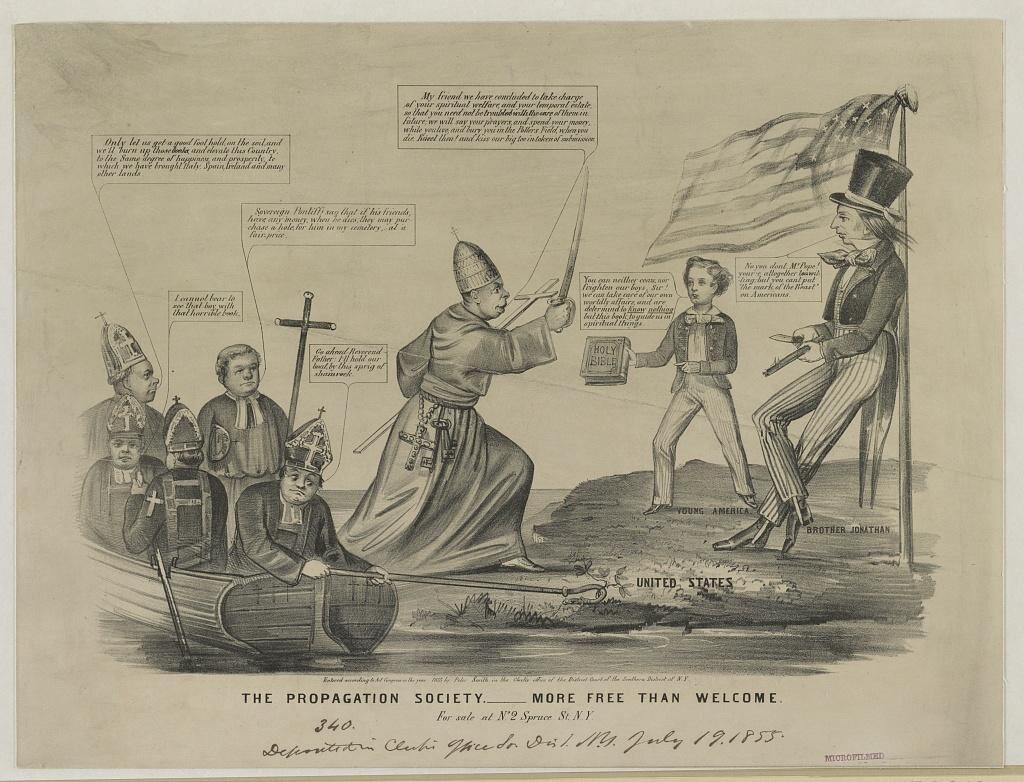
Beecher was alarmed as immigrants from Europe increasingly made the United States their home. These new arrivals were impelled to move because of political and economic conditions in their home countries and the opportunities presented by newly seized land in the United States. The 1850 census, which was the first to ask people their national origin, revealed that nearly 10% of the free US population had been born in another country. Most of these immigrants were of national origins already represented in the American populace: English, Irish, Anglo- and French-Canadian, and German. To that end, increased immigration introduced greater religious diversity largely by making existing ethnic minorities a greater proportion of the population and, in turn, making their religious practices more visible in daily life. But these immigrants brought their own local religious practices and perspectives, unsettling local congregations from the inside even as American Protestants expressed anxieties about their presence.
By 1850, Catholics rivaled Baptists and Methodists as a major denomination in the United States. But the Vatican still understood the United States as a young Catholic nation without the money or personnel to sustain its own spiritual or material operations.22 Since the British colonial period, American Catholics could only receive the sacraments through itinerant priests, and the rush of immigration at midcentury only exacerbated this issue. “National” churches became increasingly common, worrying both American Protestants and the Vatican. Isaac Hecker, an American-born convert to Catholicism who had been part of the Brook Farm set, became a priest in the Redemptorist order. At first, Hecker helped supply many German-born priests to minister to Catholics in America, but he later came to believe that it was important for American Catholics, whether immigrant or native-born, to have American priests. To accomplish this, he sought and received papal approval to establish the Missionary Society of St. Paul the Apostle, better known as the Paulist Fathers, in 1857. Many of the first members of the order were American converts like Hecker, and their ministry displayed many of the characteristics of the American Protestant culture they had come from, especially the use of tracts, books, and newspapers in extending their work.23
In a similar vein, American Jews had long created and supported Jewish institutions themselves. This work only increased as new immigrants settled in the interior. Even when they established congregations, access to Jewish resources, like religious books, kosher food, and even Jewish marriage partners, was very limited; it was nearly impossible to strictly observe Jewish law in most places.24 Ordained rabbis of varying traditions began to arrive in the United States at mid-century, but most congregations continued to be led by hazanim as they had been for decades or even centuries.25 Efforts at “modernization” and reform in some congregations, like Charleston’s historic Kahal Kadosh Beth Elohim, led to personal arguments and bureaucratic maneuvers like those seen in Protestant denominations, but with one important difference. For those opposed, the potential addition of a musical organ represented the creep of Christianity into their worship, as the organist would be breaking the Sabbath.26 In the United States, Sunday closing laws made it challenging for most Jews to observe a Saturday Sabbath and still make a living. Jews contested these laws in the public sphere, and very occasionally in court, but all but the wealthiest and most pious worked on the Sabbath.27
Political disestablishment was finally completed in 1833 when Massachusetts eliminated state funding of select churches. All non-Protestants could now vote, hold office, and swear oaths. But American Protestants reacted negatively to the increasing visibility—and potential political power—of non-Protestants. Both Jews and Seventh Day Adventists were rebuffed when they sued to overturn laws mandating the closure of businesses on Sundays, with Protestant leaders using the language of American democracy to argue that religious minorities should accede to the will of the majority.
In addition, there were efforts to promulgate a specific kind of Protestant culture through civic institutions like schools. Despite their framing as “non-sectarian,” public common schools run by private boards were vehicles for transmitting Protestant culture through the use of the Authorized Version Bible, as well as the singing of Protestant hymns, and the use of textbooks that portrayed the Catholic Church as evil.28 Religious minorities found ways to resist, and even evade, these efforts. In Philadelphia, Rebecca Gratz founded the first Jewish Sunday school in 1838, intended to counter Christian missionary efforts and strengthen Jewish knowledge and commitments among children.29
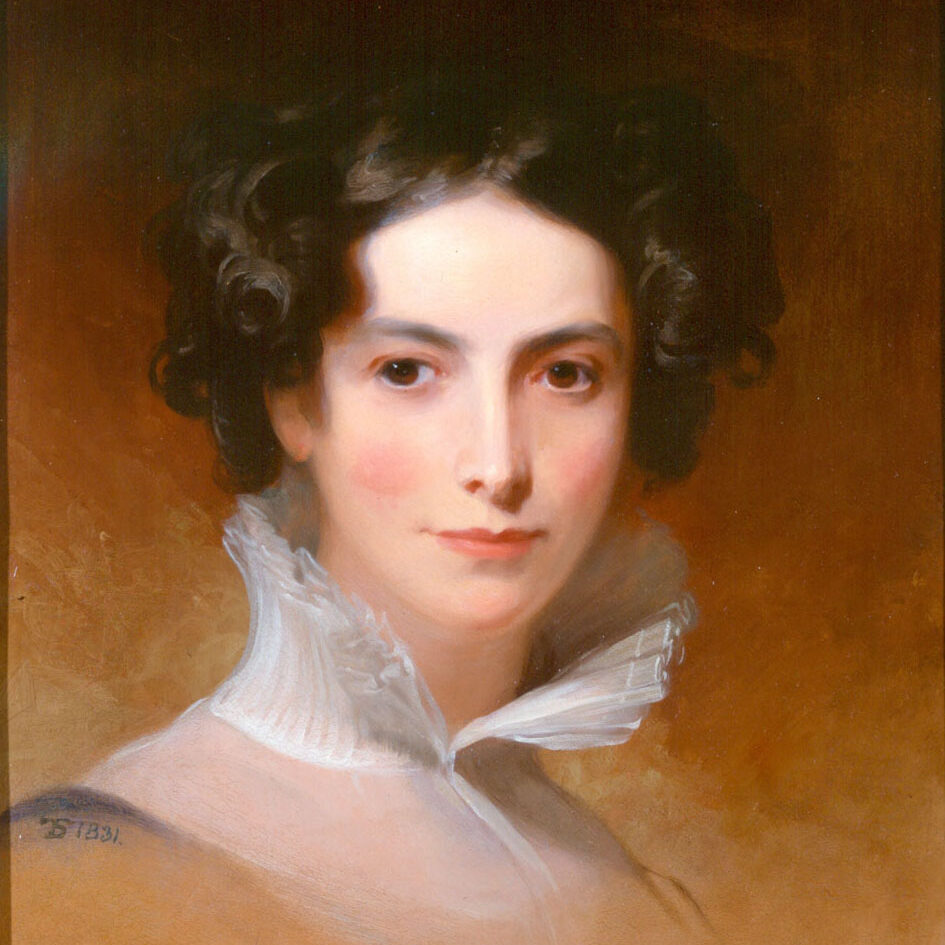
In New York City, Archbishop John Hughes argued that the school system was using taxpayer funds to proselytize to children, and that in setting up parochial schools to avoid this, Catholics were being doubly taxed. His counterargument, that the city also provide funds for parochial schools, was unpersuasive, but his maneuvering helped lead to the passage of the Maclay Act in New York State, which placed public schools directly under the control of city officials and prohibited religious instruction in those schools. This provision angered many Protestants. Despite these changes, attendance at parochial schools grew across the country.30
The school controversy in New York took place amidst growing antagonism towards American Catholics, and historians have long struggled to untangle the religious, ethnic, and economic aspects of this antagonism. American anti-Catholicism certainly grew in the 19th century in response to increased European immigration, incorporating nativist responses to the perceived threat that “unskilled” immigrant labor posed to wages.31 But it also remained rooted in ideas that had been fundamental to American self-understanding since the days of British colonialism.
In the mind of most Protestants, Catholicism represented oppression, tyranny, and subservience, everything that Anglo-American culture was not. In the United States, a key part of this ideology was the idea that Catholics were not allowed the privacy of mind to make free choices but instead were told what and how to think by their priests, and by extension the Pope, who held both spiritual and temporal power in the 19th century.32 As New England writer Catharine Maria Sedgwick noted in her 1835 novel The Linwoods, “The political institutions of a people may be inferred from their religion. Absolutism, as a mirror, reflects the Roman Catholic faith.”33 This fear was also at the core of Lyman Beecher’s plea; despite his optimistic framing, much of the piece explores the ways that un-Americanized Catholics will be the conduit through which European powers will take control of the United States.
Anti-Catholicism expressed itself at mid-century in ways that reflected the gendered nature of culture and political power in the United States. Despite the criticism of Catholicism’s supposed lack of privacy, American Protestants were obsessed with one particular Catholic private space: the convent. Some claimed that Catholic priests routinely sexually abused women in convents and murdered illegitimate children to cover their crimes. Readers across the country lapped up “convent tales” like Awful Disclosures of Maria Monk, or, The Hidden Secrets of a Nun’s Life in a Convent Exposed (1836), full of the scandalous behavior that was supposedly taking place in these private religious spaces.
Elite American Protestants sent their daughters to convent schools to benefit from the European-educated women who taught there but simultaneously rejected the idea that any woman could have rationally chosen to enter religious life. They viewed such women as disordered and in need of rescue, a reminder that the concept of a right to private choice in America has always been gendered.34 For the most part, though, nativist activism attempted to restrict Catholic participation in the electoral system. America could be fascinated by women who devoted their lives to the Church, even seeing them as victims in need of rescue. But they feared the power of Catholic men at the ballot box. Parallels to anti-Mormon sentiment are quite clear. In both cases, these religions were seen as politically dangerous, and possibly subversive, and Protestant critics focused their conspiracy theorizing on what they viewed as secret perversions of the family: polygamous marriage and the convent.
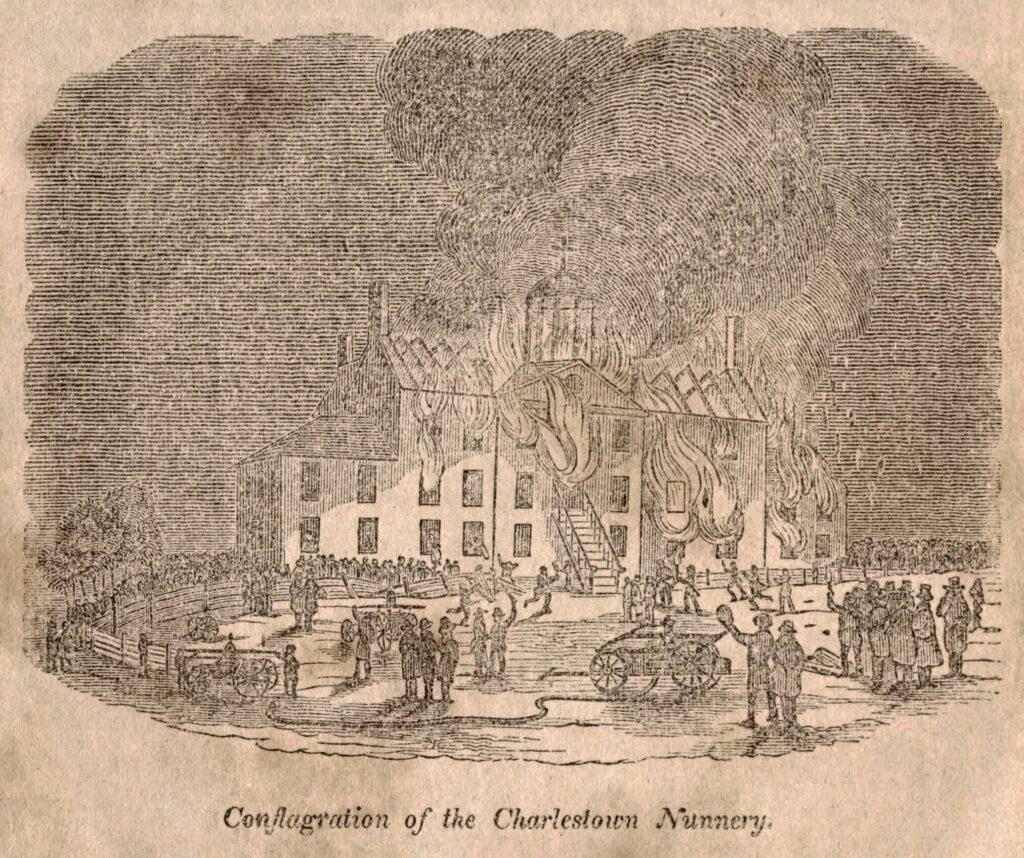
Anti-Catholic activism took many forms in the 19th century, including violence organized by private citizens and organizations. A crowd incensed by accusations of abuse and murder in Catholic institutions burned down the Ursuline convent in Charlestown, Massachusetts in August of 1834, and broader nativist riots rooted in political and civic concerns enveloped cities like Philadelphia, St. Louis, and New Orleans deep into the 1850s.35 Writing soon after the burning of the Ursuline convent, Beecher made clear that he did not support violence against Catholics and their property, but one can see a clear line between his fears of political subversion and what developed by mid-century: an explicitly nativist party.36
Candidates in the American Party, more commonly known as the Know-Nothing Party, exploited the power vacuum created by dysfunction in the major parties. Know Nothing candidates briefly swept into power in towns and cities across the country, promising to bar immigrants from jobs, public office, and even citizenship. The party’s power declined just as swiftly, unable to agree on a national platform outside of anti-Catholicism, but questions about the “dual loyalty” of American Catholics would persist well past the 1861 unification of Italy that eliminated the pope’s official control over earthly territory.
Despite the official separation of church and state, the reaction to Jewish and especially Catholic immigration in the antebellum period highlights how the country was legally and culturally Protestant and the lengths that some American Protestants would go to keep it that way. And yet, inspired by the spirit of reform that animated antebellum society, many outside mainstream Protestantism believed that their faiths were fully compatible with the political ideas of their nation, and they actively continued to participate in American civic and cultural life.
VI. Resistance and Rebellion
The question over the compatibility of Catholicism and American culture paralleled a series of other questions in the 19th century that occupied the minds of white American men. Could women be full participants in society? Could nonwhite people? Could immigrants? What would happen if they were? Even as Catholicism was held up as a faith that denied freedom of conscience and individual agency, these questions remind us that the United States also denied those and further freedoms to most of its residents during this period. Central to this was the tension between individual civil liberties and the majoritarian desire for power and money.
Nineteenth-century white Protestant thought contained a major contradiction. Protestants believed that all human beings had souls and were spiritually equal. But they also believed that human society was naturally hierarchical and therefore unequal. The rising push to reform the world opened the door for some to examine or even attempt to resolve this tension.
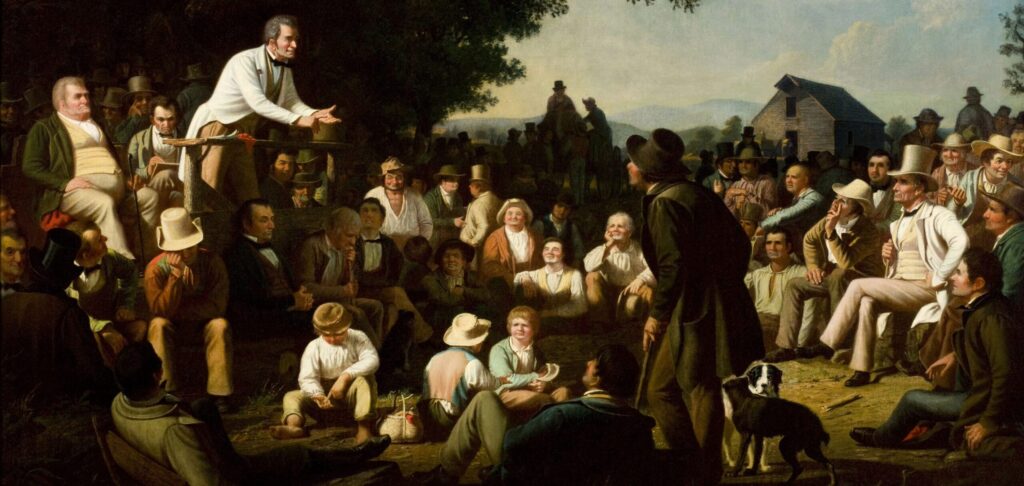
Like Catholicism, slavery had long served as a metaphor for white Americans conceptualizing what was different about their new nation. But as with Catholicism, slavery wasn’t simply metaphorical. As the economic and political system of the nation, slavery impacted the lives of every American, from those held in enslavement to free white people in states that had abolished slavery in the 18th century. In 1836, when the mill girls of Lowell, Massachusetts turned out on strike, they sang:
Oh! Isn’t it a pity, such a pretty girl as I –
Should be sent to the factory to pine away and die?
Oh! I cannot be a slave, I will not be a slave
For I am so fond of liberty,
That I cannot be a slave.37
This song was itself a reworking of the song “I won’t be a nun.” These Protestant New England girls had little danger of being forced into a convent, but their employment in the mills was predicated on other people being slaves—those who produced the cotton they worked with—and their demand for higher wages came with the understanding that those producing the raw materials would never get the same.
As slavery intensified and spread across newly colonized territories, supporters and opponents drew on the authority of the Bible, and the fact that people across political, social, and racialized spectrums could develop a range of stances on the morality and legality of slavery from biblical texts demonstrates its interpretative flexibility. There was not a simple truth about “what the Bible says about slavery.” Rather, what the Bible said about slavery emerged from complex negotiation between the biblical texts and their readers.38
Proslavery white supremacists sought to demonstrate that slavery in the Atlantic World—especially the racialized enslavement and exploitation of Africans and their descendants—was part of a long historical and biblical reality. To prove this point, writers like Josiah Priest and clergy like Holland McTyeire made the case that no passage in the Old or New Testaments abolished or explicitly condemned slave-owning.39 Instead, they found evidence that slavery was deemed acceptable by ancient Israelites and Christians. Perhaps the most robustly used biblical passage to justify slavery was the so-called “curse of Ham” (Genesis 9:20–27), a passage in which one of Noah’s sons, Ham, sees him naked; consequently, Ham’s son Canaan is cursed and labeled as a servant of Noah’s other sons. Over the centuries and through Jewish, Christian, and Islamic interpretation, this passage eventually became racialized, and proslavery writers portrayed Africans as descendants of Ham and Canaan in order to justify their “continued” enslavement from the Bible to modernity.40
The “curse of Ham” even led some to the view that Black and white humans had different origins, mirroring contemporary theories circulating throughout the Euro-American scientific community. Polygenism promoted a reading of Genesis that was deeply tempting to white supremacists looking for further justification for enslavement. But many religious Americans, especially clergy, recoiled at the idea, even as they were committed white supremacists. They believed that only some of the freedoms available to white men should belong to white women, and even fewer should be available to Black Americans or Indigenous people. However, to deny the humanity of any of these groups would be to question Scriptural truth, and that was unacceptable.41
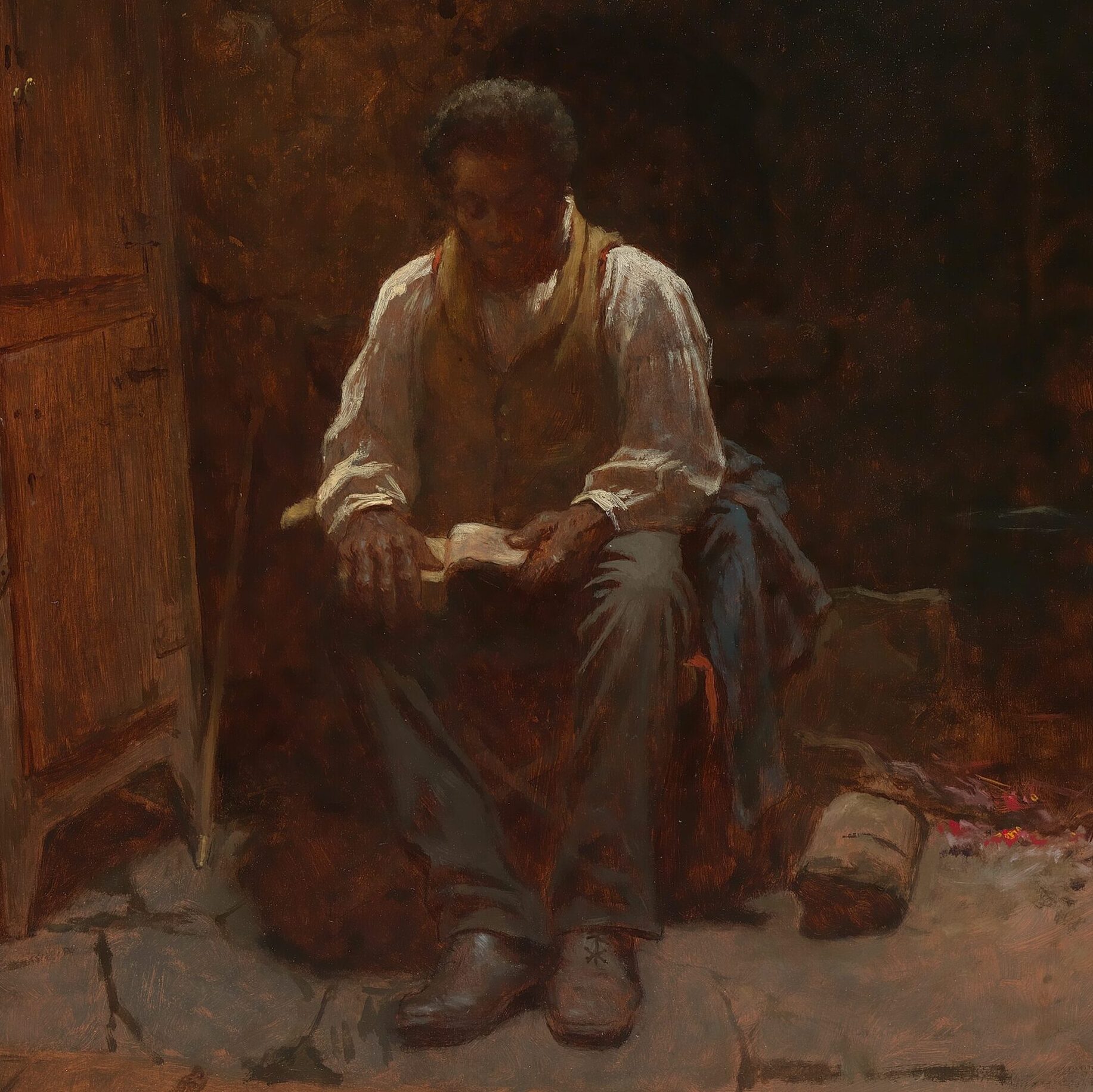
By contrast, Black and white abolitionists read biblical texts to justify their understanding of Christian theology as liberatory, turning to the academic study of language to suggest that the Bible meant “servant” and not “slave.”42 They also sought to demonstrate that Christian morals required human equality and unity. They quoted biblical texts like Galatians 3:28 (“there is no longer slave or free…”) and Acts 17:26 (“from one blood he made all peoples to inhabit the whole earth…”). Accordingly, they reasoned that Christians ought to view chattel slavery as unbiblical and demand the emancipation of enslaved people.
Black Americans, unsurprisingly, provided some of the most Bible-based arguments for abolitionism. David Walker’s 1829 Appeal to the Coloured Citizens of the World repeatedly chastised white clergy for acting contrary to the Bibles they held in their hands, for failing to understand that humans cannot be lord over one another, and for falsely believing that Africans are cursed by God. Inspired by Walker’s example, Maria Stewart became the first American woman to speak in front of a “promiscuous” audience, including white and Black listeners. She appealed to her audience in the same way that revival preachers did: “I possess nothing but moral capability—no teachings but the teachings of the Holy spirit.” Baltimore’s Frances Ellen Watkins, a young free Black woman, repeatedly targeted what she saw as the denial of Biblical truth: “A ‘reverend’ man, whose light should be/The guide of age and youth,/Brings to the shrine of Slavery/The sacrifice of truth!” This condemnation of white Christian hypocrisy was often paired with the founding phrases of the American republic that drew authority from God. Having thrown off the yoke of British oppression because of their God-given rights, white Americans were asked a provocative question by Walker: “Was your sufferings under Great Britain, one hundredth part as cruel and tyrannical as you have rendered ours under you?”43
In this, Walker gestured towards the greatest fear of every individual enslaver: slave revolt. During this period, this fear hardened into paranoia, and then into policy, but that belief in human unity meant that it was never simple. In the wake of rising abolitionist sentiment, including Walker’s appeal, North Carolina again took up a proposed ban on slave literacy, one that had repeatedly failed because enslavers believed they had a duty to ensure the people they enslaved were Christian, which required being able to read the Bible. When the ban eventually passed in 1830, it permitted the enslaved only “the use of figures,” asserting that “affording them facilities of intelligence and communication” would only make them unhappy and damage the health of the community.44 We see in this the contortions into which white supremacists twisted themselves to argue that enslavement was a natural and Bible-ordained system rooted in the inherent intellectual inferiority of those of African descent who still, nevertheless, needed to be prevented from reading and writing.


The following year, Nat Turner, a Black man and sometimes Baptist preacher in Virginia, led a rebellion that lasted four days and resulted in the deaths of over 50 white men, women, and children. The backlash then killed over 100 Black Virginians. What we know of Turner and his motivations comes from a narrative transcribed and then published by the white attorney Thomas Gray while Turner was in jail. Turner argued that he was a devout Christian and had experienced apocalyptic visions over the previous decade, giving him a reputation as a prophet among local enslaved people. The revolt was put down, and Turner was hanged, but the event seemed to confirm the fears of those who pushed for literacy bans. Turner was a Christian, a Baptist. As Joseph Smith was experiencing visions in New York, Turner was experiencing different visions in Virginia. In a way, Turner worked towards the millennium by attempting to remake the world around him. Like Smith, he claimed the mantle of a prophet. And what good could a literacy ban do in the face of that kind of belief?
VII. Schisms
External changes added pressure to American slavery discourse in the 1830s. In 1833, the United Kingdom passed a gradual emancipation bill. In 1839, Pope Gregory XVI’s encyclical In supremo apostolatus condemned the slave trade. Despite increasing immigration to the Northeast, the majority of American Catholics lived in the South in 1839, especially in Maryland and Louisiana.45 Just like Protestants sought religious sanction for white supremacy and slavery in the Bible, Southern Catholics, including bishops, advanced a hair-splitting reading of Gregory’s encyclical that condemned the trade but not necessarily the ownership of people. In practice, Southern Catholics ceased neither, and the 1838 sale of 272 enslaved men, women, and children by the Maryland Jesuit community resulted in condemnation from other Jesuits and the Vatican.46
Immigration patterns meant that far fewer American Jews lived in the South than the North, but those that did enslaved Black Americans at a similar rate to their white Christian neighbors. Jewish law did not forbid the practice, and participating in the system was one way of aligning with the dominant group.47 In almost every faith and denomination in the United States, one could find devout believers opposed to slavery, committed to slavery, and at every point in between. The only possible exception might be Islam, where most American adherents were enslaved. Nonetheless, this is also a reminder that religious belief is always, but one aspect of a person’s ethical and moral calculus, and that belief and practice often do not align.
Many white Americans defended slavery more strenuously, and even more silently received its benefits. But an increasing number of white Americans spoke and wrote on slavery and abolition, many moved by faith and conscience. As with temperance, Cherokee Removal, and missionary work itself, they banded together in organizations to advance these goals, forming the American Anti-Slavery Society in 1833. They aimed to abolish slavery on the state and national level, though they condemned slave revolts.48 Founded and controlled by white men, the organization platformed Black men like Frederick Douglass with great frequency, celebrating their speech, but never allowing them to rise into leadership. Black and white women in the organization were allowed to do neither.
Activists Angelina and Sarah Grimké hailed from a family of enslavers in South Carolina and rose to prominence in the 1830s speaking and writing directly to Southern women. Opposed by male abolitionists, they also received criticism from female abolitionists. In a series of public essays exchanged with Catharine Beecher, Angelina Grimké articulated not only the Christian and republican roots of abolitionism, but also her own right to speak on the issue as a woman. She posited that if men and women were both endowed with the same “moral nature,” the same ability to recognize good and evil in the world, then they had the same obligation to act on that moral nature: “My doctrine then is, that whatever it is morally right for man to do, it is morally right for woman to do.”49 In this, she echoed Maria Stewart, who claimed she had “nothing but moral capability,” which was all she needed.50 Beecher, who had authored a petition in the fight against Cherokee Removal and advocated for women’s education, still argued that women were to use moral suasion alone, starting with the men in their lives. Beecher equated women’s public activism, especially public speaking, with ambition. If she were to step outside of “her place as dependent and defenceless,” she would lose “the sacred protection of religion” and her right to chivalrous treatment.51
The American Anti-Slavery Society would eventually split over the issue of women’s rights, but the networks formed through their activism brought together women of different religious backgrounds to advocate for their own rights. Many of these abolitionists would have been familiar with prominent feminist Fanny Wright, a Scottish writer and activist who had advocated for women’s property rights and sexual freedom in the United States. But Wright also opposed organized religion, making her an unacceptable model of feminism for many women. American religious women had been advocating for and creating educational opportunities for white and Black women for decades, while others advocated ordaining women within their denominations. Clarissa Danforth had been ordained by the Free Will Baptists in 1815, and Joseph Smith had received a revelation ordaining his first wife Emma in 1830. Still, the pulpit was largely closed to women, just as the stage was closed to women abolitionists.
A handful of women who had cut their teeth in the anti-slavery movement later organized the 1848 women’s rights convention at Seneca Falls, New York. Those in attendance issued a “Declaration of Sentiments,” modeled on the Declaration of Independence. Just as abolitionists had used the entangled political and religious views of that document to highlight the hypocrisy of slaveholding, so did the women of this convention, proclaiming: “We hold these truths to be self-evident; that all men and women are created equal.” Where the original declaration laid out the charges against George III, this charged American men with a variety of crimes, including withholding the franchise and denying women property rights, but also barring them from participation in the ministry, denying them access to their children in divorce, establishing a different code of morals for men and women, and “[claiming] the prerogative of Jehovah himself, claiming it as his right to assign for her a sphere of action, when that belongs to her conscience and her God.”52 As with white Americans, who had no motivation to dilute their political and economic power by liberating and enfranchising Black Americans, men in America were generally uninterested in diluting their power by enfranchising women.
Just as with controversies over revivalism and cross-denominational missionary work, the question of slavery and abolition would split white Protestant denominations. For the Presbyterians, those in support of ending slavery and willing to engage in public activism aligned with the New School in the 1837 split, but the Old School would split over the issue of slavery in 1861 when the country itself did. In 1844, the Methodist Church split apart over slavery, followed by the Baptists the following year. While the final straw for these splits was often a fight about tactics, or who was appointed to missionary endeavors, the root of all of it was the unsquareable circle of holding other human beings as property.
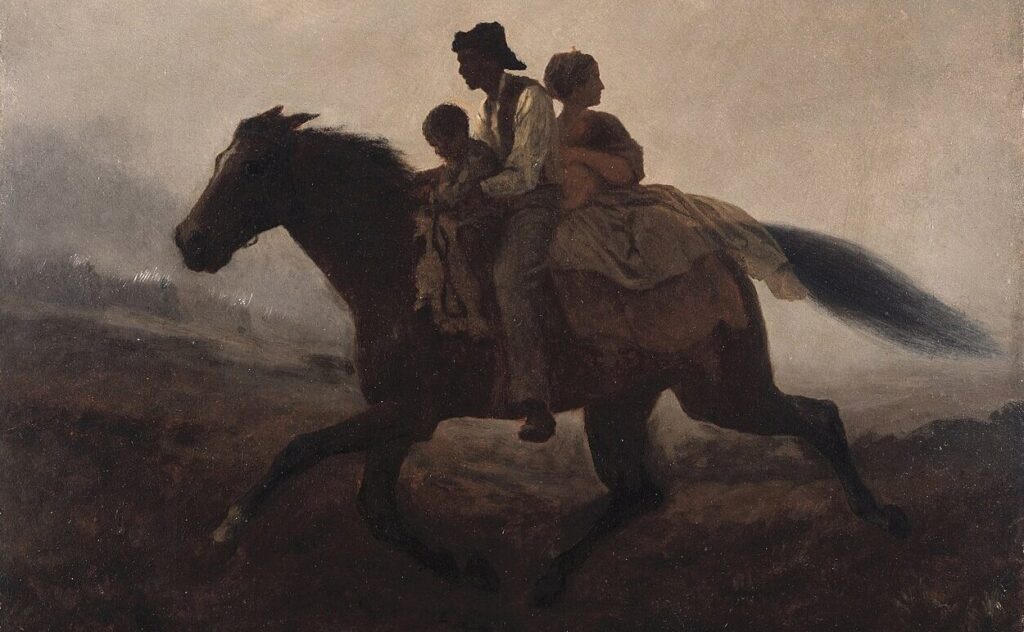

The 1850s were bookended by two religiously motivated antislavery acts, both in response to the Fugitive Slave Act of 1850 and its political fallout. Harriet Beecher Stowe and John Brown were born only a few miles apart in northwestern Connecticut, and they represent two important impulses in anti-slavery activism that would carry the nation into—and through—the Civil War.
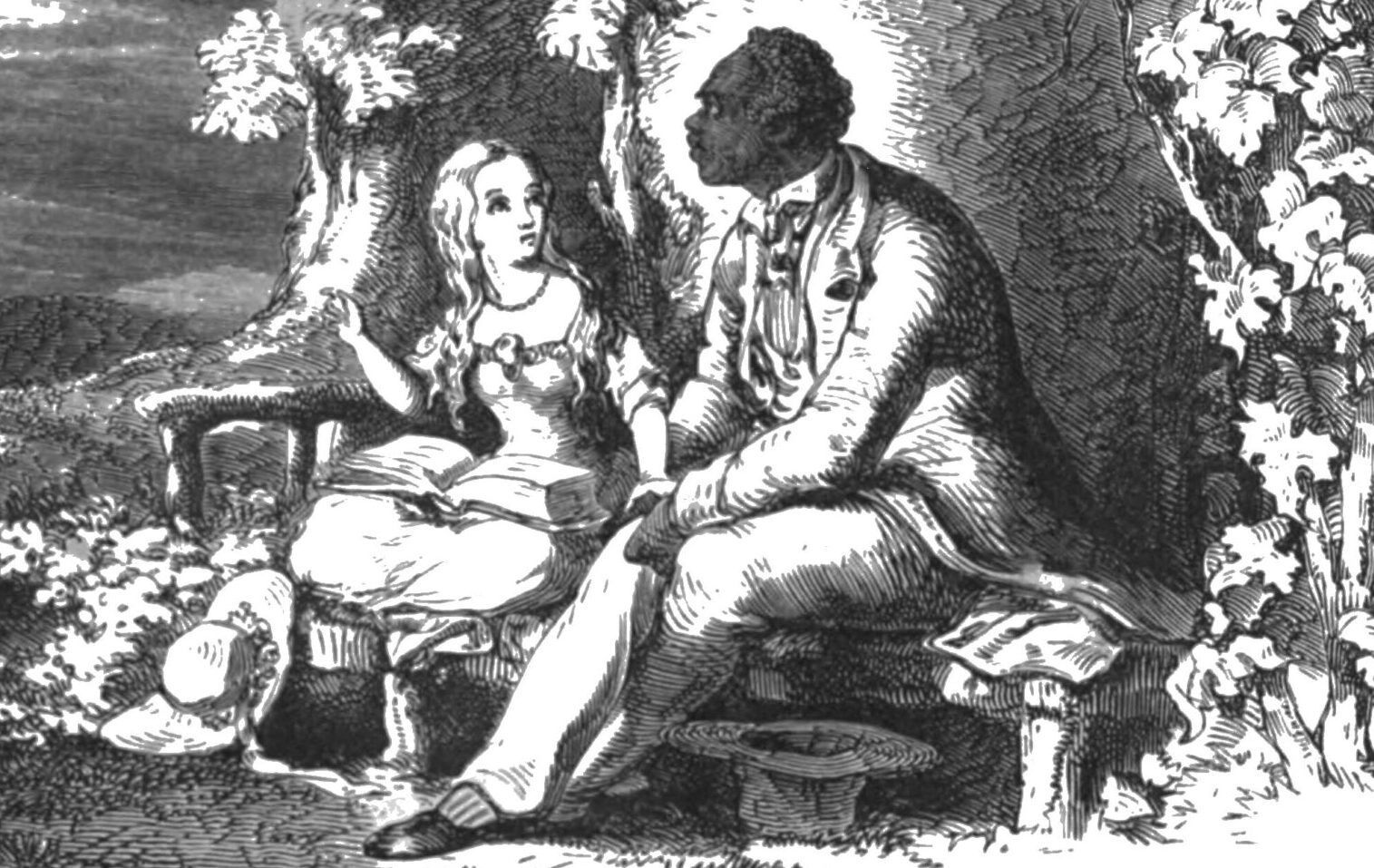
Stowe’s Uncle Tom’s Cabin; or, Life Among the Lowly, published serially in 1851, depicted slavery as an abomination that degraded human relationships, especially families, which were fundamental to the human experience. Her older sister had counseled the Grimkés and others like them that the appropriate direction for their efforts was to persuade their husbands and sons in private, not to speak to the masses. Stowe chose to persuade as well, but spoke to other mothers through her novel, asking: “if it were your Harry, mother . . . that were going to be torn from you by a brutal trader, to-morrow morning . . . how fast could you walk?” For decades, moral reformers had made the argument that mothers were the guardians of the nation’s morality, and Angelina Grimké had argued that women had the same moral nature as men and the same obligation to speak up in the face of cruelty. Harriet Beecher Stowe’s appeal to mothers combined those arguments into her own “plea,” one that attempted to reckon with the rot at the core of her father’s “young empire of mind, and power, and wealth.”53

Even the most fervent of abolitionists had to admit, though, that moral suasion had not stopped the gains of “the slave power” in the United States. John Brown knew it. He had been an active organizer in Connecticut, Massachusetts, New York, and Ohio before moving his family to Kansas to enter the bloody conflict over whether that territory should enter the Union as a free or slave state. His 1859 raid on the federal armory at Harper’s Ferry, Virginia, often portrayed as the isolated act of a fanatic, was in fact a long-planned, carefully plotted, and well-financed effort born out of Christian fervor for slave liberation inspired by Toussaint Louverture and Nat Turner. Brown’s funding came from prominent New England abolitionists and religious leaders like Theodore Parker and Samuel Gridley Howe, but funding and counsel came from a network of Black abolitionists he came to know and respect, including Harriet Tubman and Mary Ellen Pleasant.54
When he was tried in the wake of the raid and sentenced to death, his speech to the court was reprinted in newspapers around the country. In an argument that echoed Stowe’s plea to mothers, Brown pointed out that if he had committed violence to defend the wealthy white men in attendance or their family members, he would have been celebrated, but instead he had committed violence to defend enslaved people. The Bible he had sworn on told him to “remember them that are in bonds, as bound with them” (Hebrews 13:3), and he had “endeavored to act up to that instruction.”55
Brown’s death became martyrdom—and struck fear into the hearts of enslavers—not because he was willing to do what others would not, but because he was willing to follow in the path of Black liberators who had gone before, to risk his life for the liberation of the enslaved. His actions were an expression of his faith, and the radicalism of that faith was that all men were created equal, in this world and the next. Brown had resolved the tension at the heart of the American republic to his own satisfaction. What, if anything, the rest of America would do to enact Lyman Beecher’s imagined “moral and political emancipation of the world” remained to be seen.56
VIII. Conclusion
By 1860, American religion had proved to be far more than a matter of private conscience. American religion was wielded as a social and political force. Gender relations, economic inequality, imperial conquest, migration, nativism, and the very nature of national identity all drew on religious rhetoric. And American religion was in turn shaped by these forces. Experiments with new religious movements unleashed both spiritual creativity and violent backlash. New waves of migration challenged Protestant authority and exposed the limits of Americans’ commitment to religious liberty. Over the nineteenth century, revivals spawned both reform and rebellion. The same religious energies that inspired hope for social progress also intensified social tensions. The splintering of the nation’s largest Protestant denominations unleashed a new form of sectionalism. Pulpits, North and South, pushed the nation closer to the cataclysm and ultimate redemptive potential of civil war.
IX. Reference Material
This chapter was edited by Erin Bartram, with content contributions by Chance E. Bonar, Erin Bartram, Stephen Howard Browne, William E. Burns, M Dougherty, Caroline Greer, Alexandria Griffin, Tyler E. Kibbey, Mélena Laudig, William Perez, Shari Rabin, Steven Peach, Obbie Tyler Todd, Ian Wilson, and Ben Wright.
Recommended Reading
- Emily Conroy-Krutz, Christian Imperialism: Converting the World in the Early American Republic (Ithaca: Cornell University Press, 2015).
- Emily Conroy-Krutz, Missionary Diplomacy: Religion and Nineteenth-Century American Foreign Relations (Ithaca: Cornell University Press, 2024).
- Brandi Denison, Ute Land Religion in the American West, 1879–2009 (Lincoln: University of Nebraska Press, 2017).
- Maura Jane Farrelly, Papist Patriots: The Making of an American Catholic Identity (New York: Oxford University Press, 2012), 5–17.
- Elizabeth Fenton, Religious Liberties: Anti-Catholicism and Liberal Democracy in Nineteenth-Century U.S. Literature and Culture (New York: Oxford University Press, 2011).
- Jennifer Graber, The Furnace of Affliction: Prisons and Religion in Antebellum America (Oxford University Press, 2011).
- Jennifer Graber, The Gods of Indian Country: Religion and the Struggle for the American West (New York: Oxford University Press, 2018).
- Jon Gjerde, Catholicism and the Shaping of Nineteenth-Century America, ed. S. Deborah Kang (New York: Cambridge University Press, 2012).
- Chester Gillis, Roman Catholicism in America (New York: Columbia University Press, 2020).
- Sarah Barringer Gordon, The Mormon Question: Polygamy and Constitutional Conflict in Nineteenth-Century America (University of North Carolina Press, 2010).
- Jennifer Graber, The Furnace of Affliction: Prisons and Religion in Antebellum America (University of North Carolina Press, 2011).
- Philip F. Gura, American Transcendentalism: A History (New York: Hill and Wang, 2007).
- Amanda Hendrix-Komoto, Imperial Zions: Religion, Race, and Family in the American West and the Pacific (Lincoln: University of Nebraska Press, 2022).
- Kellie Carter Jackson, Force and Freedom: Black Abolitionists and the Politics of Violence (Philadelphia: University of Pennsylvania Press, 2019).
- Leon A. Jick, The Americanization of the Synagogue, 1820–1870 (Hanover, NH: University Press of New England for Brandeis University Press, 1976).
- Adam Jortner, No Place for Saints: Mobs and Mormons in Jacksonian America (Baltimore: Johns Hopkins University Press, 2021).
- Gale L. Kenny, Contentious Liberties: American Abolitionists in Post-Emancipation Jamaica, 1834–1866 (University of Georgia Press, 2024)
- Kathryn Gin Lum, Damned Nation: Hell in America from the Revolution to Reconstruction (Oxford University Press, 2014)
- Kathryn Gin Lum, Heathen: Religion and Race in American History (Harvard University Press, 2022)
- Benjamin E. Park, American Zion: A New History of Mormonism (New York: Liveright, 2024).
- Benjamin E. Park, Kingdom of Nauvoo: The Rise and Fall of a Religious Empire on the American Frontier (New York: Liveright, 2020).
- Shari Rabin, Jews on the Frontier: Religion and Mobility in Nineteenth-Century America (New York: New York University Press, 2017).
- Ben Wright, Bonds of Salvation: How Christianity Inspired and Limited American Abolitionism (Baton Rouge: Louisiana State University Press, 2020).
Notes
- Lyman Beecher, A Plea for the West (Truman & Smith, 1835), 16-7. ↩︎
- Beecher, A Plea for the West, 11. ↩︎
- Philip Barlow and Stephen J. Stein, “Religious and Geographical Expansion, 1790–1865,” in The Cambridge History of Religions in America (Cambridge University Press, 2000), 121-5. ↩︎
- Dennis C. Dickerson, “The Freedom Church, 1831–1861,” in The African Methodist Episcopal Church: A History, 56–107 (Cambridge University Press, 2020). ↩︎
- Charles Grandison Finney, Sermons on Various Subjects (1834), 13. ↩︎
- Daniel Walker Howe, Making of the American Self: Jonathan Edwards to Abraham Lincoln (Oxford University Press, 1997), 197-208. ↩︎
- William Miller, Evidence from Scripture and History of the Second Coming of Christ, About the Year 1843: Exhibited in a Course of Lectures (1836). ↩︎
- Philip F. Gura, American Transcendentalism: A History (Hill & Wang, 2007), 150-180; Charles Crowe, George Ripley, transcendentalist and utopian socialist (University of Georgia Press, 1967); Jenny Franchot, Roads to Rome: The Antebellum Protestant Encounter With Catholicism (University of California Press, 1994), 302-7; Patrick W. Carey, Orestes A Brownson: American Religious Weathervane (William B. Eerdmans, 2004), 128-131, 134-153; David. J. O’Brien, Isaac Hecker: An American Catholic (Paulist Press, 1992), 34-38. ↩︎
- Benjamin E. Park, American Zion: A New History of Mormonism (Liveright, 2024), 17-31. ↩︎
- Adam Jortner. No Place for Saints: Mobs and Mormons in Jacksonian America (John Hopkins University Press, 2021), 97; John P Greene, Facts Relative to the Expulsion of the Mormons from the State of Missouri, under the “Exterminating Order” By John P. Greene, An Authorized Representative of the Mormons, (R. P. Brooks, 1839), 26. ↩︎
- Warsaw Signal, (Illinois, May 19, 1841), Vol. 2, No. 2. ↩︎
- Park, American Zion, 81; Times and Seasons, 15 July 1842, The Joseph Smith Papers, 855, https://www.josephsmithpapers.org/paper-summary/times-and-seasons-15-july-1842/9#facts. ↩︎
- Park, American Zion, 76-81. ↩︎
- Benjamin Park. Kingdom of Nauvoo: The Rise and Fall of a Religious Empire on the American Frontier (Liveright Publishing Corporation, 2020), 274. ↩︎
- These events were documented and published by E. E. Lewis shortly after the events were described in a small pamphlet that was signed by a few dozen witnesses. See: E. E. Lewis, A Report of the Mysterious Noises, Heard in the House of Mr. John D. Fox (E. E. Lewis, 1848). ↩︎
- Quoted in David Cameron Miller, “Kindred Spirits: Martin Johnson Heade, Painter; Frederick Goddard Tuckerman, Poet; and the Identification with ‘Desert’ Places” in American Quarterly 32, No. 2 (1980): 67-185. ↩︎
- Jennifer Graber, The Gods of Indian Country: Religion and the Struggle for the American West (Oxford University Press, 2018); Amanda Hendrix-Komoto Imperial Zions: Religion, Race, and Family in the American West and the Pacific (University of Nebraska Press, 2022). ↩︎
- Thomas A. Tweed, Crossing and Dwelling: A Theory of Religion (Harvard University Press, 2006), 8-10; Linford D. Fisher, The Indian Great Awakening: Religion and the Shaping of Native Cultures in Early America (Oxford University Press, 2012); Brandi Denison, Ute Land Religion in the American West, 1879-2009 (University of Nebraska Press, 2017); and Graber, Gods of Indian Country. ↩︎
- Tiya Miles, “‘Circular Reasoning: Recentering Cherokee Women in the Antiremoval Campaigns,” American Quarterly 61, no. 2 (2009): 221-243. ↩︎
- Catharine Beecher, “CIRCULAR: Addressed to Benevolent Ladies of the United States (Boston, 1829). See also Kathryn Kish Sklar, Catharine Beecher: A Study in American Domesticity (W. W. Norton, 1973). ↩︎
- Beecher, A Plea for the West, 49. ↩︎
- Daniel Walker Howe, What Hath God Wrought: The Transformation of America, 1815-1848 (Oxford University Press, 2007), 198–200. ↩︎
- Erin Bartram, “American Catholics and ‘The Use and Abuse of Reading,’ 1865–1873,” Religion and American Culture: A Journal of Interpretation 29, no. 1 (2019): 37-40. ↩︎
- Shari Rabin, Jews on the Frontier: Religion and Mobility in Nineteenth-century America (New York University Press, 2017); Leon Jick, The Americanization of the Synagogue, 1820-1870 (Brandeis University Press, 1976). ↩︎
- Zev Eleff, Who Rules the Synagogue?: Religious Authority and the Formation of American Judaism (Oxford University Press, 2016). ↩︎
- Shari Rabin, “Judges and Jews: Congregational Conflict and the Protestant Secular in 19th-Century America,” Religion 48 no. 4 (2018): 659-677; Allan Tarshish, “The Charleston Organ Case,” American Jewish Historical Quarterly 54, no. 4 (1965): 411-449. ↩︎
- Jonathan D. Sarna and David G. Dalin, eds. Religion and State in the American Jewish Experience (Notre Dame University Press, 1997). ↩︎
- Howe, What Hath God Wrought, 127. ↩︎
- Laura Yares, Jewish Sunday Schools: Teaching Religion in Nineteenth-Century America (New York University Press, 2023); Karla Goldman, Beyond the Synagogue Gallery: Finding a Place for Women in American Judaism (Harvard University Press, 2000). ↩︎
- Jon Gjerde, Catholicism and the Shaping of Nineteenth-Century America (University of California, 2012), 152-3, 163. ↩︎
- Tyler Anbinder, Nativism and Slavery: The Northern Know Nothings and the Politics of the 1850s (Oxford University Press, 1992); David J. Endres, “Know-Nothings, Nationhood, and the Nuncio: Reassessing the Visit of Archbishop Bedini” U.S. Catholic Historian 21 (Fall 2003): 1-16; Katie Oxx, The Nativist Movement in America: Religious Conflict in the 19th Century (Routledge, 2013). ↩︎
- Maura Jane Farrelly, Papist Patriots: The Making of an American Catholic Identity (Oxford University Press, 2012), 5-17. Elizabeth Fenton, Religious Liberties: Anti-Catholicism and Liberal Democracy in Nineteenth-Century U.S. Literature and Culture (Oxford University Press, 2011), 7, 29-30. See also Francis D. Cogliano, No King, No Popery: Anti-Catholicism in Revolutionary New England (Greenwood Press, 1995); Peter D’Agostino, Rome in America: Transnational Catholic Identity from the Risorgimento to Fascism (University of North Carolina Press, 2004); Jason K. Duncan, Citizens or Papists? The Politics of Anti-Catholicism in New York, 1685-1821 (Fordham University Press, 2005). ↩︎
- Catharine Maria Sedgwick, The Linwoods; or, “Sixty years since” in America, Vol. 1 (Edward Churton, 1835), 91. ↩︎
- Erin Bartram, “Jane Minot Sedgwick II and the World of American Catholic Converts, 1820-1890,” (PhD Diss., University of Connecticut, 2015), 74-77, 148-151; Tracy Fessenden, “The Convent, the Brothel, and the Protestant Woman’s Sphere,” Signs 25, no. 2 (2000):451-478; Marie Anne Pagliarini, “The Pure American Woman and the Wicked Catholic Priest: An Analysis of Anti-Catholic Literature in Antebellum America,” Religion and American Culture: A Journal of Interpretation 9, no. 1 (1999): 97-128. ↩︎
- A Full and Complete Account of the Late Awful Riots in Philadelphia (B. Perry, 1844). ↩︎
- Beecher, A Plea for the West, 62. ↩︎
- Harriet H. Robinson, Loom and spindle : or, life among the early mill girls ; with a sketch of “The Lowell Offering” and some of its contributors (1898), 83-86. ↩︎
- For helpful overviews, see Mark Noll, The Civil War as a Theological Crisis (University of North Carolina Press, 2006); J. Albert Harrill, “The Use of the New Testament in the American Slave Controversy: A Case History in the Hermeneutical Tension between Biblical Criticism and Christian Moral Debate,” Religion and American Culture 10, no.2 (2000): 149–86. ↩︎
- Josiah Priest, Bible Defence of Slavery, and Origin, Fortunes, and History of the Negro Race, 5th ed. (W. S. Brown, 1852); Holland N. McTyeire, Duties of Masters to Servants: Three Premium Essays (Southern Baptist Publication Society, 1851). ↩︎
- See David M. Goldenberg, The Curse of Ham: Race and Slavery in Early Judaism, Christianity, and Islam (Princeton University Press, 2005). ↩︎
- G. Blair Nelson, “Infidel science! Polygenism in the mid-nineteenth-century American weekly religious press,” (PhD Diss., University of Wisconsin-Madison, 2014) 1-5. ↩︎
- Albert Barnes, An Inquiry into the Scriptural Views of Slavery (Perkins & Purves, 1846); George B. Cheever, The Guilt of Slavery and the Crime of Slaveholding: Demonstrated from the Hebrew and Greek Scriptures (Negro Universities Press, 1969 [1860]). ↩︎
- David Walker, David Walker’s Appeal, in Four Articles, Together with a Preamble, to the Coloured Citizens of the World, but in Particular, and Very Expressly, to Those of the United States of America (Hill and Wang, 1965 [1830]). ↩︎
- Richard D. Brown, The Strength of a People: The Idea of an Informed Citizenry in America, 1650-1870 (University of North Carolina Press, 1997), 180. ↩︎
- Chester Gillis, Roman Catholicism in America (Columbia University Press, 2020), 66-68. ↩︎
- Thomas Murphy’s Jesuit Slaveholding in Maryland, 1717-1838 (Routledge, 2001) is a thorough account of slavery on Jesuit plantations. For an overview of attempts to confront Jesuits’ history of slavery, see Kelly L. Schmidt, “A National Legacy of Enslavement: An Overview of the Work of the Slavery, History, Memory, and Reconciliation Project,” Journal of Jesuit Studies 8 (2021), 81-107. For primary sources specifically related to the 1838 sale, see the Georgetown Slavery Archive (https://slaveryarchive.georgetown.edu/). On the lives and communities of people enslaved by the Jesuits, see Kelly L. Schmidt, “Enslaved Faith Communities in the Jesuits’ Missouri Mission,” U.S. Catholic Historian 37 no. 2 (2019): 49-81; and associated digital visualization project, “Jesuits’ Enslaved Communities in Missouri” (https://kumu.io/KLS/jesuits-enslaved-communities). ↩︎
- Mark I. Greenberg, “Becoming Southern: The Jews of Savannah, Georgia, 1830-70,” American Jewish History 86, no. 1 (1998): 60-61. ↩︎
- The American Anti-Slavery Society, The Constitution of the American Anti-Slavery Society: with the declaration of the National Anti-Slavery Convention at Philadelphia, 1833, and the address to the public issued by the Executive Committee of the Society in Settember [sic] 1836 (New York, 1838) ↩︎
- Angelina E. Grimke, Letters to Catherine Beecher (Boston, 1838), 115. ↩︎
- Maria W. Stewart, “Lecture Delivered At The Franklin Hall, Boston, September 21, 1832” in Meditations from the Pen of Mrs. Maria W. Stewart (Washington, 1879), 55-59. ↩︎
- Catharine E. Beecher, Essay on Slavery and Abolitionism (Philadelphia, 1837), 101-102. ↩︎
- Report of the Woman’s Rights Convention, held at Seneca Falls, New York, July 19th and 20th, 1848. Proceedings and Declaration of Sentiments (Rochester, 1848). ↩︎
- Harriett Beecher Stowe, Uncle Tom’s Cabin (Boston, 1852), 80; Beecher, A Plea for the West, 16-7. ↩︎
- Kellie Carter Jackson, Force and Freedom: Black Abolitionists and the Politics of Violence (University of Pennsylvania Press, 2019), 112-119. ↩︎
- Address of John Brown to the Virginia Court, when about to receive the sentence of death, for his heroic attempt at Harper’s Ferry to give deliverance to the captives, and to let the oppressed go free (Boston, 1859). ↩︎
- Beecher, A Plea for the West, 16-7. ↩︎