You are reading a working draft of The Palace of Thundering Gods, a living history project built through scholarly collaboration. Please click here to help improve this chapter.
I. Introduction
Americans turned to religion as they navigated rising tensions with Great Britain, the conflicts of the American Revolution, and the meaning of their new Independent nation. In the second half of the eighteenth century, Great Britain levied a series of new taxes on the American colonies to recoup the debt acquired in the Seven Years’ War (1754-1763. This outraged many colonists. Religious issues helped deepen the rift between the colonies and England. In the decades before the revolution, colonists feared a tightening of the ecclesiastical control the Church of England had over the English settlements in the New World. At the end of the Seven Years’ War, the Archbishop of Canterbury moved toward appointing an Anglican bishop for North America. The news triggered intense backlash from colonists of other denominations.1 Although the proposal was ultimately abandoned, the controversy escalated the imperial crisis. The Quebec Act of 1774, in which England promised the conquered French colony the freedom to practice Catholicism, caused similar outrage. To the predominantly Protestant population of the English colonies to the South, most of whom shared deep anti-Catholic sentiments, the law seemed to further confirm the looming threat of religious tyranny.
Still, in the 1760s and early 1770s, the idea of launching a mass rebellion against the mother country and moving toward separation seemed crazy. Over the course of the previous centuries, the thirteen colonies had created different political, legal, and economic systems, and developed distinct, if overlapping, demographic profiles and cultural identities. The alliance of thirteen diverse colonies was difficult to develop. Revolutionary leaders knew that they needed to create a shared sense of identity and purpose. Religion helped revolutionaries foster patriotic sentiment and argue for the righteousness of their rebellion.
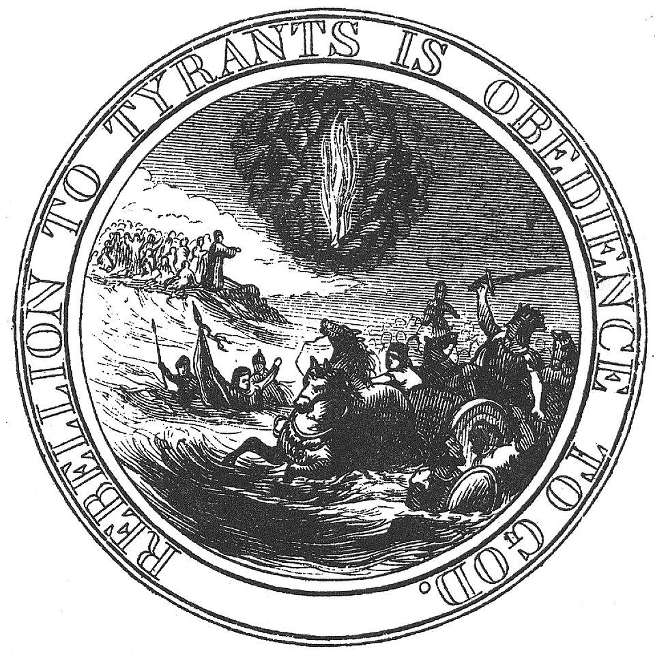
The colonies were religiously diverse on the eve of American independence, but they were also predominantly Christian. As the single most significant text, the Bible provided a common language and interpretative framework for the majority of settlers. Revolutionary leaders drew heavily on Christian scripture to justify the rebellion against British monarchical rule and to sacralize the violence of the war for independence. This was true even for figures who were famously critical of institutionalized religion, such as Thomas Paine. In January of 1776, the recent English immigrant published Common Sense, the treatise that would become synonymous with American revolutionary sentiment. Paine would later describe the Hebrew Bible (or Old Testament) as rather “the word of a demon than the Word of God.”2 Yet in Common Sense, he quoted extensively from the Bible to argue against monarchical rule. “These portions of scripture,” he argued, were “direct,” “positive,” and allowed for “no equivocal construction.” Paine concluded that this could mean one of two things. It was either “true” that “the Almighty hath here entered his protest against monarchical government…, or the scripture is false.”3 Royal power, he claimed, cannot “be defended on the authority of scripture; for the will of the Almighty…expressly disapproves of government by Kings.”4 Benjamin Franklin, moreover, proposed a depiction of the Exodus for the nascent nation’s official seal, with the caption, “Rebellion to Tyrants Is Obedience to God.”5 Whether or not these political leaders personally believed in the Bible, they understood that appealing to Christian scripture could help make their point.6
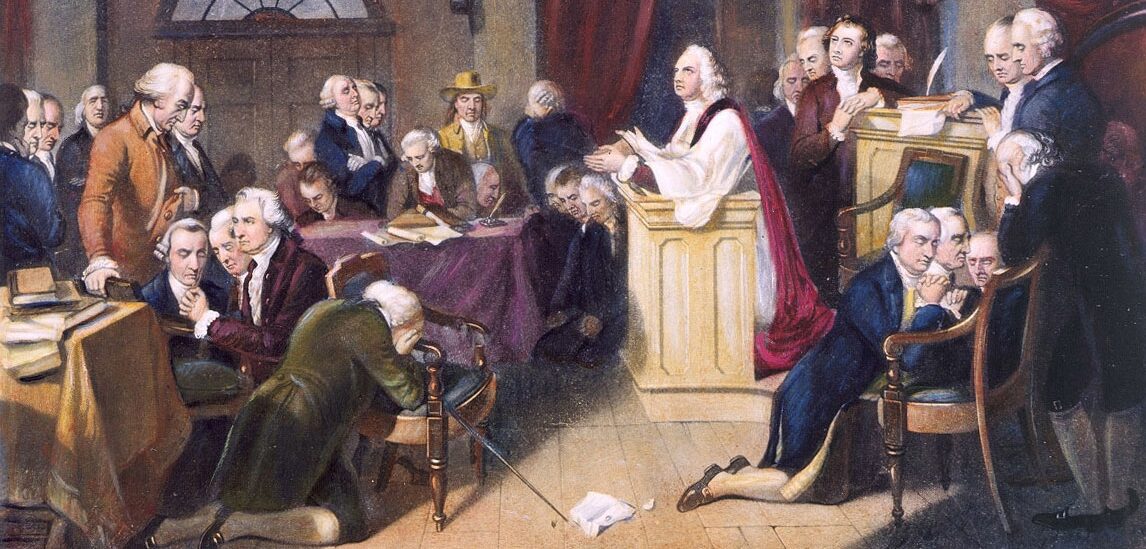
Government officials in the different colonies as well as delegates at the Continental Congress recognized the utility of religion in furthering the war effort. Revolutionaries used Christian rituals to unite the disparate colonies. In 1774, for instance, Virginia declared a fast day—an old Puritan tradition—to express solidarity with Massachusetts after the Boston Tea Party.7 The following year, the Continental Congress proclaimed a fast day throughout all the English colonies on the continent.8 As in previous wars, revolutionary politicians understood the value of army chaplains in boosting soldiers’ morale and increasing their obedience. The Continental Congress established a national chaplaincy on July 29, 1775.9 George Washington, then Commander-in-chief of the Continental Army wrote in December 1775 to the governor of Connecticut, Jonathan Trumbull, praising one chaplain, “the Reverend Mr. [Abiel] Leonard from your Colony,” for “holding forth the Necessity of courage and bravery and at the same time of Obedience and Subordination to those in Command.”10
Wartime preaching also played a significant role off the battlefield. Many colonists looked to their clergy to provide meaning for the experience of violence and war, as they had done in previous armed conflicts during the colonial period.11 During the war, New England clergymen alone delivered over two thousand sermons each week,12 the published versions of which comprised more than four times the total of all political pamphlets.13 As the rift with Britain widened, many clergymen used the Old Testament narrative of the Exodus as a metaphor for revolutionary politics. The wicked Pharaoh represented King George III, the Sea of Reeds the Atlantic Ocean, and imperial policy the bondage of slavery. Beyond the elite clergy, the war also inspired new religious thinking among lay people. The tumultuous political context led many to conclude that the end of times was imminent. Hundreds of men and women emerged as “prophets,” and numerous publications recorded pseudo-Scriptural dreams and visions.14 By the end of the war, the military conflict had physically destroyed many churches, but American religion remained vibrant, diverse, and, in many ways, reborn.
II. Religion, Loyalists, and the Disaffected
The American Revolution was not merely a conflict between American colonists and British forces. It was a civil war, in which the settler population made up a sizeable portion of those fighting to maintain their status as subjects within the British Empire. Despite rising dissatisfaction with Britain among many colonists, there was far from a consensus about the desirability of separating from the mother country. Those labeled “loyalists” or “Tories” by their opponents were motivated by a variety of concerns. Many were caught between the patriotic popular sentiment and their religious commitments. Out of an overall population of under three million, over 30,000 Americans ultimately took up arms for the British, and by the close of the war, twice as many had been displaced into exile.15
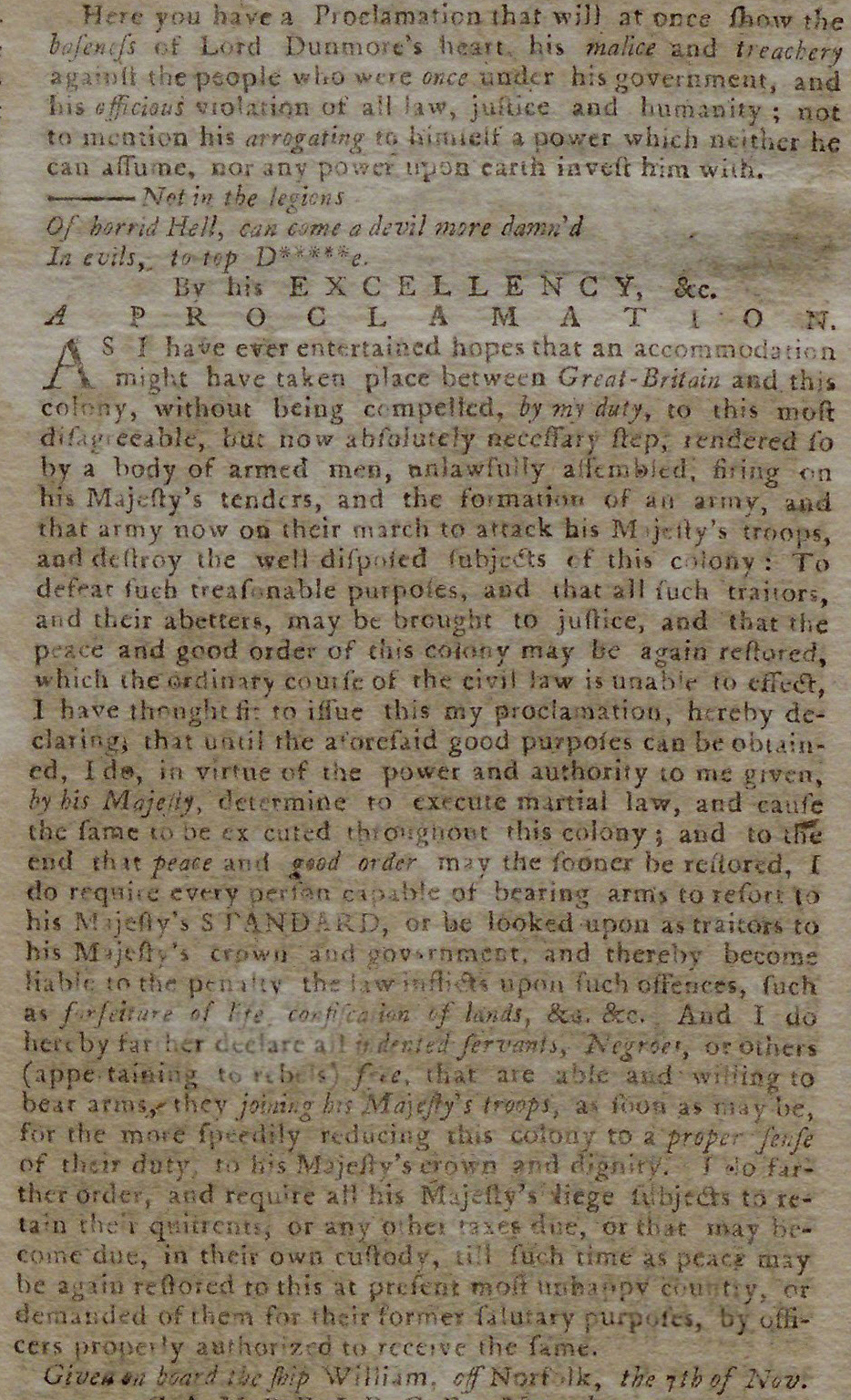
There were many reasons why Americans fought against Independence. Thousands of people of African descent—both previously enslaved and free—fought on the side of the crown during the war. On November 7, 1775, the last royal governor of Virginia, John Murray, the fourth Earl of Dunmore, issued a proclamation declaring “all indented servants, Negroes, or others (appertaining to rebels) free” who were “able and willing to bear arms” to “join the Majesty’s troops.” Around 800 men joined Lord Dunmore’s “Royal Ethiopian Regiment” as a way to secure their legal emancipation.16 Dunmore’s offer of freedom was later expanded by British General Henry Clinton’s Philipsburg Proclamation, and thousands of people gained freedom from slavery through the British Army. Many more gained freedom by running away and hiding among Black communities in cities, swamps, or wherever they could evade recapture.
The patriots’ victory in the war made many of these newly freed people into refugees who sought new homes, including new religious congregations, outside of the newly independent United States. The Black Baptist George Liele (sometimes spelled Lisle, ca. 1750–1820) led a small congregation to Kingston, Jamaica. Members of the group, who came to be known as the Ethiopian Baptists, helped plant other Baptist congregations in rural areas of the island. A large number of African Americans, including Baptists and Methodists, fled to Nova Scotia. More than a thousand later relocated to Western Africa, where they participated in forming Freetown, Sierra Leone. Black loyalists and other people of African descent, who witnessed the expansion of chattel slavery in the new republic, also settled in places such as the Bahamas, Trinidad, and Liberia. Following the Revolutionary War, Black Americans in exile founded churches across the Atlantic World—some of which exist today—and, thus, increased the transnational reach of American religion(s).
The Revolutionary War put members of the Church of England, also called the Anglican Church, in a particularly tough position. King George III was the worldly leader of Britain and its empire, as well as the “supreme governor” of the Church of England, the country’s official—or “established”—religion. Anglican ministers swore an oath to the king as the head of their church, and most considered it their religious duty to promote loyalty to the crown. Anglican ministers largely sided with loyalists.17 As tensions escalated, their religious affiliation made them increasingly the target of patriotic pressure. Especially in New England, where they were a religious minority, Anglicans faced significant hostility.18 A delegation of Massachusetts Anglican ministers reported to the bishop of London in 1768 that “we are neither allowed to speak nor scarcely to be silent unless we join with those who we believe to be laboring in the destruction of our constitution, civil and religious.”19 Members of the Church of England who stayed in the United States after British defeat formed the Episcopal Church in 1789—a body that was fully independent from the English ecclesiastical hierarchy and the crown but maintained key Anglican traditions and theological emphases.
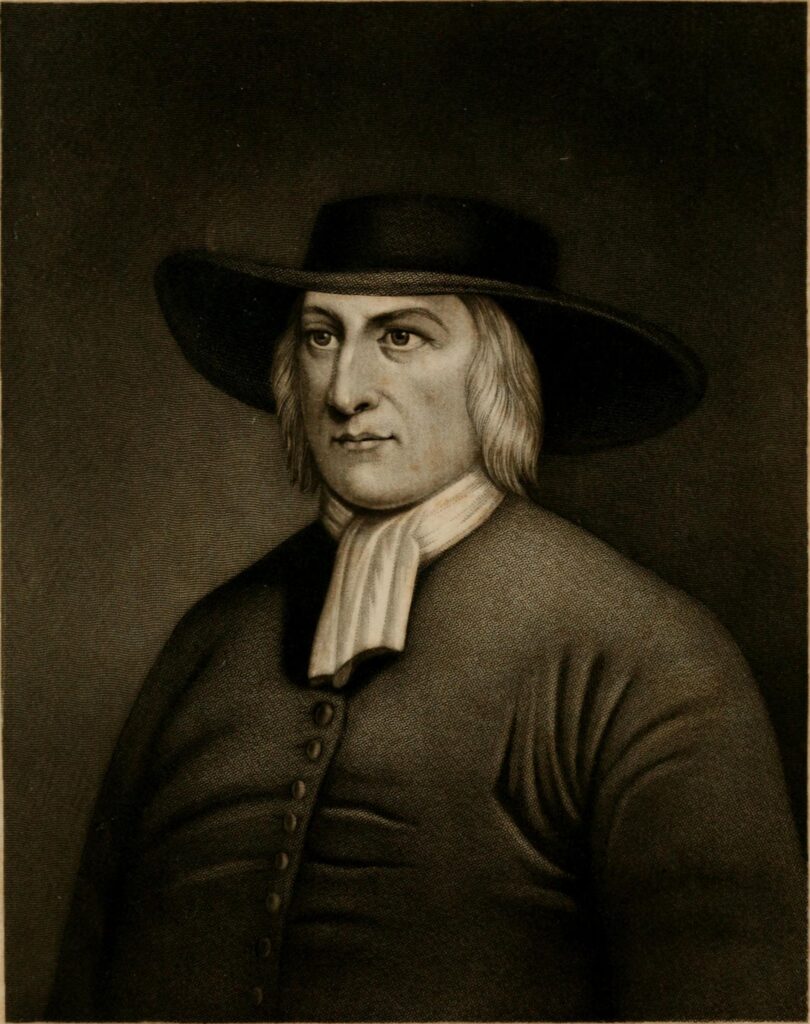
Not all of those labeled “loyalists” were motivated by a deep sense of loyalty to the British crown. Many had tried to stay out of the revolution altogether. The growing intensity of the armed conflict, however, made life for the so-called “disaffected”—“the large and ever-shifting mass of people who were not strongly aligned with either side,” as one historian defines them—increasingly precarious.20 Pacifist sects such as the Society of Friends (“Quakers”), and “Peace Germans” (Moravians, Mennonites, and Schwenkfelders) all opposed armed conflict on theological grounds. These groups experienced difficulty in accommodating the political pressures of the Revolution and the dictates of their faith. In many cases, these religious pacifists had emigrated to the North American colonies from Europe to escape religious persecution and state demands for mandatory military service or swearing oaths.21 While these pacifist groups were present throughout the colonies, they were especially prominent in Pennsylvania, the colony founded by the Quaker William Penn.22
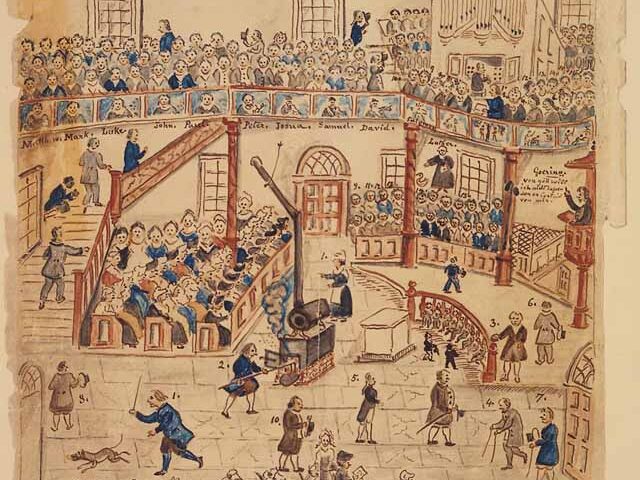
Having religious scruples against direct participation in the Revolutionary War did not necessarily mean that pacifists rejected other settlers’ critique of Britain’s imperial rule. In the early 1760s, before the eruption of armed conflict, Friends (or Quakers) participated in the non-violent protests against the new taxes imposed on the American colonies. Over eighty Philadelphia Friends, for instance, signed a Stamp Act nonimportation agreement (1765).23 The mood began to shift by the time of the new 1768 taxes called the Townshend Duties, however. At this point, the influential Quaker Philadelphia Yearly Meeting judged that further participation in the protest movement would encourage war. In January 1775, the Meeting called on Friends across the colonies to avoid “every usurpation of power and authority in opposition to the laws and government, and against all combinations, insurrections, conspiracies, and illegal assemblies,” under threat of disownment.24 Not all congregants complied. Ultimately, over a thousand Friends were cast out of their religious communities for actively supporting the patriots’ cause.25
But following the directive of religious authority figures, too, could have serious consequences for members of pacifist groups. Over the course of the Revolutionary War, those who hesitated or refused to join the Patriots in securing national independence—whatever their motivations were—came under increasing attack. “If these internal enemies are suffered to proceed with their hellish schemes,” a piece published in the Connecticut Courant in May of 1776 raged, “our ruin is certain; but, if they are destroyed, the power of hell and Britain will never prevail against them.”26 Pacifists’ commitment was tested when revolutionary governments began to require loyalty oaths from all male residents, mandatory militia service, and taxes to explicitly support the war effort.27 Even the Pennsylvania General Assembly proclaimed “allegiance and protection are reciprocal…those who will not bear the former are not nor ought to be entitled to the benefits of the latter.”28 After 1776, states began confiscating possessions of those who did not serve in the militia or swear allegiance to the new governments, seizing land, houses, commercial property, and even clothing and household goods.29 Those refusing to pay fines lost civil rights and could have their property sold at auction.30 After Pennsylvania passed its Test Act in 1777, Patriot militias seized Moravian men and marched them off, jailing some for refusing to swear oaths.31 Between 1775 and 1782, 143 Quakers in northern Virginia sacrificed property for their failure to support the war effort.32 In the midst of heated warfare, the quiet existence of certain minority religions became seen as a potential threat to the revolutionary cause.
III. Deists, Evangelicals, and the Road to Disestablishment
According to many interpreters, from the late eighteenth century to the present day, the legal codification of broad religious freedom guarantees was one of the great triumphs of US independence. In many ways, the so-called religion clauses of the First Amendment to the US Constitution—“Congress shall make no law respecting an establishment of religion, or prohibiting the free exercise thereof”33—were indeed revolutionary. For centuries, established churches had been the rule throughout Europe. These included both Catholic and Protestant churches that were recognized by the government or worldly ruler as the official religion of the state.34
In most European nations, religious dissenters experienced persecution, discrimination, violence, as well as financial and legal repercussions for openly practicing their faith or refusing to join the established church. As James Madison described it in an 1833 letter to a clergyman, in the eighteenth century, “the legal establishment of a particular religion without…or with very little toleration of others” was “taken for granted” as an “essential” “part of the political & civil organization.” It was “the prevailing opinion in Europe,” he continued to explain, “that Religion could not be preserved without the support of Government, nor government be supported without an established Religion.” But, Madison argued, “few of the most enlightened judges” would now “maintain that the system has been favorable to either Religion or to Government.” Church establishments and religious intolerance, he and other revolutionaries argued, were part of the European legacy that the new American nation, with its more “enlightened” government, needed to leave behind. It was up to them to put the “great & interesting subject to a fair…[and] decisive test.”35
Although Madison and other so-called “founding fathers” celebrated their “enlightened” nation for its departure from European-style church establishments, they knew that they were not the first champions of religious freedom. Beginning in the late seventeenth century, philosophers and theologians across Europe increasingly debated the soundness of strict church establishments and articulated the value of tolerating different religious groups within the same body politic.36 Many came to see religion as a private matter between individuals and their god. The English philosopher and theologian John Locke famously articulated these ideas in his 1689 Letter Concerning Toleration. The power of government, in his view, “neither can nor ought in any Manner to be extended to the Salvation of Souls.” Locke believed that true religion “consists in the inward and full Persuasion of the Mind” and that no one could “be compelled to the Belief of any Thing by outward Force.”37 A church was, then, a “voluntary society of men,” which should be “absolutely separate and distinct from the commonwealth.”38 While the concept of separating church and state was not an American invention, US independence and the framing of a new government provided an unprecedented opportunity to make religious freedom a political and legal reality.
Many of the so-called “Founding Fathers” and other leading figures of the revolutionary period—such as Thomas Jefferson, James Madison, Benjamin Franklin, and Thomas Paine—fell on what one historian has described as “the Deist spectrum.”39 Deists were a product of the Enlightenment-era embrace of human reason over an allegedly irrational “superstition.” They generally acknowledged the existence of a god who had created the universe but rejected the supernaturalism of traditional Christianity. This means that Deists rejected the divinity of Jesus, the idea of divine intervention, biblical miracles, and claims that the Bible was divinely inspired.40
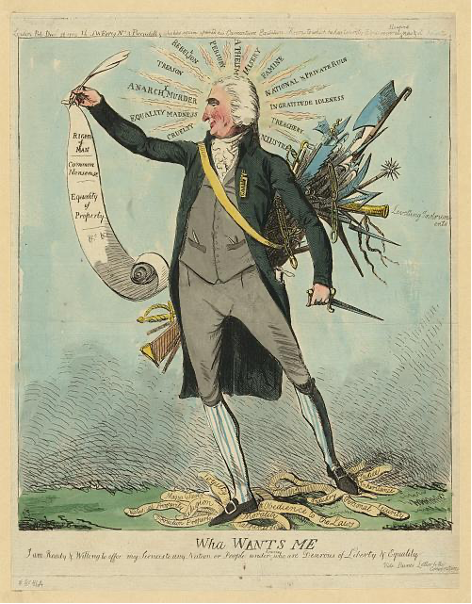
According to some accounts, deist advocates of church and state separation anticipated or even hoped that the principles enshrined in the First Amendment would lead to a thorough secularization of American society. But they were far from modern-day atheists. Although Jefferson rejected many of the elements that would have been considered central to Christian orthodoxy, he continued to uphold the moral teachings of the Bible and believed that the spread of a “rational” version of Christianity would actually benefit republicanism and support national progress.41 As one historian has argued, “while Jefferson demanded a firm wall of separation between church and state, he neither feared nor opposed a flourishing religious society beyond that wall.”42

As was true for other decisions regarding the US government, its relationship with religion was the result of debate and compromise. Virtually all of the leading politicians rejected the idea of a strict church establishment like the one in England, but they disagreed on the details of what to do. Some politicians promoted a model of local religious establishments, in which individual communities would establish distinct churches. Others argued that the US government should support not a specific church but religion more generally, in the form of tax exemptions, donating public lands, financially supporting religious schools and charities, and by legally prohibiting things like blasphemy.43 At the time, even advocates of religious toleration or freedom usually believed that religion was necessary to uphold public morality. Without a religious populace, many argued, republics—where so much rested on the individual citizen’s virtue—would sink into anarchy.44 Ultimately, religious freedom meant different things to different people. In his Notes on the State of Virginia, Thomas Jefferson declared that “it does me no injury for my neighbour to say there are twenty gods, or no god. It neither picks my pocket nor breaks my leg.”45 But Jefferson’s support of extending full equal rights to polytheists and atheists made him an outlier even among deists.46 Most of his peers expected that US society would remain predominantly Christian.
Skeptics of institutional religion and Christian orthodoxy were not the only forces behind American disestablishment. The adoption of the Virginia Statute for Religious Freedom and the First Amendment to the US Constitution also depended on the support of evangelical Christians, such as the Baptists, who opposed close church-and-state relations on theological grounds.47 The common ground between Enlightenment thinkers and evangelical believers is particularly obvious in a letter exchange between a committee appointed by the Danbury Baptist Association and Jefferson in 1801 and 1802. The Danbury Baptists, as they are typically called, began their letter congratulating Jefferson on his “appointment to the chief Magistracy in the United States.” After expressing their “great satisfaction” about the third US president’s “Election to office,” they quickly moved on to their actual concern. “Our Sentiments,” they stressed, “are uniformly on the side of Religious Liberty—That Religion is at all times and places a Matter between God and Individuals—That no man aught [sic] to suffer in Name, person or effects on account of his religious Opinions—That the legitimate Power of civil Government extends no further than to punish the man who works ill to his neighbour.”48
Jefferson wrote back to the “Gentlemen” the following January. After returning the customary pleasantries, the president expressed his solidarity with the Danbury Baptists’ concerns. He agreed “that religion is a matter which lies solely between Man & his God, that he owes account to none other for his faith or his worship, [and] that the legitimate powers of government reach actions only, & not opinions.” Jefferson praised the First Amendment’s religion clauses as an “expression of the supreme will of the nation in behalf of the rights of conscience” and a step toward “building a wall of separation between Church & State.”49 The phrase did not appear in any of the twenty-five proposals for federal religion clauses drafted and discussed between 1787 and 1787.50 However, as one historian has put it, “Jefferson’s architectural metaphor, in the course of time, has achieved virtual canonical status and become more familiar to the American people than the actual text of the First Amendment.”51 The exchange also serves as a reminder that religious actors participated in making American religious freedom a reality.
Baptists and many of the groups who benefited most from the new American legal regime of religious disestablishment had first-hand experience with different forms of religious intolerance and persecution in Europe and the North American colonies. In the late 1630s, the Baptist Roger Williams was famously expelled from Puritan Massachusetts and founded the colony of Rhode Island (originally called Providence Plantations) as a safe haven for religious dissenters in New England. Williams argued that every individual should be free to follow his own convictions in religious matters, for, in his words, “forced worship stinks in the nostrils of God.”52 The Puritan establishment in New England saw Baptists like Williams as “incendiaries of the commonwealths and the infectors of persons in main matters of religion and the troubles of churches in all places where they have been.”53 Further attempts of Baptist dissenters within seventeenth-century Massachusetts or Connecticut were “bludgeoned into silence or exile.”54 An attempt to build a meeting-house in the heart of Boston in 1679, for example, led to its being boarded up when there was an attempt to use it for worship. As a result, in 1700 there were only twenty-four Baptist churches in the American colonies.55 By the late eighteenth century, things had changed dramatically. In 1780, Baptists had about 400 congregations.56
One of the key Baptist leaders during the American Revolution was Isaac Backus. Like Williams, Backus was convinced that “religion must at all times be a matter between God and individuals”57 and that “true religion is a voluntary obedience unto God.”58 “[S]ince religion is ever a matter between God and individuals,” he asked his supporters of church establishments, “how can any man become a member of a religious society without his own consent?”59 For Backus, the church was a voluntary society of believers. A state church, therefore, could not be a true church because it forced people to belong to it against their wills.60 If state and church stayed in their own lanes, he argued, both sides would profit. This was what Backus called the “sweet harmony”: “civil rulers ought to be men fearing God, and hating covetousness, and to be terrors to evil doers, and a praise to them who do well; and as ministers ought to pray for rulers, and to teach the people to be subject to them; so there may be and ought to be a sweet harmony between them.”61
The Continental Congress did not immediately settle the question of the proper relationship between church and state. The original text of the Constitution, adopted in 1787 and ratified in 1788, prohibited “religious Test[s]” as a requirement for federal office holding in Article VI, but otherwise remained largely silent on religious matters. This was not an oversight. The delegates gathered at the Constitutional Convention generally assumed that questions of religious freedom (along with all other matters not explicitly granted to the federal government) would be resolved on the state level. In fact, by the time of the Constitutional Convention in 1787, all thirteen state governments had either created new religious freedom protections or retained the respective provisions made in their colonial charters. However, many Americans ended up being dissatisfied with the omission of specific civil liberties—a federal bill of rights—from the original text of the Constitution. As records of the state ratification debates suggest, specifically the absence of any religious freedom guarantees troubled many. Several states ratified the Constitution only on the condition that the First Session of Congress would amend the document accordingly.62
The members of the First US Congress (1789-1791) who came together in New York and later Philadelphia to draft a federal bill of rights drew on the debates about religion which had taken place in their respective home states. The Virginia Statute for Religious Freedom, written by Thomas Jefferson, proved especially influential.63 First introduced in the state’s General Assembly in 1779, the bill finally passed in 1786 under the leadership of James Madison, who—during Jefferson’s absence as a diplomat in France—had to defend the proposal against outspoken opponents. Madison’s petition titled Memorial and Remonstrance Against Religious Assessments helped shift public opinion in the bill’s favor. The Virginia Statute’s broad religious freedom guarantees and strict break with the long tradition of religious establishments are considered an important precedent for the religion clauses of the First Amendment, passed by the First Congress on September 25, 1789.
IV. Religious Freedom and Its Limits
Baptists and other religious minorities celebrated the principles enshrined in the First Amendment. But they knew that the law had its limitations. Like the rest of the US Bill of Rights, its religious freedom protections only applied to the federal government and not the states (this only changed with the Fourteenth Amendment, ratified in 1868). Several states, such as Virginia, outlawed religious establishments in their state constitutions either before or soon after the ratification of the First Amendment. Others did not. While all states granted their constituents some degree of religious freedom, several held on to their colonial-era church establishments, giving certain groups privileges over others, including supporting them with tax money. Eleven states had oaths of office that restricted non-Christians, so-called Anabaptists, and other radical Christians from office-holding; eight states supported particular churches through taxes, and atheists were barred from participating as witnesses in courtrooms.
The last states to disestablish were Connecticut in 1818 and Massachusetts in 1833. In their 1801 letter to Thomas Jefferson, the Danbury Baptist Association64—most of whose member churches were located in Connecticut—highlighted the fact that whatever “religious privileges” they had as members of a religious minority in the state, they “enjoy[ed] as favors granted, and not as inalienable rights.” As long as it was considered an “object of Legislation” left up to individual states, they feared, their “Religious Liberty” was at risk of being taken away.65
Despite the supposed separation of church and state at the federal level, lawmakers continued to uphold many of the obviously religious (and more specifically Christian) rituals and policies implemented by the Continental Congress between 1774 and 1789, such as opening their daily sessions with prayer, and appointing (and funding) chaplains.66 At his presidential inauguration on April 30, 1789, Washington swore his oath of allegiance on the balcony of Federal Hall and then gave a short address in which he reminded his listeners that “No people can be bound to acknowledge and adore the Invisible Hand which conducts the affairs of men more than those of the United States. Every step by which they have advanced to the character of an independent nation seems to have been distinguished by some token of providential agency.”67
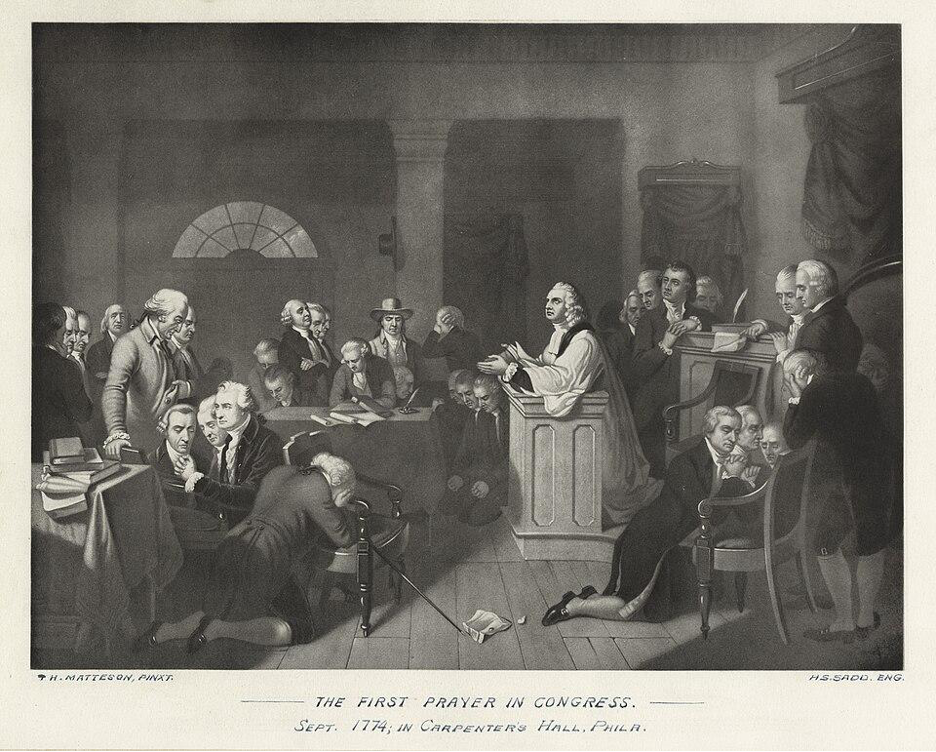
Washington invited Americans to imagine the nation as supported and approved by a benevolent God. He would go on to declare a Thanksgiving Day on November 26, 1789. In his Thanksgiving Proclamation, he reminded Americans that “it is the duty of all Nations to acknowledge the providence of Almighty God, to obey his will, to be grateful for his benefits, and humbly to implore his protection and favor.”68 Washington imagined that the new nation would be supported by God’s providence. Although there was no established church in the United States, many Americans remained convinced that America was God’s chosen nation and that the combination of democracy and a populace attentive to God’s providence would make America successful.
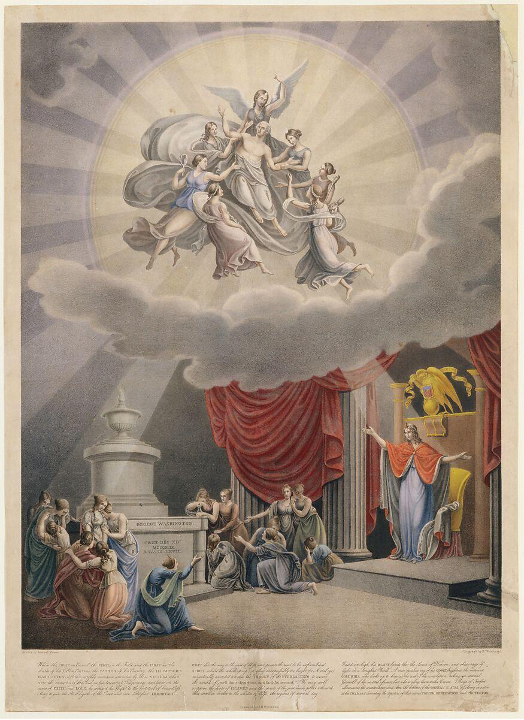
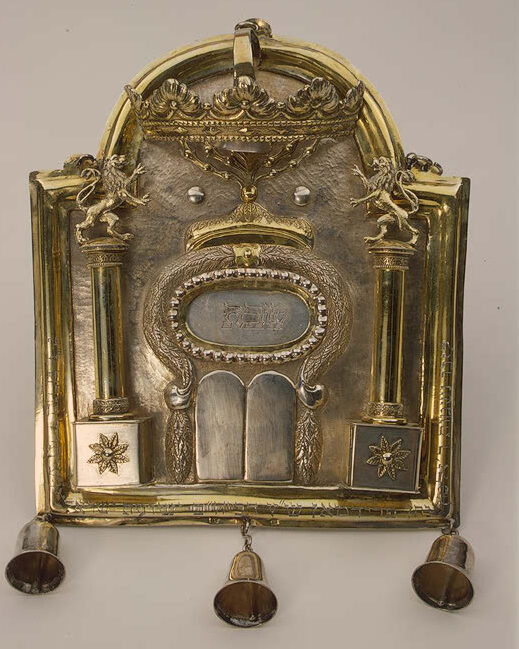
While the “wall of separation between Church & State”69 remained porous and Protestant Christianity maintained its dominant position, the legal regime of religious freedom in the early republic improved conditions for some religious groups which had historically been excluded from public life. Jewish Americans were granted full citizenship at halting and inconsistent levels. Still, on the eve of American independence, Jews received greater recognition for civil rights than elsewhere in Europe, where persecution remained the norm.70
In the decades and years leading up to the Revolution, Jews had actively participated in both the movement for and against American independence. Those in favor signed non-importation agreements, petitioned along with their Christian neighbors, and joined the Sons of Liberty. During the war, they served in the Patriot Army, some even in leading positions. Colonel Mordecai Sheftall of Savannah held the third-highest rank in the Patriot Army, behind Brigadier and Major generals. Solomon Bush and David S. Franks served as lieutenant colonels, and more than a half dozen other Jews were officers. The role of these Jewish officers in positions of authority indicates an erosion of antisemitism. Other Jewish men supported the crown, including David Franks, who provided materials to British troops from his home in Philadelphia, and the Hart family of Newport, Rhode Island, who contributed to the crown through both espionage and active combat.
American Jews also increasingly held positions of authority outside of the military. In 1774, Francis Salvador was elected to South Carolina’s Provincial Congress and in 1776 was elected to the new state’s General Assembly, thus becoming the first Jew elected to a legislature in both the new United States and the Atlantic world. David S. Franks transitioned from his career in the army to serving as a diplomat in North Africa and then as an aide to Thomas Jefferson on his diplomatic mission to France. He later joined the Washington administration. In the 1790s, Jews were elected to public office in New York and Pennsylvania. Solomon Simson, the former president of Shearith Israel, won two consecutive terms as the assessor for New York City. Under Jefferson and Madison, Joel Hart and Mordecai Manuel Noah served as diplomats. Noah, a major in the militia, was later the sheriff of New York City and then a judge.71
Reflecting on his recent visit to Newport, RI, and the “cordial welcome” he had received there “from all classes of Citizens,” George Washington addressed a letter to the local Jewish congregation in August of 1790. He reaffirmed his administration’s commitment to religious freedom, offering exactly the kind of message that Jewish Rhode Islanders wanted to hear:
“All possess alike liberty of conscience and immunities of citizenship. It is now no more that toleration is spoken of, as if it was by the indulgence of one class of people, that another enjoyed the exercise of their inherent natural rights. For happily the Government of the United States, which gives to bigotry no sanction, to persecution no assistance requires only that they who live under its protection should demean themselves as good citizens, in giving it on all occasions their effectual support.”72
“May the children of the Stock of Abraham, who dwell in this land,” Washington wrote in closing, “continue to merit and enjoy the good will of the other Inhabitants.”73 While these words are nearly entirely plagiarized from the language that the Jewish congregation in Newport used when writing to Washington, his willingness to recognize Jewish claims of belonging indicates the transformations of religious liberty in the period. However, these advances for Jewish Americans occurred right as the rights of African Americans and Indigenous people were being attacked and eroded, as will be discussed below.74
Writing in retrospect in 1833, Madison described the American experiment with disestablishment and religious freedom as a resounding success. The “existing character” of the young United States, “distinguished as it is by its religious features…now more than fifty years, since the legal support of Religion was withdrawn,” he argued, “sufficiently prove[d], that it does not need the support of Government. And it will scarcely be contended that Government has suffered by the exemption of Religion from its cognizance, or its pecuniary aid.”75 Disestablishment, he argued, had ultimately benefited both “Government” and “Religion.”
V. Revivalism and Religious Diversification in the Early Republic
Religion indeed flourished in the early republic. National disestablishment and religious freedom provided a fertile ground for religious innovation and experimentation, creating what many scholars have referred to as a competitive and increasingly pluralistic religious marketplace, despite continuing prejudices against non-Protestants. As the United States grew in terms of land and people—through conquest and immigration—over the course of the early national and antebellum periods, so did its number of churches, rising from 4,696 in 1790 to an estimated 52,500 in 1860.76
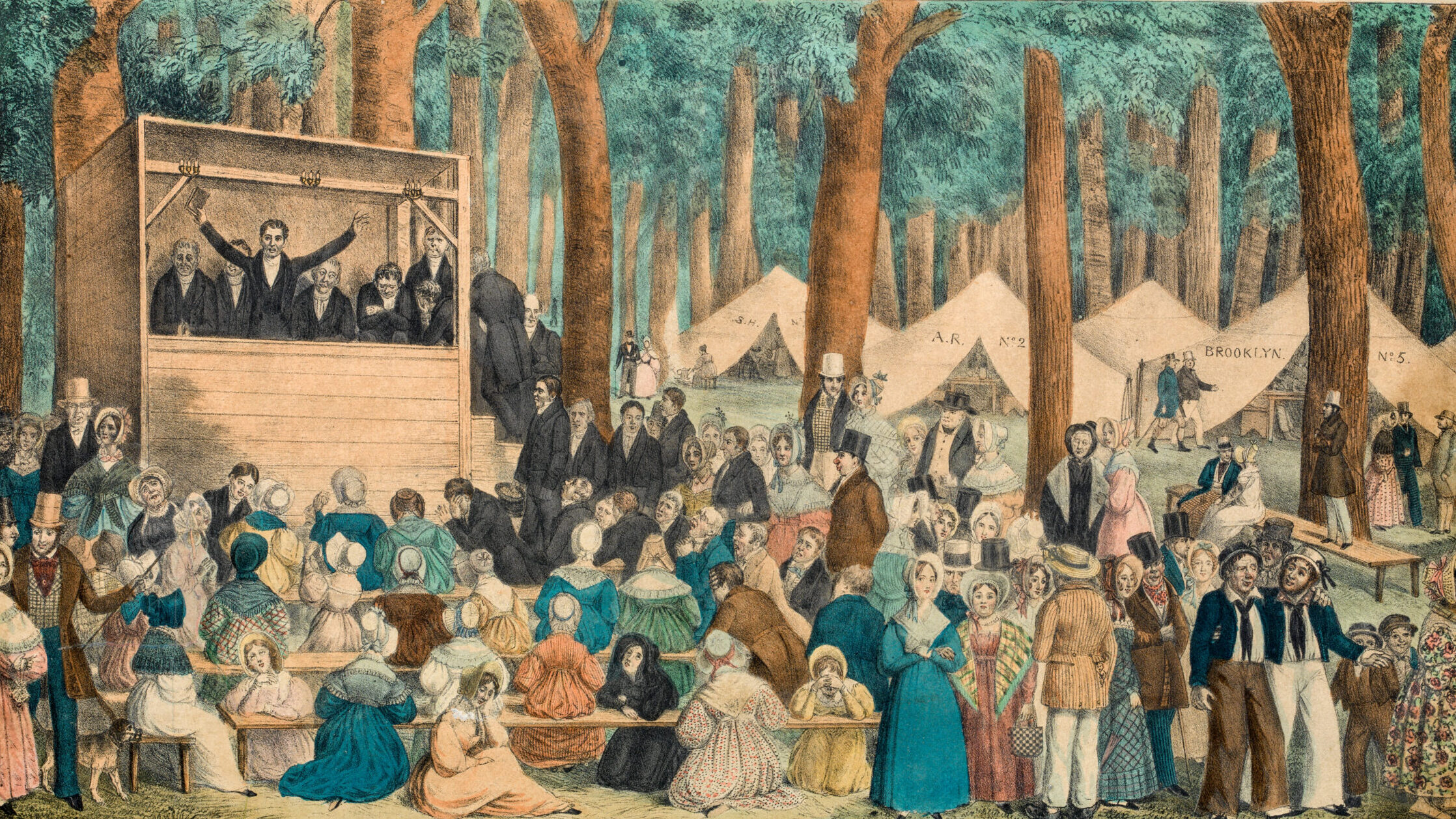
One of the most significant developments of the period was the growth of evangelical Protestantism—an interdenominational movement emphasizing a spiritual rebirth—into a mass phenomenon. Beginning in the 1790s, a new wave of religious revivals—often referred to as the Second Great Awakening—led to an increase in church membership across the Protestant denominational spectrum. Evangelical revivals in the early republican period took on a variety of forms, ranging from orderly spiritual renewal within churches to large, unruly, outdoor camp meetings that included highly advertised spectacles, featuring charismatic preaching and converts overcome by intense emotions and exhibiting spiritual gifts such as holy laughter or speaking in tongues. Proponents saw these as evidence of a genuine outpouring of the Holy Spirit. Skeptics, including more moderate evangelicals, viewed the lack of order and discipline and alleged enthusiasm as unnecessary and possible signs of the devil’s involvement.
A revival at Cane Ridge, Kentucky, drew between 10,000 and 20,000 people. Beginning in August of 1801, it became one of the signal events of the Second Great Awakening. One of the largest outdoor camp meetings in decades, the Cane Ridge Revival showed how early republican revivalism promoted the emergence of new religious movements outside of established denominations. Interdenominational by design, the meeting was led by the minister Barton Stone. Although Stone was a Presbyterian minister at the time of the revival, he is better known for being a leading figure in the Restoration Movement. Restorationists believed that reforming society was best done by restoring the early Christian church described in the New Testament. They embraced the belief that the pure religion of Jesus had become increasingly corrupted in the centuries since his death. The only way to recapture that original perfection was to remake the world in the image of the “primordial” days – a conviction known as primitivism.77
For Barton Stone, the desire to return to ancient models emerged from a discontent with the fragmented nature of contemporary Protestantism into different denominations. Swept up in the success of the Cane Ridge Revival, Stone announced the death of his “sect”—the Presbyterian Church—in 1804 by issuing The Last Will & Testament of the Springfield Presbytery. With dramatic flair, Stone and his followers, “in perfect soundness and composure of mind,” willed “that this body die” so that it might “sink into union with the Body of Christ at large.”78 Stone’s decision to sever his ties with his original denomination and encourage his followers to do the same was part of a larger pattern that distinguished the early republican revivalism from the so-called First Great Awakening in the early to mid-eighteenth century—a revitalization movement that primarily took place within existing denominations.
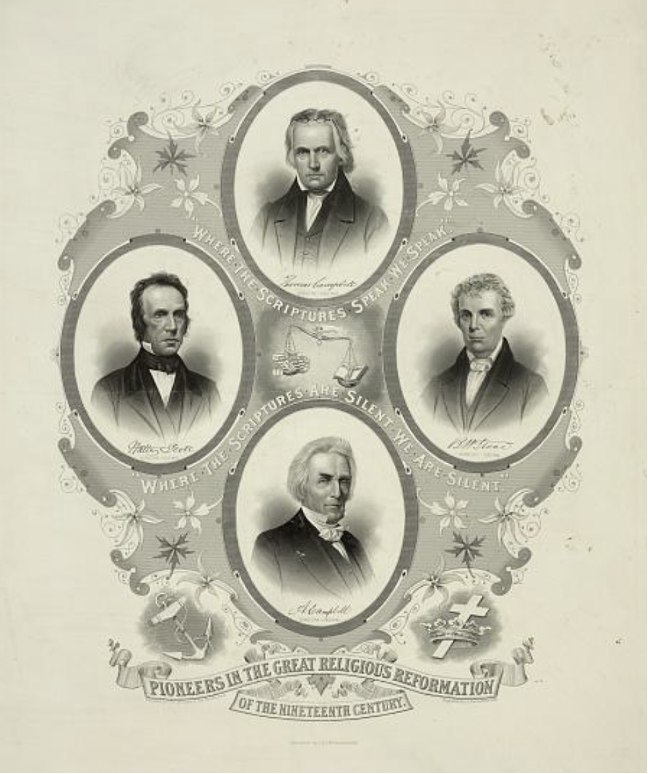
His mission to restore the ancient world through a literal reading of the Bible connected Stone to other primitivists of the age, including Thomas Campbell and his son Alexander, both of whom had recently immigrated from Scotland. In 1809, Thomas Campbell issued his Declaration and Address, a pivotal document for restorationists, which outlined a similar agenda to Stone’s in Kentucky. Campbell insisted they were fostering reform and unity by “opening up the way, that we may come fairly and firmly to original grounds…and take up things just as the Apostles left them.–That thus disentangled from the accruing embarrassments of intervening ages, we may stand with evidence upon the same ground on which the church stood at the beginning.”79 Having thrown off the labels of “Presbyterian,” “Methodist,” and “Baptist,” Restorationists preferred more ‘historical’ labels, such as “Christians” or, older still, “Disciples.”
The various restorationists united in 1832 under the combined influence of Barton Stone and Alexander Campbell.80 The focus among “Christians” or “Disciples” on restoring the conditions of the early church precluded them from participating in the reform efforts embraced by an increasing number of Americans in the early republican and antebellum periods. Restorationists believed that even the “millennium,” the return of God, would not bring newness. “Just in so far as the ancient order of things, or the religion of the New Testament, is restored,” Alexander Campbell wrote in 1825, “just so far has the Millennium commenced.”81 This stifled religious vision had wider social and cultural consequences, especially when it came to abolition and women’s rights. In both cases, restorationists’ literal reading of the New Testament convinced them of a lack of ‘scriptural’ precedents for abolishing slavery or for women’s leadership in church or society.
Although all Protestant denominations grew in the context of the Second Great Awakening, not all did so at the same speed. This lastingly changed the landscape of American Christianity. In terms of membership growth, Methodists and Baptists were the clear winners of the early republican revivals. Both were more open to recognizing lay religious authority and experimenting with new revivalistic methods. These denominations—neither of which had experienced the comforts of being the established church in any of the colonies—had an easier time adjusting to the new legal and social conditions. At the time of national independence, Congregationalists—with 668 churches and twice as many preachers as any other denomination in British North America—had been the dominant force in American Protestantism.82 By 1820, things had changed drastically. While Congregationalists had nearly doubled their number of churches, Baptists and Methodists had grown from 497 and 495 churches in 1776, respectively, to approximately 2,700 each.83
Groups such as Methodists and Baptists, on the whole, were more willing than some Protestant contemporaries to challenge certain kinds of traditional religious authority.84 For instance, they often recognized the charismatic authority of lay itinerant preachers over formally trained and ordained clergy. While it would be misleading to think of these Baptists and Methodists as egalitarian, the prioritization of personal new birth experiences did provide more opportunities for those generally excluded from positions of power, such as Americans of African descent.
White Baptists, inspired by Jonathan Edwards’s evangelical Calvinism, began preaching among Black people in New England, South Carolina, and Georgia in the 1760s, converting a few and baptizing them by immersion. They also encouraged a small number of Black men to preach as exhorters but usually restricted them from performing the sacraments (called “ordinances” by Baptists) of baptism and communion. A scarcity of first-hand accounts produced by the largely disenfranchised people of African descent in this period makes it difficult to ascertain what drew individual Black converts to a specific denomination and how they experienced their conversion to Christianity. Some scholars have observed that Baptist rituals meshed well with some West African cosmologies. Conversion as experienced at the hand of a revivalistic preacher might have seemed similar to spirit possession as known in some West African religions. Baptism by immersion made sense to those who knew of water spirits and had heard of religious ceremonies involving substances like salt. A deity predetermining all events (most early Black Baptists were Calvinists) was familiar not only from West African religions but also from Islam, which had touched many of the regions on the African continent most impacted by European colonialism and the transatlantic slave trade. Independent Black Baptist congregations, moreover, could also offer women and men of African descent a degree of autonomy and self-determination, which—whether enslaved or free—they were denied in American society as a whole.
Early Black Methodism originated in the efforts of English missionaries like George Whitefield, John Wesley, Francis Asbury, and Thomas Coker. Preaching divine care for the disenfranchised and the need for immediate acceptance of divine presence in one’s life, these men were successful in bringing Black people into the church. White evangelicals’ interest in converting Americans of African descent did not necessarily lead them to reject slavery. Wesley ultimately came to oppose the institution as cruel and sinful. Whitefield, on the other hand, legally owned enslaved people. Generally speaking, most White Methodists did not welcome Black believers as equal church members. In the late eighteenth century, Methodist churches with biracial congregations enforced segregation, pushing Black members into crowded or obscured seats. One important incident in early Black Methodism occurred in 1787 in Philadelphia when Richard Allen led Black congregants out of the church after they were ordered not to pray in an area claimed for White worshippers. The walkout ultimately resulted in the founding of the African Methodist Episcopal Church (AME Church), the first separate Black American denomination.
VI. Reform and Mission
Fueled by the religious revivals in the decades after national independence, Americans turned with a renewed interest to reform. Anxieties about the moral character of a society undergoing dramatic demographic and geopolitical changes motivated many evangelical Protestants to pursue causes like temperance, education, and antislavery efforts. Cut off from much of the European institutional support, they founded a multitude of voluntary, lay-led societies modeled after British examples.85 Many of these were denomination-specific or regional, but around the turn of the century, transregional and inter-Protestant efforts emerged. Women often took on leading roles within this movement of social reform, which is sometimes referred to as the “Benevolent Empire.”86
Many early republican evangelicals came to understand it as their duty to facilitate the spread of Christianity, in the United States as well as abroad. In June of 1810, Adoniram Judson Jr., Samuel Nott Jr., Samuel J. Mills, and Samuel Newell, students at Andover Theological Seminary, approached the Congregational ministers who made up the General Association of Massachusetts. Declaring that “their minds have been long impressed with the duty and importance of personally attempting a mission to the heathen,” the four young men requested the guidance “of their Rev. Fathers” on how they could devote themselves to the cause. The General Association agreed that the “object of missions to the heathen cannot but be regarded, by the friends of the Redeemer, as vastly interesting and important.”87 Citing the Great Commission that a resurrected Jesus Christ had given to his disciples—“go ye into all the world, and preach the gospel to every creature”88—they claimed that each Christian had a duty to participate in the conversion of the world. Based on these beliefs, they voted unanimously to create an institution to support that effort.89 And in so doing they birthed the American Board of Commissioners for Foreign Missions (ABCFM), the first nominally interdenominational and national foreign missions society in the young United States. It would become the most significant body of its kind in the nineteenth-century US.
The foreign missions movement emerged in the context of ongoing evangelical revivals (commonly known as the Second Great Awakening) and a renewed dedication among American Protestants to social and moral reform around the turn of the nineteenth century. Its declared goal was nothing if not ambitious: the “conversion of the world” (which, according to an 1818 ABCFM pamphlet, required evangelizing every human who wanted the gospel.90 Although nineteenth-century evangelicals generally believed that Christ had died for all of humanity, without access to the saving message of the Bible, the large majority of the world’s population was thought to be headed toward eternal damnation.91 The widespread conviction that the end-times were fast approaching lent a sense of urgency to global conversion efforts. While its supporters were motivated by deep spiritual commitments, the early Protestant foreign missions movement also depended on European and American imperial expansion for physical access to distant lands as well as material support.92
The founding of the ABCFM and various state- and denomination-based mission societies represented the opening of a new chapter in the history of American Protestantism. But the notion that Christians needed to save so-called “heathen” populations was not new.93 In fact, this belief had legitimized European settler colonialism and conquest in the Americas from the very beginning. The 1629 seal of the Puritan Massachusetts Bay Colony, for instance, depicted a Native American man with the words “Come over and help us!”94 The mostly British-funded evangelizing activities conducted by Protestant Euro-Americans during the colonial period, however, remained largely unsuccessful in terms of Native American conversion.95
Nineteenth-century missionaries understood themselves to be part of this colonial-era legacy. But it was the recent evangelizing work conducted by Europeans that served as a more immediate catalyst. American efforts built on and helped re-intensify older transatlantic religious networks. Sermons, tracts, and evangelical newspapers exposed large numbers of Americans to missionary intelligence from across the globe. The reports of British evangelicals laboring in India and Tahiti under the auspices of the London Missionary Society (LMS), especially, garnered much attention among American Protestants. It was these reports, as well as direct guidance from the LMS, which helped Board leaders decide on the ABCFM’s first mission site. Within two years of the organization’s founding, the first American missionaries set sail for Asia.96 Before their departure in 1812, they were instructed to regard “[t]he Christian Missionaries of every Protestant denomination, sent from Europe to the East, …as your brethren; the servants of the same Master, and engaged in the same work with yourselves.”97 Spreading the Kingdom of God was understood as a transnational Protestant affair.
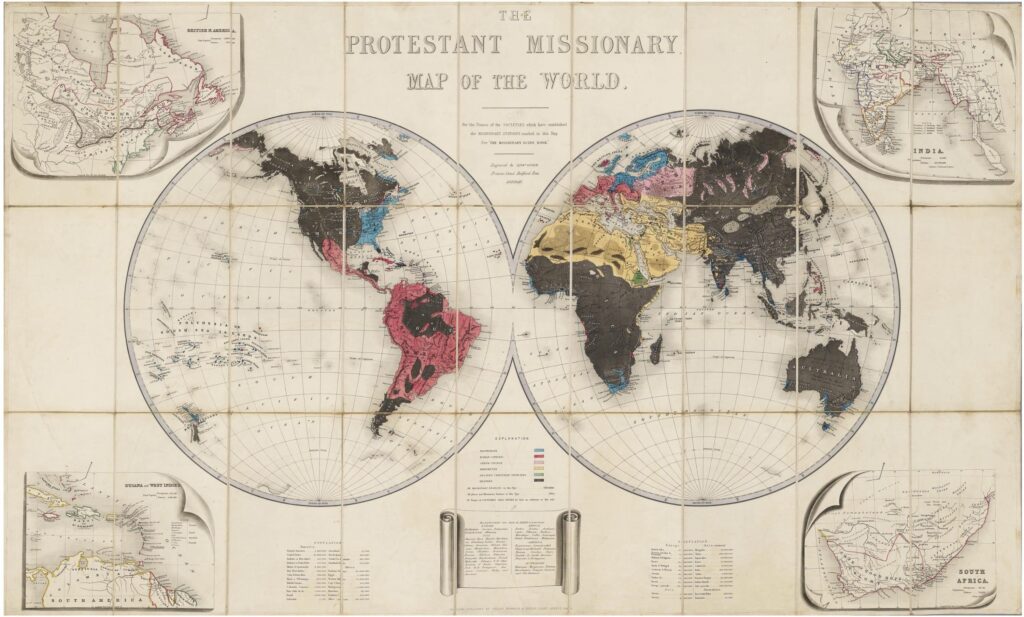
By the time of its bicentennial “jubilee meeting” in 1860, the ABCFM’s then-president proudly announced that the organization’s many mission stations now “belt the globe, so that the sun does not set upon them.”98 Over the course of its first fifty years of existence, the ABCFM had dispatched roughly thirteen hundred missionaries and missionary assistants. Compared to the “heyday”99 of American foreign mission activity beginning after Reconstruction, this number was modest. But the influence of the missionary impulse on American society in the early republic and antebellum period cannot be accurately gauged from the lists of those employed by mission societies. Mission work, after all, was an expensive endeavor that relied on the broader public’s ideological and financial support. The ABCFM and other nineteenth-century mission societies thus invited, or rather urged, Americans at home to imagine themselves as active participants in the cause. As one historian has recently argued, “popular interest in and devotion to the missionary cause” permeated American culture in the early republic.100
VII. Conclusion
The American Revolution transformed American religion as profoundly as it reshaped American politics. Religion helped inspire, execute, and sustain the movement for Independence as well as galvanize opposition to the American rebellion. The Revolution dealt a blow to the millennia-old tradition of state-sponsored religion, unleashing a new era of religious creativity and competition. From camp meetings to reform societies, Americans yearned to see God’s kingdom take hold in their new nation. Protestantism remained hegemonic in American culture, yet practitioners of religious traditions and those opposed to all of them continued to carve out spaces for themselves. As Americans claimed a place for themselves on the global stage, they did so through a renewed commitment to meshing their national identity with their visions of divine destiny. These powerful dreams proved to be nightmares for many, yet their power would only grow in the coming decades.
VIII. Reference Material
This chapter was edited by Johanna I. Mueller, with content contributions from Michael A.G. Azad Haykin, Shannon Duffy, Paul Finkelman, Gino Grivetti, Israel Ben-Porat, Johanna I. Mueller, John Saillant, Tara Strauch, Ben Wright, and Kristofer Zimmitti.
Recommended Readings
- James B. Bell, A War of Religion: Dissenters, Anglicans, and the American Revolution (Palgrave Macmillan, 2008).
- Jon Butler, Awash in a Sea of Faith: Christianizing the American People (Harvard University Press, 1992).
- Katherine Carté Engel, Religion and the American Revolution: An Imperial History (University of North Carolina Press, 2021).
- Emily Conroy-Krutz, Christian Imperialism: Converting the World in the Early American Republic (Cornell University Press, 2015).
- David L. Holmes, The Faiths of the Founding Fathers (Oxford University Press, 2006).
- Nathan O. Hatch, The Democratization of American Christianity (Yale University Press, 1989).
- Thomas S. Kidd, God of Liberty: A Religious History of the American Revolution (Basic Books, 2010).
- Kathryn Gin Lum, Damned Nation: Hell in America from the Revolution to Reconstruction (Oxford University Press, 2014).
- Kathryn Gin Lum, Heathen: Religion and Race in American History (Harvard University Press, 2022).
- Spencer W. McBride, Pulpit and Nation: Clergymen and the Politics of Revolutionary America (University of Virginia Press, 2016).
- Mark A. Noll, America’s God: From Jonathan Edwards to Abraham Lincoln (Oxford University Press, 2002).
- Amanda Porterfield, Conceived in Doubt: Religion and Politics in the New American Nation (Chicago: 2012).
- Shari Rabin, The Jewish South: An American History (Princeton University Press, 2025).
- John A. Ragosta, Religious Freedom: Jefferson’s Legacy, America’s Creed, Jeffersonian America (University of Virginia Press, 2013).
- Daniel K. Williams, The Search for a Rational Faith: Reason and Belief in the History of American Christianity (Oxford University Press, 2026).
- John Witte Jr. and Joel A. Nichols, Religion and the American Constitutional Experiment, 4th ed. (Oxford University Press, 2016).
Notes
- Peter W. Walker, “The Bishop Controversy, the Imperial Crisis, and Religious Radicalism in New England, 1763-74,” The New England Quarterly 90, no. 3 (2017): 306. ↩︎
- Thomas Paine, Age of Reason (1794, 1795), quoted in James Byrd, Sacred Scripture, Sacred War: The Bible and the American Revolution (Oxford University Press, 2013), 2. ↩︎
- Thomas Paine, Common Sense; Addressed to the Inhabitants of America, Second Edition (R. Bell, 1776), 19. ↩︎
- The Writings of Thomas Paine, ed. Moncure Daniel Conway (G.P. Putnam’s Sons, 1894), vol. 1, §XV. ↩︎
- “Proposal for the Great Seal of the United States, [before 14 August 1776],” Founders Online, National Archives, https://founders.archives.gov/documents/Franklin/01-22-02-0330. ↩︎
- Cf. Byrd, Sacred Scripture, 2. ↩︎
- Spencer McBride, Pulpit and Nation: Clergymen and the Politics of Revolutionary America (University of Virginia Press, 2016), 12, 15-17. ↩︎
- Worthington C. Ford, ed., Journals of the Continental Congress, 1774-1789, 2:87-88. ↩︎
- Byrd, Sacred Scripture, 42. ↩︎
- George Washington to Jonathan Trumbull, December 15, 1775, George Washington Papers, Series 2, Letterbooks 1754-1799: Letterbook 7, June 24, 1775 – March 13, 1776. https://www.loc.gov/item/mgw2.007/. ↩︎
- Byrd, Sacred Scripture, 3. ↩︎
- Byrd, Sacred Scripture, 16. ↩︎
- Harry Stout, The New England Soul: Preaching and Religious Culture in Colonial New England (Oxford University Press, 1986), 6, 373 n. 6. ↩︎
- Susan Juster, Doomsayers: Anglo-American Prophecy in the Age of Revolution (University of Pennsylvania Press, 2003), 64. ↩︎
- Ruma Chopra, Choosing Sides: Loyalists in Revolutionary America (Rowman & Littlefield, 2013), 28, 46; Maya Jasanoff, Liberty’s Exiles: American Loyalists in the Revolutionary World (Alfred P. Knopf, 2011), 6, 351-352. ↩︎
- Dunmore’s Proclamation, printed in the Pennsylvania Journal and Weekly Advertiser, December 6, 1775. The Gilder Lehrman Institute of American History, GLC01706, https://www.gilderlehrman.org/sites/default/files/content-images/dunmores_proclamation_glc01706p124.jpg. ↩︎
- James B. Bell, A War of Religion: Dissenters, Anglicans, and the American Revolution. (Palgrave Macmillan, 2008), 224-240. ↩︎
- Carla Gardina Pestana, “Revolutionary Divisions, Continuing Bonds,” in Protestant Empire: Religion and the Making of the British Atlantic World (University of Pennsylvania Press, 2009), 218-255; Katherine Carte Engel, “Revisiting the Bishop Controversy,” in Patrick Spero and Michael Zuckerman, eds. The American Revolution Reborn (University of Pennsylvania Press, 2016), 133; Bell, A War of Religion, x. ↩︎
- Bell, A War of Religion, 83. ↩︎
- “Disaffected” is a term increasingly used in place of “neutrals” to describe those in Revolutionary America who attempted to remain apart from the events of the Revolution—as Aaron Sullivan defines them: “the large and ever-shifting mass of people who were not strongly aligned with either side.” See: Aaron Sullivan, The Disaffected: Britain’s Occupation of Philadelphia during the American Revolution (University of Pennsylvania Press, 2019), 6. ↩︎
- Based on the teachings of their founder George Fox, Quakers, for instance, did not pay taxes in support of war, swear oaths, or paid fines in lieu of military service. Quakers committed to pacifism shortly after their founding in the 1640s. Founder George Fox argued that “every man was enlightened by the divine light of Christ,” and that embracing this “inward light” was required for salvation. Such salvation “takes away the occasion of wars, and gathers our hearts together to God…” A. Glenn Crothers, “Northern Virginia’s Quakers and the War for Independence: Negotiating a Path of Virtue in a Revolutionary World,” in The Other Loyalists: Ordinary People, Royalism, and the Revolution in the Middle Colonies, 1763–1787, eds. Joseph S. Tiedemann, Eugene Fingerhut, and Robert Venables (SUNY Press, 2009), 108. Mandatory militia laws, war taxes, and loyalty oaths also posed a theological problem for the Pietist or “Peace” Germans—the Mennonites, Moravians, Dunkers, and Schwenkfelders—who stressed quiet obedience to earthly rulers until “Providence” should decide otherwise. Jared S. Burkholder, “Neither “Kriegerisch” nor “Quäkerisch”: Moravians and the Question of Violence in Eighteenth-Century Pennsylvania,” Journal of Moravian History 12, no. 2 (2012): 153-155. ↩︎
- Hugh Barbour and J. William Frost, The Quakers (Friends United Press, 1988), 144. ↩︎
- Richard Bauman, For the Reputation of Truth: Politics, Religion, and Conflict among the Pennsylvania Quakers, 1750-1800 (Johns Hopkins University Press, 1971), 128, 131. ↩︎
- Karin Wulf, “Introduction,” in Milcah Martha Moore’s Book: A Commonplace Book from Revolutionary America, eds. Catherine La Courreye Blecki and Karin A. Wulf (University Park: Pennsylvania State University Press, 1997), 41. ↩︎
- Wulf, “Introduction,” Milcah Martha Moore’s Book, 40. ↩︎
- Connecticut Courant, May 20, 1776, in Chaim M. Rosenberg, The Loyalist Conscience: Principled Opposition to the American Revolution (McFarland & Company, Inc., 2018), 92-93. ↩︎
- Chopra, Choosing Sides, 13. Virginia also did not accommodate the roughly 2,000 Quakers living in the commonwealth. In September 1777, fourteen Quakers were seized in Frederick County, muskets were tied to their bodies, and they were forcibly marched to Washington’s headquarters outside Philadelphia; only the intercession of a Continental officer and lapsed Quaker released them. A. Glenn Crothers, “Northern Virginia’s Quakers and the War for Independence,” 105-106. ↩︎
- Aaron Sullivan, “Uncommon Cause: The Challenges of Disaffection in Revolutionary Pennsylvania,” in The American Revolution Reborn, eds. Patrick Spero and Michael Zuckerman (University of Pennsylvania Press, 2016), 53. ↩︎
- Rosenberg, Loyalist Conscience, 79. ↩︎
- Aaron Sullivan, “Uncommon Cause,” 52. ↩︎
- Scott Paul Gordon, “Patriots and Neighbors: Pennsylvania Moravians in the American Revolution,” Journal of Moravian History 12, no. 2 (2012): 112, 128. Moravian leader Johann Ettwein of Bethlehem, Pennsylvania called the Test Act “the most absurd, tyrannical & wicked Law that ever was passed in a free country. Gordon, “Patriots and Neighbors,” 113. ↩︎
- A. Glenn Crothers, “Northern Virginia’s Quakers and the War for Independence,” 118. ↩︎
- Lawmakers on the state and federal level drafted and debated at least twenty-five different proposals before the First House and Senate passed the exact language of the First Amendment’s religion clauses on September 25, 1789. See: “Drafts of Federal Religion Clauses (1787-1789),” in John Witte, Jr. and Joel A. Nichols, Religion and the American Constitutional Experiment, 4th ed. (Oxford University Press, 2016), 295-297. ↩︎
- In the aftermath of the Protestant reformations in the sixteenth century, European monarchs increasingly asserted that their status and absolute authority was the result of their divine appointment. Since monarchs were God’s representatives on earth, challenging their rule, according to the theory referred to as “the divine right of kings,” was an offense against God. Glenn Burgess, “The Divine Right of Kings Reconsidered,” The English Historical Review 107, no. 425 (1992): 837–61. ↩︎
- James Madison to Jasper Adams, September 1833, Founders Online, https://founders.archives.gov/documents/Madison/99-02-02-2830. ↩︎
- Donald Wayne Viney, “American Deism, Christianity, and the Age of Reason,” American Journal of Theology & Philosophy 31, no. 2 (2010): 84f. ↩︎
- “A Letter Concerning Toleration. Written by Mr. Locke. LICENSED, October 3d, 1689,” (Printed in the Year M.DCC.XL), 9-10. ↩︎
- Quoted in: Witte and Nichols, Religion and the American Constitutional Experiment, 33. Locke, as John Witte Jr. and Joel A. Nichols highlight, “did not press this thesis to radical secular conclusions,” as he “presupposed a magistracy and community committed to a common Christianity.” In his envisioned community, there was no room for non-Christians “who deliver themselves up to the service and protection of another prince” and “those…who deny the being of a God” were “not at all tolerated.” Quoted in Witte and Nichols, 33. ↩︎
- David L. Holmes, The Faiths of the Founding Fathers (Oxford University Press, 2006), 44. ↩︎
- Deists differed in their attitudes toward Christian orthodoxy but generally emphasized Jesus’s moral lessons over the redemptive nature of his death. Daniel K. Williams, The Search for a Rational Faith: Reason and Belief in the History of American Christianity (Oxford University Press, 2026), 197-8. ↩︎
- “Thomas Jefferson to Moses Robinson, 23 March 1801,” Founders Online, National Archives, https://founders.archives.gov/documents/Jefferson/01-33-02-0362. [Original source: The Papers of Thomas Jefferson, vol. 33, 17 February–30 April 1801, ed. Barbara B. Oberg (Princeton University Press, 2006), 423–424]. Jefferson anticipated that Americans would increasingly embrace a form of Christianity that was compatible with his own religious convictions. He celebrated the rise of Unitarianism—a movement emerging within New England Congregationalism whose followers rejected traditional Calvinism and, especially, the doctrine of the trinity—in the early nineteenth century as a “revival of primitive Christianity,” and “confidently expect[ed] that the present generation will see Unitarianism become the general religion of the United states.” “Thomas Jefferson to James Smith (of Ohio), 8 December 1822,” Founders Online, National Archives, https://founders.archives.gov/documents/Jefferson/03-19-02-0157. [Original source: The Papers of Thomas Jefferson, Retirement Series, vol. 19, 16 September 1822 to 30 June 1823, ed. J. Jefferson Looney et al. (Princeton University Press, 2022), 213–214.] ↩︎
- John Andrew Ragosta, Religious Freedom: Jefferson’s Legacy, America’s Creed, Jeffersonian America (University of Virginia Press, 2013), 30. ↩︎
- Witte and Nichols, Religion and the American Constitutional Experiment, 38-9. ↩︎
- Ragosta, Religious Freedom, e.g. 34, 77. ↩︎
- “Query XVII,” in Notes on the State of Virginia, in Thomas Jefferson, Writings, The Library of America 17 (Literary classics of the United States, 1984), 285. ↩︎
- Although far from being an atheist himself, Jefferson’s “unorthodox” religious views made him a target for his political opponents. New England Federalists attacked Jefferson’s unorthodox religious views in an attempt to prevent his election as president in 1800. Timothy Dwight, a well-known Congregationalist minister and current president of Yale College, predicted that the country would “see the Bible cast into a bonfire, …and our children, either wheedled or terrified, uniting in the mob, in chanting mockeries against God” should Jefferson be elected. The Hartford Courant prophesied that “[m]urder, robbery, rape, adultery, and incest will be openly taught and practiced, the air will be rent with the cries of distress, the soil will be soaked with blood, the nation black with crimes.” Quoted in: Ragosta, Religious Freedom, 18-19. ↩︎
- Witte and Nichols, Religion and the American Constitutional Experiment, 32. ↩︎
- “Danbury Baptist Association to Thomas Jefferson, [after 7 October 1801],” Founders Online, National Archives, https://founders.archives.gov/documents/Jefferson/01-35-02-0331 [Original source: The Papers of Thomas Jefferson, vol. 35, 1 August–30 November 1801, ed. Barbara B. Oberg (Princeton University Press, 2008), 407–409]. ↩︎
- “V. Thomas Jefferson to the Danbury Baptist Association, 1 January 1802,” Founders Online, National Archives, https://founders.archives.gov/documents/Jefferson/01-36-02-0152-0006. [Original source: The Papers of Thomas Jefferson, vol. 36, 1 December 1801–3 March 1802, ed. Barbara B. Oberg (Princeton University Press, 2009), 258.] ↩︎
- Witte and Nichols, Religion and the American Constitutional Experiment, 103. ↩︎
- Daniel Dreisbach, Thomas Jefferson and the Wall of Separation Between Church and State (NYU Press, 2002), 3. ↩︎
- Quoted in: J. Stanley Lemons, First: The First Baptist Church in America (The First Baptist Church in America, 2001), 5. ↩︎
- William G. McLoughlin, Soul Liberty: The Baptists’ Struggle in New England, 1630−1833 (University Press of New England for Brown University Press, 1991), 34. ↩︎
- McLoughlin, Soul Liberty, 26. ↩︎
- H. Leon McBeth, The Baptist Heritage (Broadman Press, 1987), 200. ↩︎
- Jon Butler, Awash in a Sea of Faith: Christianizing the American People (Harvard University Press, 1992), 270. ↩︎
- Isaac Backus, A Door Opened for Christian Liberty (Boston, 1783) in Isaac Backus on Church, State, and Calvinism: Pamphlets, 1754−1789, ed. William G. McLoughlin (The Belknap Press of Harvard University Press, 1968), 431. ↩︎
- Isaac Backus, Government and Liberty Described (Boston, 1778) in Isaac Backus on Church, State, and Calvinism, 351. ↩︎
- Isaac Backus, A Door Opened for Christian Liberty (Boston, 1783), in Isaac Backus on Church, State, and Calvinism, 432. ↩︎
- This is demanded by the Lord’s exclusion of the sword from his kingdom—Backus appealed here to John 18:36⎯and by the nature of religion itself. Isaac Backus, Policy as Well as Honesty (Boston, 1779) in Isaac Backus on Church, State, and Calvinism, 382. ↩︎
- Isaac Backus, A Fish Caught in his Own Net (Boston, 1768) in Isaac Backus on Church, State, and Calvinism, 190−191. ↩︎
- Witte and Nichols, Religion and the American Constitutional Experiment, 70-5. ↩︎
- Formally called: A Bill for Establishing Religious Freedom, in Thomas Jefferson, Writings, The Library of America 17 (Literary classics of the United States, 1984), 346-8. ↩︎
- Organized in 1790, the Danbury Baptist Association primarily represented Baptist churches in Danbury, Connecticut, but also included three congregations in eastern New York. The Association was at the center of a petition movement campaigning to end the establishment of the Congregational Church in the state of Connecticut. William G. McLoughlin, Volume II New England Dissent, 1630–1833: The Baptists and the Separation of Church and State, Volume II: The Baptists and the Separation of Church and State (Harvard University Press, 1971), 920, 985-6. ↩︎
- “Danbury Baptist Association to Thomas Jefferson, [after 7 October 1801],” Founders Online, National Archives, https://founders.archives.gov/documents/Jefferson/01-35-02-0331 [Original source: The Papers of Thomas Jefferson, vol. 35, 1 August–30 November 1801, ed. Barbara B. Oberg (Princeton University Press, 2008), 407–409.]. ↩︎
- Witte and Nichols, Religion and the American Constitutional Experiment, 65ff. ↩︎
- George Washington’s First Inaugural Address; 4/30/1789; (SEN 1A-E1); Presidential Messages, 1789 – 1875; Records of the U.S. Senate, Record Group 46; National Archives Building, Washington, DC. ↩︎
- George Washington, George Washington Papers, Series 8, Miscellaneous Papers -99, Subseries 8A, Correspondence and Miscellaneous Notes: Correspondence and Miscellaneous Notes, 1773 to 1799. /1799, 1773. Manuscript/Mixed Material. https://www.loc.gov/item/mgw8a.124/. ↩︎
- “V. Thomas Jefferson to the Danbury Baptist Association, 1 January 1802,” Founders Online, National Archives, https://founders.archives.gov/documents/Jefferson/01-36-02-0152-0006. [Original source: The Papers of Thomas Jefferson, vol. 36, 1 December 1801–3 March 1802, ed. Barbara B. Oberg (Princeton University Press, 2009), 258.]. ↩︎
- Jews in England could not vote, earn degrees at universities, become military officers, barristers (the British equivalent of a lawyer), judges, enter various professions and business, serve in Parliament or in any local office or be “employed in any office or trust, civil or military.” David S. Katz, The Jews in the History of England, 1485-1850(Oxford University Press, 1994) 241-42. For a counter narrative see David Sorkin, Jewish Emancipation: A History across Five Centuries (Princeton University Press, 2019). ↩︎
- For a full discussion of these issues, see Paul Finkelman and Lance J. Sussman, “The American Revolution and the Emergence of Jewish Legal and Political Equality in the New Nation,” American Jewish Archives Journal, 75 (2023): 1-47. ↩︎
- “George Washington to the Hebrew Congregation in Newport, Rhode Island, 18 August 1790,” Founders Online, National Archives, https://founders.archives.gov/documents/Washington/05-06-02-0135. [Original source: The Papers of George Washington, Presidential Series, vol. 6, 1 July 1790 – 30 November 1790, ed. Mark A. Mastromarino (University Press of Virginia, 1996), 284–286.]. ↩︎
- “George Washington to the Hebrew Congregation in Newport, Rhode Island, 18 August 1790,” Founders Online, National Archives, https://founders.archives.gov/documents/Washington/05-06-02-0135. [Original source: The Papers of George Washington, Presidential Series, vol. 6, 1 July 1790 – 30 November 1790, ed. Mark A. Mastromarino (University Press of Virginia, 1996), 284–286.]. ↩︎
- Shari Rabin, The Jewish South: An American History (Princeton University Press, 2025). ↩︎
- “James Madison to Jasper Adams, September 1833,” Founders Online, National Archives, https://founders.archives.gov/documents/Madison/99-02-02-2830. [This is an Early Access document from The Papers of James Madison. It is not an authoritative final version.] ↩︎
- Mark Noll, America’s God: From Jonathan Edwards to Abraham Lincoln (Oxford University Press, 2002), 166. ↩︎
- Primitivists read the Bible literally, viewing it as a historical account of ancient Palestine, but also embraced new historical research. Their emphasis on historical accuracy illustrated the ways in which religion, and religious revivals, and “enlightened” learning could go hand in hand for American Protestants. ↩︎
- Barton Stone et al, The Last Will & Testament of the Springfield Presbytery (1804), 21. ↩︎
- Thomas Campbell, Declaration and Address of the Christian Association of Washington (1809), 16, emphasis added. ↩︎
- Alexander Campbell, like his father and Stone, believed in relying on the Bible alone to restore what he called “the Ancient Order of Things.” A publisher and newspaper editor, he used his print empire to disseminate “biblical” truth that would help in the project of restoration. Campell became particularly embroiled in topics that he did not deem part of the original church, including the historically legitimate form of baptism and even the legitimacy of the Trinity as a description of God. ↩︎
- Quoted in: Nathan Hatch, The Democratization of American Christianity (Yale University Press, 1989), 168. Emphasis added. ↩︎
- Roger Finke and Rodney Stark, The Churching of America, 1776 – 2005: Winners and Losers in Our Religious Economy, 2nd ed., 4th paperback pr (Rutgers University Press, 2008), 28. Hatch, The Democratization of American Christianity, 4; 59. ↩︎
- Figure 31 in Edwin S. Gaustad, Historical Atlas of Religion in America (Harper & Row, 1962), 43. By 1860, the trend was even more obvious: 2,234 Congregational churches, 6,406 Presbyterian churches, 12,150 Baptist churches, and 19,883 Methodist churches. See: Figure 32 in Edwin S. Gaustad, Historical Atlas of Religion in America(Harper & Row, 1962), 43. See also: Noll, America’s God, 181. ↩︎
- Jon Butler complicates the notion that American Protestantism after the revolution was a democratic or antiauthoritarian force. Jon Butler, Awash in a Sea of Faith: Christianizing the American People (Harvard University Press, 1992). ↩︎
- Brian Russell Franklin, “America’s Missions: The Home Missions Movement and the Story of the Early Republic,” (PhD diss., A&M University, 2012), 23-4. ↩︎
- As Thomas Whittaker recently observed: “The phrase “benevolent empire” seems to have been coined by Gilbert Hobbs Barnes, The Antislavery Impulse, 1830-1844 (D. Appleton-Century Company, 1933).” See: footnote 13 in Thomas Whittaker, “The Missionary Republic: Missionization, Improvement, and the Remaking of American Protestantism, 1787-1837” (PhD Diss., Harvard University, 2022), 5. ↩︎
- “Minutes of the First Annual Meeting,” in ABCFM, First Ten Annual Reports of the American Board of Commissioners for Foreign Missions, With Other Documents of the Board (Printed by Crocker and Brewster, 1834), 2-3. ↩︎
- Mark 16:15-16 (KJV), as cited in: “Minutes of the First Annual Meeting,” First Ten Annual Reports, 3. Cf. Matthew 28:19-20. ↩︎
- Cf.: “Minutes of the First Annual Meeting,” First Ten Annual Reports, 3. See also: Emily Conroy-Krutz, Christian Imperialism: Converting the World in the Early Republic (Cornell University Press, 2017), 24. ↩︎
- Gordon Hall and Samuel Newell, The Conversion of the World: or, the Claims of Six Hundred Millions of Heathen, and the Ability and Duty of the Churches Respecting Them (Printed for the American Board of Commissioners for Foreign Missions, By Flagg & Gould, 1818), 14. ↩︎
- Kathryn Gin Lum, Damned Nation: Hell in America From the Revolution to Reconstruction (Oxford University Press, 2014). ↩︎
- Conroy-Krutz, Christian Imperialism, 24-25, 30, 178. The relationship between missionaries and the US state was often mutually beneficial. See, Conroy-Krutz, Missionary Diplomacy: Religion and Nineteenth-Century American Foreign Relations (Cornell University Press, 2024). ↩︎
- For an in-depth discussion of the “heathen” as a racialized category in American history, see: Kathryn Gin Lum, Heathen: Religion and Race in American History (Harvard University Press, 2022). ↩︎
- For the seal, see: https://www.sec.state.ma.us/divisions/public-records/history-of-seal.htm. This is a reference to Acts 16:9-10, which describes a vision of the Apostle Paul. Acts 16:9-10 (KJV): “And a vision appeared to Paul in the night; There stood a man of Macedonia, and prayed him, saying, Come over into Macedonia, and help us. And after he had seen the vision, immediately we endeavoured to go into Macedonia, assuredly gathering that the Lord had called us for to preach the gospel unto them.” Cf: William R. Hutchison, Errand to the World: American Protestant Thought and Foreign Missions (University of Chicago Press, 1993), 5, 8, 10, 23ff. ↩︎
- Whittaker, “The Missionary Republic,”25-26. For a convincing argument against “conversion” as the most useful category in the history of Native Americans’ engagement with Christianity, see: Linford Fisher, The Indian Great Awakening: Religion and the Shaping of Native Cultures in Early America (Oxford University Press, 2012). ↩︎
- Conroy-Krutz, Christian Imperialism, 23-24, 61. ↩︎
- “Minutes of the Third Annual Meeting,” in First Ten Annual Reports, 39. ↩︎
- “Dr. Hopkins’s Historical Discourse,” in Rufus Anderson, Memorial Volume of the First Fifty Years of the American Board of Commissioners for Foreign Missions (Published by the Board, 1861), 18. William Hutchison estimates that a total of around two thousand American missionaries were sent abroad over the course of the movement’s first sixty years. See Hutchison, Errand to the World, 7. ↩︎
- Hutchison identifies the period between 1880 and 1930 as the “heyday” of the “foreign mission enterprise.” Hutchison, Errand to the World, 1. ↩︎
- Whittaker, “The Missionary Republic,” 2. ↩︎

![Puritan Separatist Roger Williams' book, The Bloudy [Bloody] Tenent of Persecution, argues for the separation of church and state. He suggests that politics and governmental interference would harm the church. Across the page are the following words: "The Bloody tenet of persecution, for cause of conscience, discussed, in A Conference betweene Truth and Peace who, In all tender Affection, present to the High Court of Parliament, (As the Result of Discourse) these, (among other Passage) of highest consideration." At the bottom, "printed in the Year 1644" is printed.](https://www.thunderinggods.com/wp-content/uploads/2026/07/The_Bloudy_Tenent_of_Persecution_for_Cause_of_Conscience_by_Roger_Williams.jpg)





![A woodcut of Native Americans in a longhouse. A man with a headress sits elevated facing the foreground. Two figures sit at his side and 19 others are below, crowded around a fire. Across the bottom of the image is "Powhatan [in large bold letters] followed by Held this state & fashion when Capt. Smith was delivered to him prisoner 1607." To the right, Appamatuck is identified as a small settlement.](https://www.thunderinggods.com/wp-content/uploads/2026/08/Powhatan_john_smith_map-712x1024.jpg)